
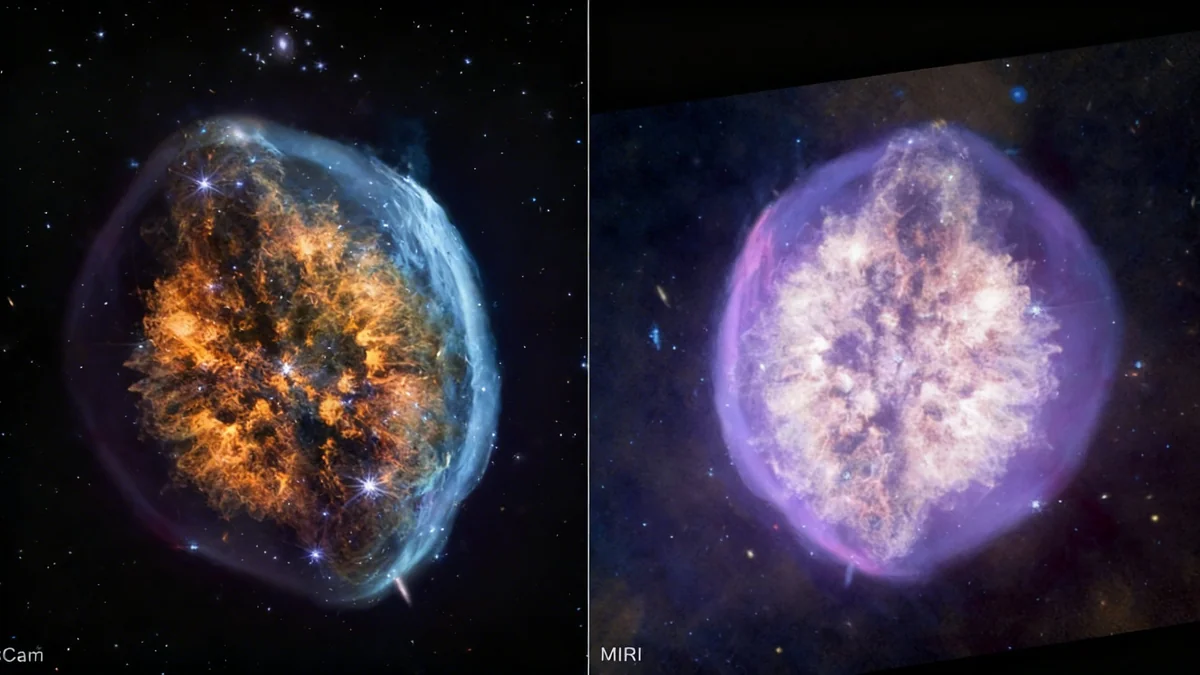

The James Webb Space Telescope has captured breathtaking new images of a distant nebula, providing an unprecedented view of a star in the final stages of its life. Nicknamed the “Exposed Cranium” for its striking resemblance to a brain encased in a skull, the nebula, officially known as PMR 1, is a cloud of gas and dust shed by a dying star.
These new observations, made using Webb's advanced infrared instruments, reveal intricate structures and features that were previously hidden, offering scientists a detailed snapshot of the dynamic processes that occur as a star exhausts its fuel.
Key Takeaways
- The James Webb Space Telescope has produced new high-resolution images of the nebula PMR 1, nicknamed the “Exposed Cranium.”
- The images reveal complex structures within the gas and dust cloud created by a dying star.
- Observations in near-infrared and mid-infrared light show different components of the nebula, such as stars and glowing dust.
- The data provides valuable insights into the late stages of stellar evolution and how stars enrich the cosmos with new elements.
A Cosmic Portrait of a Star's End
The nebula PMR 1 is located thousands of light-years from Earth and represents a fleeting moment, in cosmic terms, in the life cycle of a star. As stars like our sun age, they begin to shed their outer layers of gas into space, creating beautiful and complex structures known as planetary nebulae.
The images from Webb showcase this process in remarkable detail. They reveal two main components of the nebula: a faint, expansive outer shell composed mostly of hydrogen gas, which was likely ejected by the star first, and a more vibrant, structured inner region containing a mix of different gases and dust.
This level of detail surpasses previous observations, including those from the now-retired Spitzer Space Telescope, which first identified the nebula over a decade ago. Webb’s superior resolution and sensitivity bring the “Cranium” into sharp focus, enhancing its brain-like appearance.
The Brain-Like Structure Explained
One of the most captivating features of the nebula is a dark, vertical lane that runs through its center, effectively dividing the inner cloud into two distinct hemispheres. This feature is largely responsible for the nebula's unusual nickname.
Scientists believe this dark lane is not merely an empty space but could be a channel carved out by powerful outflows from the central star. In their final phases, many stars eject high-speed jets of material in opposite directions. These jets would push aside the surrounding gas and dust, creating the dark divide seen in the images.
Evidence for this outflow is particularly strong at the top of the nebula, where the inner gas appears to be actively pushed outward, creating a distinct boundary. This dynamic interaction helps shape the overall structure and appearance of the nebula.
Two Views from a Single Telescope
The James Webb Space Telescope used two different instruments to observe the Exposed Cranium nebula, each revealing a different aspect of its composition:
- NIRCam (Near-Infrared Camera): This view penetrates much of the gas and dust, revealing countless stars within and behind the nebula, along with distant background galaxies.
- MIRI (Mid-Infrared Instrument): This instrument is sensitive to the heat emitted by cosmic dust. In the MIRI image, the dust within the nebula itself glows brightly, highlighting the intricate filaments and structures of the inner cloud.
Unlocking the Secrets of Stellar Evolution
Observing objects like PMR 1 is crucial for understanding the life cycle of stars and their impact on the universe. The material expelled by dying stars is rich in heavier elements, such as carbon and oxygen, which are forged inside the star during its lifetime.
This material, known as stellar wind, eventually disperses and mixes with the interstellar medium. Over millions of years, these enriched clouds of gas and dust can collapse to form new stars and planetary systems. In a very real sense, the building blocks for planets like Earth, and for life itself, were created inside ancient stars.
The Fate of a Dying Star
What happens next for the central star of the Exposed Cranium nebula depends entirely on its mass, a detail researchers are still working to determine. There are two primary paths for a star at this stage:
- If it is a Sun-like star (less massive): It will continue to shed its outer layers until only its hot, dense core remains. This remnant is called a white dwarf, which will gradually cool and fade over billions of years.
- If it is a massive star: Its life will end in a far more dramatic fashion. The core will collapse under its own gravity, triggering a spectacular explosion known as a supernova. A supernova can briefly outshine an entire galaxy and leaves behind either a neutron star or a black hole.
By studying the composition and structure of the nebula, astronomers can gather clues about the central star's properties and its ultimate destiny. Each new image from Webb provides another piece of the puzzle, helping to refine our models of how stars live and die.
Webb's Continued Mission
The James Webb Space Telescope is an international collaboration between NASA, the European Space Agency (ESA), and the Canadian Space Agency (CSA). Since beginning its science operations, it has consistently delivered groundbreaking images and data that are transforming our understanding of the cosmos.
Its ability to peer through cosmic dust in infrared light makes it uniquely suited to study phenomena like star death, star birth, and the formation of the earliest galaxies.
The detailed examination of the “Exposed Cranium” nebula is just one example of Webb's power to probe the mysterious structures of our universe. As the telescope continues its mission, it will undoubtedly uncover more secrets hidden within the beautiful and complex objects that populate our night sky.