
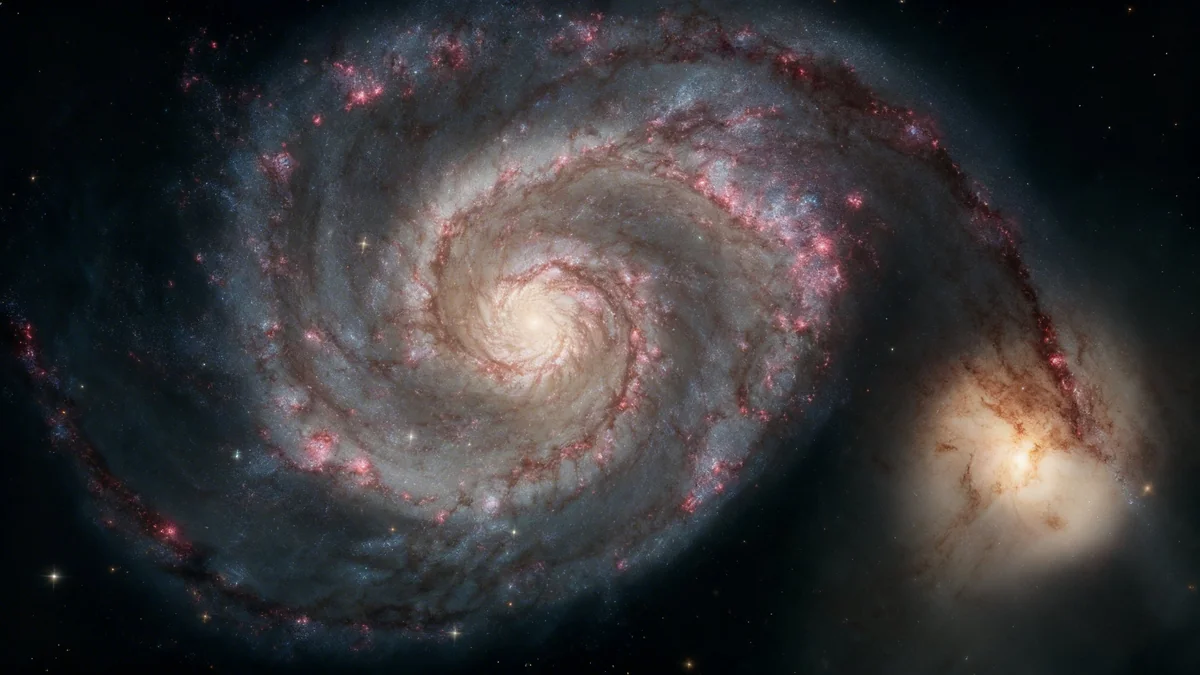




As the Northern Hemisphere welcomes spring, the night sky is opening a unique window into the deep universe. For the next few months, amateur astronomers and stargazers will have an unparalleled opportunity to observe distant galaxies, as the Earth's orientation provides a clearer view beyond our own Milky Way.
This period, often called "galaxy season," is the result of our planet's annual journey around the sun. During spring, our nighttime view points away from the dense, dusty plane of the Milky Way, revealing the vast expanse of intergalactic space and the countless galaxies within it.
Key Takeaways
- Spring in the Northern Hemisphere is known as "galaxy season" because the Earth's position offers a clear view away from the Milky Way's dense plane.
- Constellations like Leo and Virgo, which host major galaxy clusters, are optimally positioned for viewing during this time.
- Observing these faint, distant objects requires dark skies, minimal moonlight, and a telescope with at least a 6-inch aperture or large binoculars.
- Key targets include the Leo Triplet, Bode's and Cigar galaxies, the Sombrero Galaxy, the Whirlpool Galaxy, and Markarian's Chain.
Why Spring is Prime Time for Galaxy Spotting
The changing seasons on Earth directly influence what we can see in the night sky. As our planet orbits the sun, our perspective of the cosmos shifts. In the spring months, the Northern Hemisphere is angled away from the star-filled, hazy band of our own galaxy.
This celestial alignment provides a less obstructed view into deep space, allowing observers to peer at objects millions of light-years away. According to Finn Burridge, a Science Communicator at the Royal Observatory Greenwich, this is when key constellations rich with galaxies become prominent.
"Constellations like Leo and Virgo are where our nearest galaxy clusters lie and in springtime, these constellations are best visible at midnight, the darkest point of the day," Burridge explained.
These constellations are home to the Virgo and Coma Clusters, massive collections containing thousands of individual galaxies. While most are too faint for the naked eye, they become accessible with the right equipment and conditions.
Preparing for a Deep Space Observation
Viewing galaxies is a rewarding but challenging experience. Their immense distance means their light is incredibly faint by the time it reaches Earth. Success depends on preparation and patience.
Understanding Magnitude
Astronomers use a scale called apparent magnitude to measure the brightness of celestial objects as seen from Earth. The lower the number, the brighter the object. The faintest stars visible to the unaided eye in perfect conditions are around magnitude +6.5. Most galaxies require telescopes to be seen as they are much dimmer.
Burridge advises that optimal conditions are crucial. "Galaxies are hard to spot," he said. "They are very faint and distant and need perfectly dark conditions to see them best, so avoid a full or large Moon."
For equipment, a telescope with an aperture of at least 6 inches is recommended to start gathering enough light to see these distant smudges. Large astronomy binoculars can also reveal some of the brighter targets. Many modern telescopes feature GoTo mounts, which can automatically locate thousands of celestial objects, simplifying the search process.
The Averted Vision Technique
A useful method for observing faint objects is called averted vision. Instead of looking directly at the target, you look slightly to the side. This places the image onto the periphery of your retina, where rod cells are more concentrated. These cells are more sensitive to low light levels, making faint objects appear more clearly. Using this technique, a dim, fuzzy patch can resolve into the core and halo of a distant galaxy.
Five Must-See Galactic Targets This Spring
With a clear night and a good telescope, a number of spectacular galaxies and galaxy groups come into view. Here are five top targets to search for in the coming months.
1. The Leo Triplet (M65, M66, and NGC 3628)
Located approximately 30 million light-years away in the constellation Leo, this group consists of three spiral galaxies: M65, M66, and NGC 3628. Their proximity to each other means they can often be seen together in the same field of view with a low-power eyepiece, making it a stunning sight.
- How to Find It: Locate the constellation Leo in the southeastern sky. The triplet is found midway between the stars Chertan and Iota Leonis, which form one of the lion's hind legs.
- What to Expect: M66 is the brightest and easiest to spot. NGC 3628, also known as the "Hamburger Galaxy," is seen edge-on and its dark dust lane can be a challenge, requiring darker skies.
2. Bode's Galaxy (M81) and the Cigar Galaxy (M82)
This pair in the constellation Ursa Major offers a fantastic contrast. Bode's Galaxy (M81) is a large, bright spiral galaxy about 11.6 million light-years away, with a brilliant core. Its neighbor, the Cigar Galaxy (M82), is a starburst galaxy, where intense star formation is occurring due to gravitational interactions with M81.
Bode's Galaxy shines with an apparent magnitude of 6.9, making it one of the brightest galaxies visible from the Northern Hemisphere.
- How to Find It: Start with the Big Dipper. Draw an imaginary line from the star Phecda through Dubhe (the two stars at the end of the Dipper's bowl) and extend it an equal distance. This will lead you directly to the pair.
- What to Expect: M81 will appear as a hazy oval with a bright center. The elongated, cigar-like shape of M82 is distinctive, even in smaller telescopes.
3. The Sombrero Galaxy (M104)
Named for its resemblance to a broad-rimmed hat, the Sombrero Galaxy is a striking object located 28 million light-years away. We view it almost perfectly edge-on, which reveals a prominent dark dust lane bisecting its bright, bulging core. This dust lane is one of its most famous features.
- How to Find It: The galaxy lies between the constellations Virgo and Corvus. Find Spica, Virgo's brightest star, and the four-star diamond shape of Corvus. M104 is located just above the line connecting Spica and the top of Corvus.
- What to Expect: A 6-inch telescope will show the bright core. An 8-inch or larger telescope under dark skies may reveal the subtle line of the dust lane.
4. The Whirlpool Galaxy (M51a)
Perhaps one of the most famous spiral galaxies, the Whirlpool Galaxy is seen face-on, showcasing its magnificent spiral arms. Located 31 million light-years away, it is actively interacting with a smaller companion galaxy, NGC 5195, which can be seen at the tip of one of its arms. This interaction is fueling bursts of star formation.
- How to Find It: Use the Big Dipper's handle. From Alkaid, the last star in the handle, move your telescope about 4 degrees southwest.
- What to Expect: In a small telescope, it appears as two fuzzy patches of light. Larger instruments begin to reveal the spiral structure and the bridge of stars connecting it to its companion.
5. Markarian's Chain
This is not a single galaxy but a beautiful, curved string of them located in the heart of the Virgo Cluster. Named after the astrophysicist who discovered their common motion, the chain includes the bright galaxies M84 and M86. The centerpiece for many observers is a pair of interacting galaxies known as "The Eyes."
- How to Find It: The chain is located in the patch of sky directly between the star Denebola in Leo and Vindemiatrix in Virgo.
- What to Expect: A wide-field telescope eyepiece is best for framing this target. You can spend hours sweeping through this region and discovering one faint galaxy after another, giving a true sense of the scale of the universe.
Observing these ancient islands of stars is a profound experience, connecting us to a universe far beyond our own world. With clear skies and a little preparation, the spring galaxy season offers a chance to witness the grand scale of the cosmos from your own backyard.