


Deep beneath a mountain in Japan, a massive, upgraded telescope is preparing to listen for the whispers of the universe's most violent events. Scientists are on the verge of detecting faint “ghost particles” from stars that exploded billions of years ago, potentially unlocking a new window into the cosmic past.
The Super-Kamiokande detector, an immense instrument designed to observe elusive particles called neutrinos, could soon capture the collective echo of every massive star that has ever died. This breakthrough would allow astronomers to study cosmic history using particles that have traveled unimpeded through space and time, some originating even before the formation of Earth.
Key Takeaways
- Japan's Super-Kamiokande telescope has been upgraded to detect faint neutrinos from ancient supernovas.
- These "ghost particles" travel for billions of years, carrying information about the death of massive stars.
- A successful detection would create a new field of astronomy, allowing scientists to study the universe's entire history of stellar explosions.
- The data could help solve mysteries about what happens after a supernova, such as the formation of black holes or neutron stars.
The Search for Ghostly Messengers
Scientists are closing in on a monumental discovery: the first clear detection of neutrinos from distant, long-dead stars. These particles are often called "ghost particles" because they have almost no mass and no electric charge, allowing them to pass through planets, stars, and entire galaxies without being stopped or altered.
Every second, billions of these neutrinos from the sun and other cosmic sources pass through your body completely unnoticed. While this makes them incredibly difficult to detect, it also makes them perfect messengers. They carry pure information about their origin, unaffected by the long journey across the cosmos.
What is a Supernova?
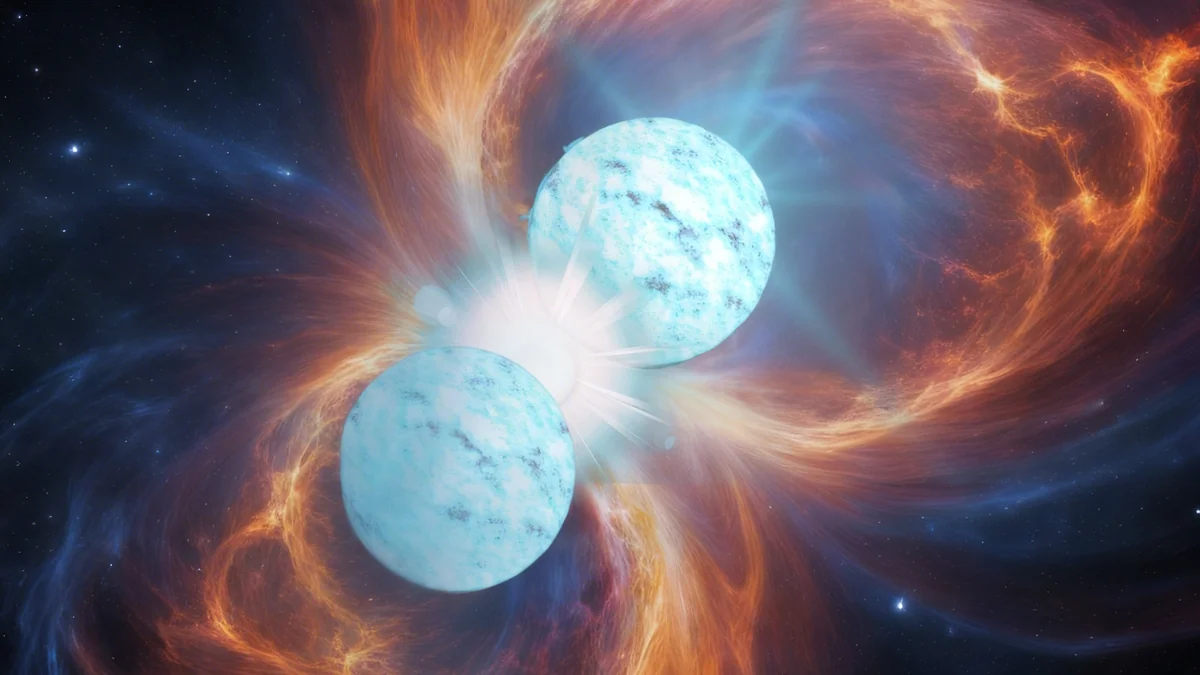
A supernova is the explosive death of a star. This fate is reserved for the most massive stars in the universe—those with at least eight times the mass of our sun. When these giants run out of fuel, their core collapses under immense gravity, triggering a cataclysmic explosion that can briefly outshine an entire galaxy.
The instrument at the forefront of this search is the Super-Kamiokande observatory in Japan. Buried deep underground to shield it from other cosmic radiation, this massive detector is essentially a giant tank of ultra-pure water lined with thousands of light sensors, waiting patiently for the rare interaction of a neutrino with a water molecule.
A New Window into Cosmic History
While supernovas are rare in our own galaxy, occurring perhaps once every few decades, they happen somewhere in the vast universe approximately every single second. Each of these explosions releases an unimaginable amount of energy, with 99% of it carried away by neutrinos.
Until now, astronomers have only detected neutrinos from two supernovas: one in our neighboring galaxy in 1987, and the sun. The new goal is to detect what is known as the "diffuse supernova neutrino background" (DSNB). This is the faint, persistent glow created by the combined neutrinos from all the supernovas that have ever occurred throughout the history of the universe.
Successfully detecting this background signal would be like hearing the collective hum of every stellar explosion that has ever happened. It would provide a direct record of star formation and death stretching back more than 10 billion years.
Cosmic Time Capsules
Because neutrinos travel for billions of years without interacting with anything, the ones arriving at Earth today are pristine relics from the ancient universe. Detecting them is like opening a time capsule that reveals what the cosmos was like long before our solar system existed.
Solving the Mysteries of Stellar Death
Observing these ancient neutrinos could help answer some of the biggest questions in astrophysics. When a massive star explodes, its core collapses into an extremely dense object. But what does it become?
The two primary possibilities are:
- A neutron star: An incredibly dense object only about 12 miles (20 kilometers) across, where matter is crushed to a state not found anywhere else in the universe.
- A black hole: An object with gravity so strong that nothing, not even light, can escape.
By studying the energy and number of neutrinos from countless past supernovas, scientists can better understand the conditions that lead to the formation of one or the other. This data would provide a universal survey of stellar collapse, offering insights that are impossible to gain just by looking at the 1% of energy released as visible light.
With the Super-Kamiokande's enhanced capabilities, which are scheduled to begin full operations in 2027, the scientific community is optimistic. A detection would not just confirm theoretical models; it would mark the dawn of a new era in astronomy, one where we can study the universe not just by the light we see, but by the ghostly particles that travel through it.