


Scientists have developed a new theoretical framework that could allow them to peer into the hearts of neutron stars, the incredibly dense remnants of massive stars. By analyzing the gravitational waves from colliding neutron stars, researchers believe they can identify the exotic states of matter hidden within, potentially including a substance last seen moments after the Big Bang.
This breakthrough, published in the journal Physical Review Letters, provides a roadmap for using future gravitational-wave observatories to solve one of the biggest mysteries in astrophysics and fundamental physics.
Key Takeaways
- Researchers have created a new mathematical method to analyze the interiors of neutron stars.
- The technique relies on detecting subtle signatures within gravitational waves produced by two merging neutron stars.
- This could confirm the existence of a quark-gluon plasma, a state of matter from the early universe, inside the stars' cores.
- The work is currently theoretical, but it provides a crucial tool for the next generation of gravitational-wave detectors.
Unlocking the Universe's Most Extreme Matter
Neutron stars are among the most extreme objects in the universe. They pack the mass of several suns into a sphere just the size of a city. The pressure inside is so immense that it crushes atoms, forcing protons and electrons to merge into a sea of neutrons.
However, what happens deep in the core remains a mystery. Physicists theorize that the pressure could be strong enough to break down neutrons themselves into their fundamental components: quarks and gluons. This would create a state of matter known as a quark-gluon plasma.
What is Quark-Gluon Plasma?
Quark-gluon plasma is a super-hot, super-dense state of matter that is believed to have existed for only a few microseconds after the Big Bang. In this state, quarks and gluons—the building blocks of protons and neutrons—are not confined within larger particles but move freely. Recreating and studying it can provide direct insights into the conditions of the early universe.
Until now, scientists have had no direct way to confirm if this plasma exists inside neutron stars. This new research offers a potential solution by using gravitational waves as a probe.
Gravitational Waves as a Messenger
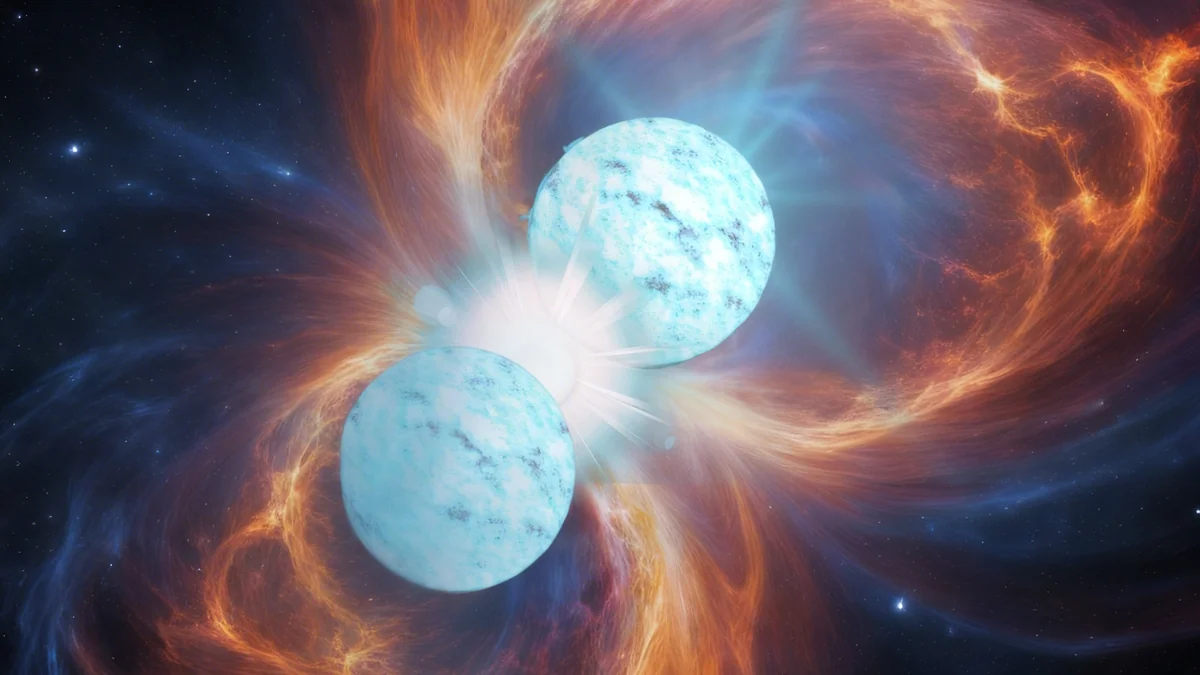
The method focuses on binary neutron star systems, where two of these dense objects orbit each other. As they spiral closer, they radiate energy in the form of gravitational waves—ripples in spacetime first predicted by Albert Einstein.
As the stars get very close, their immense gravity causes tidal forces that deform each other. According to Abhishek Hegade of Princeton University, a lead researcher on the study, "The amount of deformation depends on what's inside of those stars."
This deformation triggers internal oscillations, similar to the ringing of a bell. Each pattern of oscillation, or "mode," is influenced by the star's internal composition. These modes leave a distinct imprint on the frequency of the emitted gravitational waves.
As they merge, binary neutron stars can reach speeds up to 40% the speed of light. Analyzing the gravitational waves from these events requires the complex mathematics of Einstein's general theory of relativity.
Solving a Relativistic Puzzle
The main challenge was that Einstein's theory of general relativity made these calculations extraordinarily difficult. Under simpler Newtonian physics, it's possible to describe a complete set of an object's oscillation modes. But in relativity, the system constantly loses energy through gravitational waves, which complicated the math.
"If your system is losing energy, then its modes cannot be complete," explained Hegade.
The team, led by Nicolás Yunes of the University of Illinois, devised a solution. They broke the problem down by analyzing each star individually and treating its companion as an external source of gravity. By combining solutions for different scales, they successfully derived a complete set of oscillation modes that works within general relativity.
"We showed two major things," said Hegade. "First, we were able to subtract off radiation, finding that a neutron star's modes do indeed form a complete set. Second, we found that... you can do all the same things in general relativity as in Newtonian gravity."
A Window into the Big Bang
If this method proves successful, it could provide definitive answers about the inner workings of neutron stars. This would have profound implications for our understanding of physics at its most extreme.
"One hope is that we'll be able to get some information about the neutron-star equation of state at densities found in the inner core," stated Yunes. "Is there really a quark core, as some have recently claimed? Are there phase transitions occurring inside that we don't know about yet?"
By confirming the presence of quark-gluon plasma, scientists would not only be observing a new state of matter but also gaining a direct look at the conditions that governed the universe in its very first moments.
Neutron Star Density
- Mass: Up to several times that of our sun.
- Diameter: Approximately 20 kilometers (12 miles).
- Density: A single teaspoon of neutron star material would weigh billions of tons on Earth.
The Future of Gravitational Wave Astronomy
The research is currently theoretical. Today's gravitational-wave detectors, such as LIGO, are not yet sensitive enough at the high frequencies needed to detect these subtle imprints from the stellar oscillations.
However, the researchers are optimistic. The findings provide a clear target for the next generation of observatories. Future upgrades and new detectors are being designed with higher frequency sensitivity in mind, which could make this type of analysis possible within the next decade.
This work lays the essential groundwork for turning gravitational wave observatories into powerful tools for exploring the fundamental nature of matter, transforming what was once theoretical into something observable.