


A new study suggests that life could exist in the cold, dark expanse of interstellar space, far from the warmth of any star. Researchers have found that moons orbiting lone, starless planets could maintain liquid water—a key ingredient for life—for billions of years through internal heat generated by gravity.
This discovery dramatically expands the range of potential habitats in the universe, suggesting that even the darkest corners of the galaxy could harbor life. The findings hinge on a process called tidal heating and the insulating properties of a dense hydrogen atmosphere.
Key Takeaways
- Moons orbiting starless 'rogue' planets could host liquid water for over 4 billion years.
- Internal heat is generated by 'tidal heating,' where the planet's gravity squeezes and flexes the moon.
- A dense hydrogen atmosphere is essential to trap this internal heat and prevent water from freezing.
- This research significantly broadens the search for habitable environments beyond traditional star systems.
A New Frontier for Habitability
For decades, the search for extraterrestrial life has focused on planets within the 'habitable zone' of a star, where temperatures are just right for liquid water to exist on the surface. However, recent computer simulations from researchers at the Ludwig Maximilian University of Munich are challenging this long-held assumption.
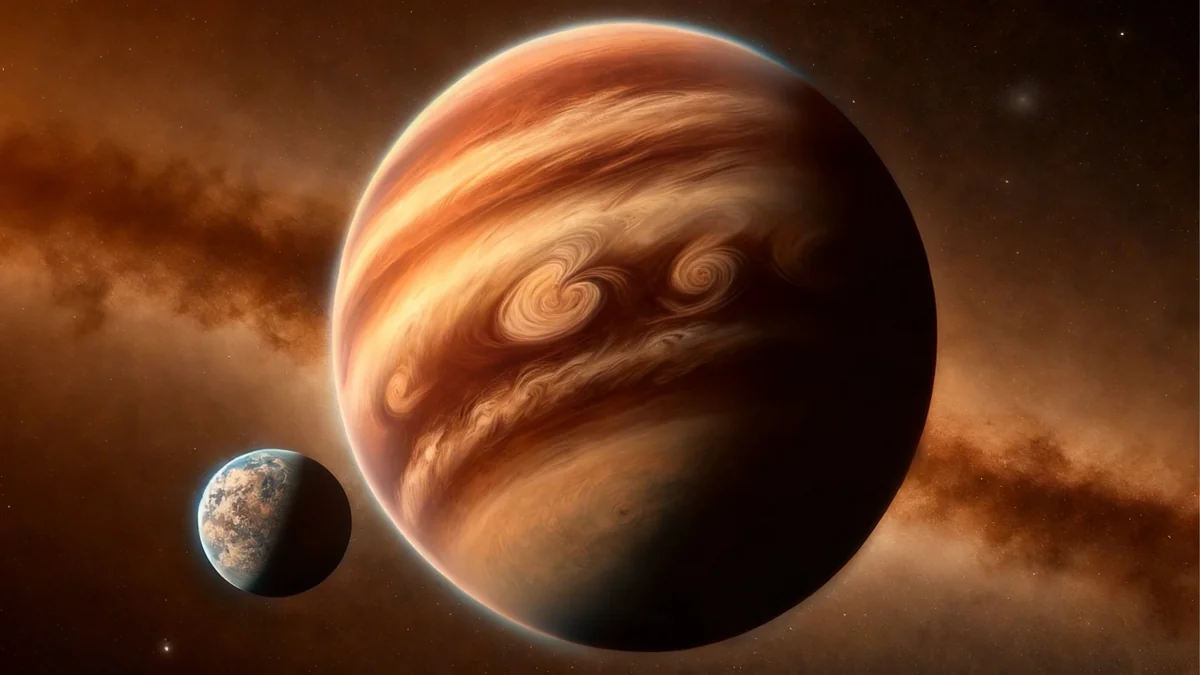
The study explores a scenario previously considered science fiction: an Earth-sized moon orbiting a Jupiter-sized planet that drifts alone through interstellar space. These 'rogue' planets are thought to be common, ejected from their original solar systems during their chaotic formation.
According to the models, these nomadic planets have a high probability of keeping their moons, even after the violent ejection process. This event often reshapes the moon's orbit into a more elongated, or elliptical, path.
What Are Rogue Planets?
Rogue planets, also known as free-floating planets, are celestial bodies that do not orbit a star. They are believed to form within a planetary system and are later ejected due to gravitational interactions with other, larger bodies. Astronomers estimate there could be billions, or even trillions, of these starless worlds roaming our galaxy.
The Power of Tidal Heating
The key to keeping these sunless moons warm lies in their elliptical orbits. As the moon travels along its path, it moves closer to and then farther from its massive host planet. The planet's immense gravity constantly squeezes and stretches the moon's interior, creating immense friction.
This process, known as tidal heating, generates a tremendous amount of internal warmth. It's the same mechanism responsible for the intense volcanic activity on Jupiter's moon Io and for maintaining the subsurface liquid oceans on moons like Europa and Enceladus in our own solar system.
"The cradle of life does not necessarily require a sun," stated David Dahlbüdding, the study's lead author, highlighting the paradigm shift this research represents.
The new simulations suggest that this internal furnace could be powerful enough to maintain surface temperatures above the freezing point of water, even in the extreme cold of deep space where background temperatures are near absolute zero.
A Long-Lived Habitat
The study's models show that an Earth-sized exomoon could remain warm enough for liquid water for up to 4.3 billion years. This is nearly as long as Earth itself has existed, providing a vast timescale for life to potentially emerge and evolve.
The Crucial Role of the Atmosphere
Generating internal heat is only half the battle. To maintain liquid water on its surface, a moon must also be able to hold onto that warmth. This is where the atmosphere becomes critical.
Previous studies considered carbon dioxide (CO2) as a potential greenhouse gas for these worlds. However, the new research points out a fatal flaw: in the frigid conditions of interstellar space, CO2 would eventually freeze and condense, causing the atmosphere to collapse and allowing all the heat to escape.
Hydrogen as an Insulating Blanket
The team's simulations propose a different solution: a thick, high-pressure atmosphere composed primarily of hydrogen. Under these dense conditions, hydrogen molecules behave differently. When they collide, they can temporarily absorb thermal energy that would otherwise radiate away into space.
This effect allows a dense hydrogen atmosphere to function as a highly effective insulating blanket, trapping the heat generated from tidal forces. This insulation is what could keep the moon's surface warm enough for liquid water over geological timescales.
- Heat Generation: Gravitational squeezing from the host planet creates internal friction.
- Heat Retention: A dense hydrogen atmosphere traps the internal heat, preventing it from escaping.
- Result: Surface temperatures remain stable enough for liquid water to persist for billions of years.
Expanding the Search for Life
While astronomers have yet to definitively confirm the existence of an exomoon around any planet, mounting evidence suggests a discovery is imminent. This new research provides a compelling reason to develop methods to search for these rogue systems.
The findings could "significantly broaden the spectrum of possible environments that could harbor life," the research team noted. It implies that life is not restricted to planets basking in the light of a parent star.
Instead, countless dark worlds, drifting silently between the stars, could be home to stable, long-lived aquatic environments. This revolutionary idea suggests that life could arise and endure even in the most unexpected and seemingly inhospitable regions of our galaxy.