


An international team of scientists has announced a major update to the catalog of gravitational waves, adding 128 new detections from a nine-month observation period. This surge in data, collected between May 2023 and January 2024, surpasses the total of 90 events recorded in all previous years combined, offering an unprecedented view into the universe's most violent events.
The new findings include the most massive black hole merger ever observed and provide crucial new data for testing Albert Einstein's theory of general relativity and measuring the expansion of the universe.
Key Takeaways
- Scientists detected 128 new gravitational wave signals in just nine months, more than all previous detections combined.
- The new catalog includes the heaviest black hole binary merger ever found, with each object about 130 times the mass of our sun.
- Researchers also identified a pair of black holes spinning at an exceptionally high speed.
- The data is being used to rigorously test Einstein's theory of general relativity and refine measurements of the universe's expansion rate.
A New Era of Gravitational Wave Astronomy
A global collaboration of researchers using the LIGO, Virgo, and KAGRA observatories has released the Gravitational-Wave Transient Catalog-4.0 (GWTC-4.0). This latest dataset marks a significant acceleration in the field of gravitational wave astronomy.
The 128 new signals, primarily from the mergers of black holes, were captured in a relatively short period. This rapid increase is attributed to enhanced sensitivity in the detectors and improved data analysis techniques.
"In the past decade, gravitational wave astronomy has progressed from the first detection to the observation of hundreds of black hole mergers," said Stephen Fairhurst of Cardiff University, a co-author of the study. "These observations enable us to better understand how black holes form from the collapse of massive stars."
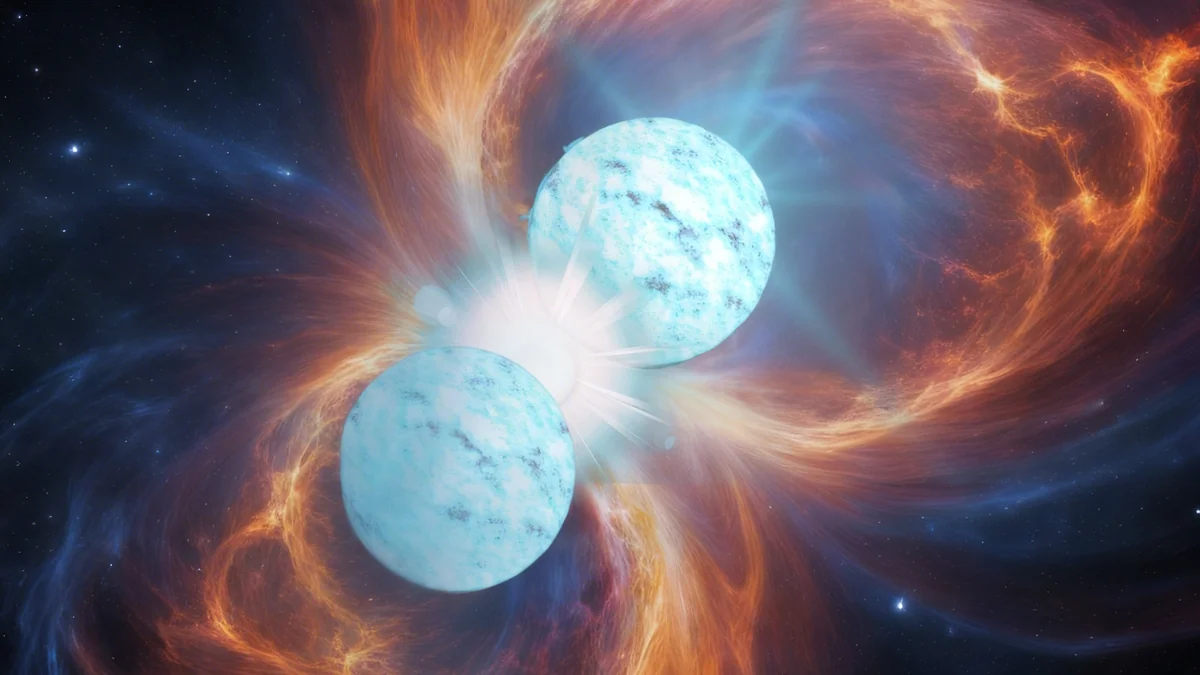
These detections are essentially ripples in the fabric of spacetime, created by cataclysmic events like the collision of black holes or neutron stars. Predicted by Albert Einstein over a century ago, their direct detection in 2015 opened a new window to observe the cosmos.
Uncovering the Universe's Most Extreme Objects
The latest catalog is not just about quantity; it also reveals a new diversity of cosmic phenomena that challenge existing models of astrophysics. The new data is pushing the boundaries of what scientists thought was possible.
Record-Breaking Merger
Among the new detections is the most massive binary black hole merger ever recorded. Each of the colliding black holes was approximately 130 times the mass of our sun. Scientists suspect these giants may have formed from the mergers of smaller black holes in a previous generation.
Researchers also identified other unusual systems. One involved a pair of black holes spinning at an astonishing rate, while another featured an odd couple where one black hole was twice as massive as its partner. These discoveries provide crucial clues about the life cycle of stars and the formation of black holes in the early universe.
"The message from this catalog is: We are expanding into new parts of what we call ‘parameter space’ and a whole new variety of black holes," commented Daniel Williams of the University of Glasgow. "We are really pushing the edges and are seeing things that are more massive, spinning faster and are more astrophysically interesting and unusual."
A Diverse Cosmic Population
The range of properties observed in the new catalog is striking. The discoveries are helping scientists build a more complete census of black holes in the universe.
"Some of them are over 100 times the mass of our sun, others are as small as only a few times the mass of the sun. Some black holes are rapidly spinning, others have no measurable spin," said Jack Heinzel of the Massachusetts Institute of Technology. "We still don’t completely understand how black holes form in the universe, but our observations offer a crucial insight into these questions."
Putting Einstein's Theories to the Ultimate Test
Beyond cataloging cosmic collisions, the new data serves a fundamental purpose: testing the limits of physics. The extreme gravitational environments created by merging black holes are natural laboratories for probing Einstein's theory of general relativity.
What Are Gravitational Waves?
Imagine spacetime as a fabric. Massive objects like black holes create depressions in it. When two such objects orbit each other and merge, they create ripples in this fabric that travel outward at the speed of light. These are gravitational waves. By the time they reach Earth, these ripples are incredibly faint, requiring highly sensitive instruments to detect.
So far, Einstein's century-old theory has passed every test thrown at it. The signals from these mergers match the predictions of general relativity with remarkable accuracy.
"Black holes are one of the most iconic and mind-bending predictions of general relativity," stated Aaron Zimmerman of the University of Texas at Austin. "When testing our physical theories, it’s good to look at the most extreme situations we can, since this is where our theories are most likely to break down, and where we have the best chance of discovery."
Measuring the Expanding Universe
The data also provides a new, independent method for measuring the Hubble Constant—the rate at which the universe is expanding. By analyzing the signals, scientists can determine how far away a merger occurred.
"Merging black holes have a really unique property: We can tell how far away they are from Earth just from analyzing their signals," explained Rachel Gray at the University of Glasgow. By combining measurements from many events, astronomers can calculate the expansion rate with increasing precision. The current estimate from this method is 76 kilometers per second per megaparsec.
The Technology Behind the Discoveries
Detecting these faint cosmic whispers requires some of the most sensitive scientific instruments ever built. The Laser Interferometer Gravitational-wave Observatory (LIGO) in the United States, Virgo in Italy, and KAGRA in Japan work in unison.
These observatories are interferometers with two long, perpendicular arms. A laser beam is split and sent down each arm, reflecting off mirrors at the end. When the beams recombine, they create an interference pattern.
When a gravitational wave passes through, it stretches one arm while compressing the other by a minuscule amount—about 1/1000th the width of a proton. This tiny change alters the interference pattern, signaling the passage of a wave and allowing scientists to decode the cosmic event that created it.
With each new observation run, these detectors become more sensitive, promising an even greater flood of data and more profound discoveries about the nature of our universe.