
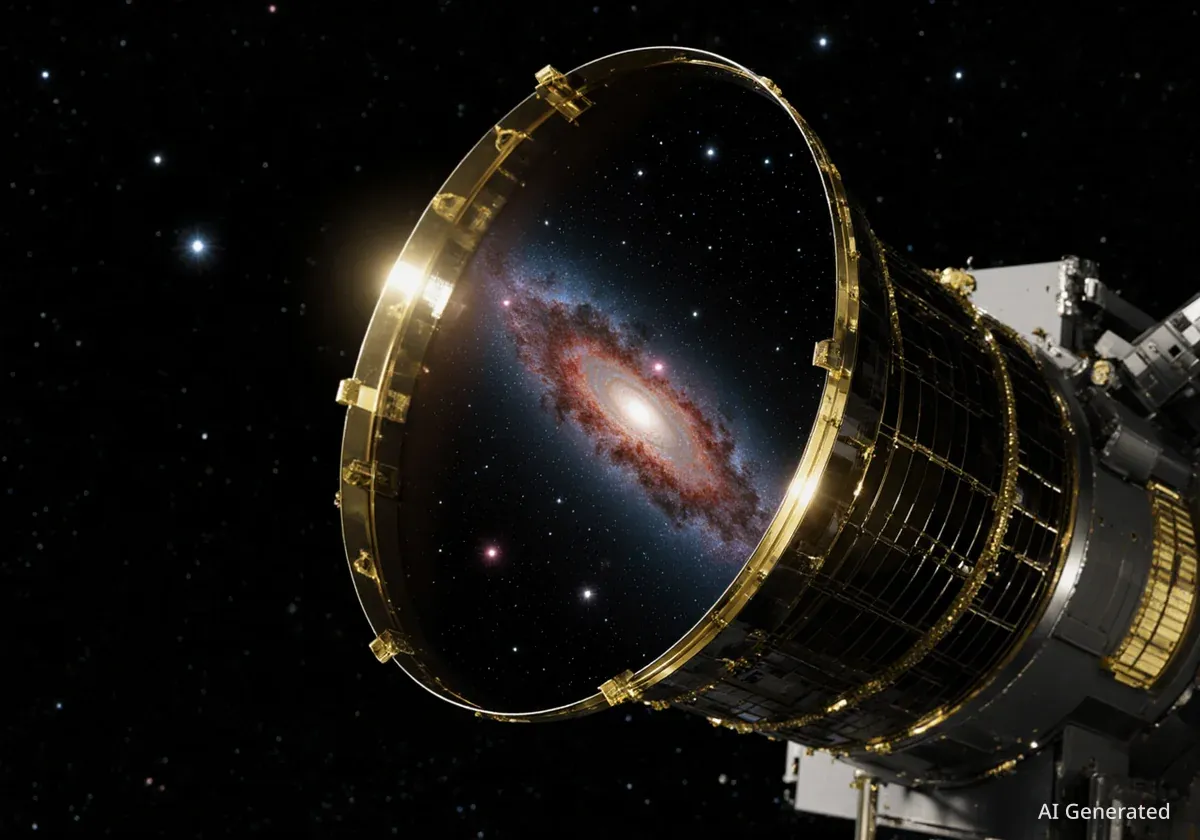

The James Webb Space Telescope (JWST) is peering back to the dawn of time, on a mission to find the very first generation of stars. These ancient giants, nicknamed 'dinosaur stars,' hold the keys to understanding some of the universe's biggest mysteries, including the rapid formation of supermassive black holes and the nature of dark matter.
Since beginning operations in 2022, the powerful observatory has already challenged existing cosmic timelines. Now, by combining its own advanced optics with a natural phenomenon predicted by Einstein, astronomers are closing in on a direct observation of these elusive celestial bodies for the first time.
Key Takeaways
- Astronomers are using the James Webb Space Telescope to search for Population III stars, the first generation of stars in the universe.
- These massive stars, made only of hydrogen and helium, lived short, violent lives and created the first heavy elements.
- JWST utilizes a technique called gravitational lensing, where massive galaxy clusters act as natural cosmic telescopes, to magnify light from these distant stars.
- Observing these stars could help explain how supermassive black holes formed so early in the universe and provide new insights into the properties of dark matter.
The Quest for Cosmic Dawn
When the universe was in its infancy, it was a much simpler place. The cosmos was filled almost exclusively with hydrogen and helium, the lightest elements forged in the Big Bang. From this primordial gas, the very first stars ignited, known to scientists as Population III stars.
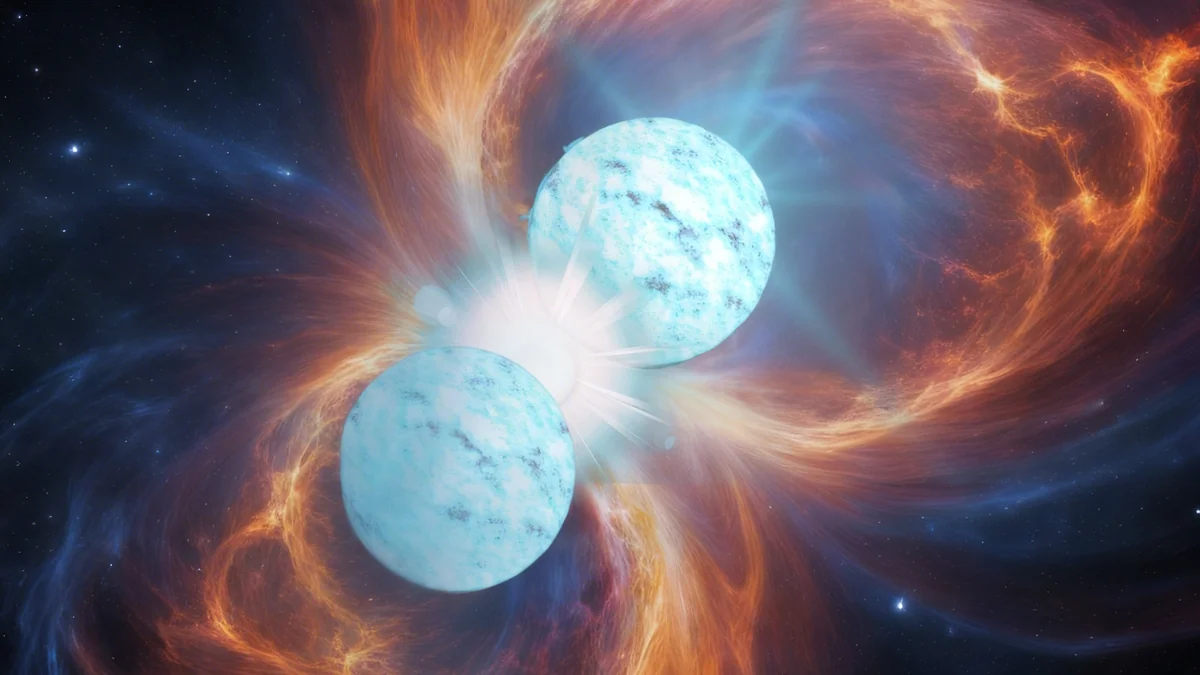
These were not like the stars we see today. Theory suggests they were incredibly massive, hundreds of times the mass of our own sun, and burned extremely hot and bright. Because of their immense size, their lives were fleeting—lasting only a few million years before ending in spectacular supernova explosions.
Their short, brilliant lives had a profound impact. Inside their cores, they fused hydrogen and helium into heavier elements like carbon, oxygen, and iron for the first time. When they exploded, they scattered these new elements across the young universe, seeding the next generation of stars and galaxies and providing the raw materials necessary for planets and, eventually, life.
What Are Population III Stars?
Population III stars are a hypothetical first generation of stars that formed when the universe was less than a few hundred million years old. They are characterized by their lack of 'metals'—the term astronomers use for any element heavier than hydrogen and helium. Their immense mass and pristine composition made them burn hotter and live shorter lives than modern stars.
A Cosmic Magnifying Glass
Observing an individual star from over 13 billion years ago is a monumental challenge, even for an instrument as powerful as the JWST. On its own, the telescope is not large enough to resolve such a distant, single point of light. To overcome this, astronomers are relying on a helping hand from the universe itself.
The technique is called gravitational lensing, a phenomenon first predicted by Albert Einstein. His theory of general relativity described how massive objects warp the fabric of spacetime. When light from a distant object travels through this warped space, its path is bent, much like light passing through a glass lens.
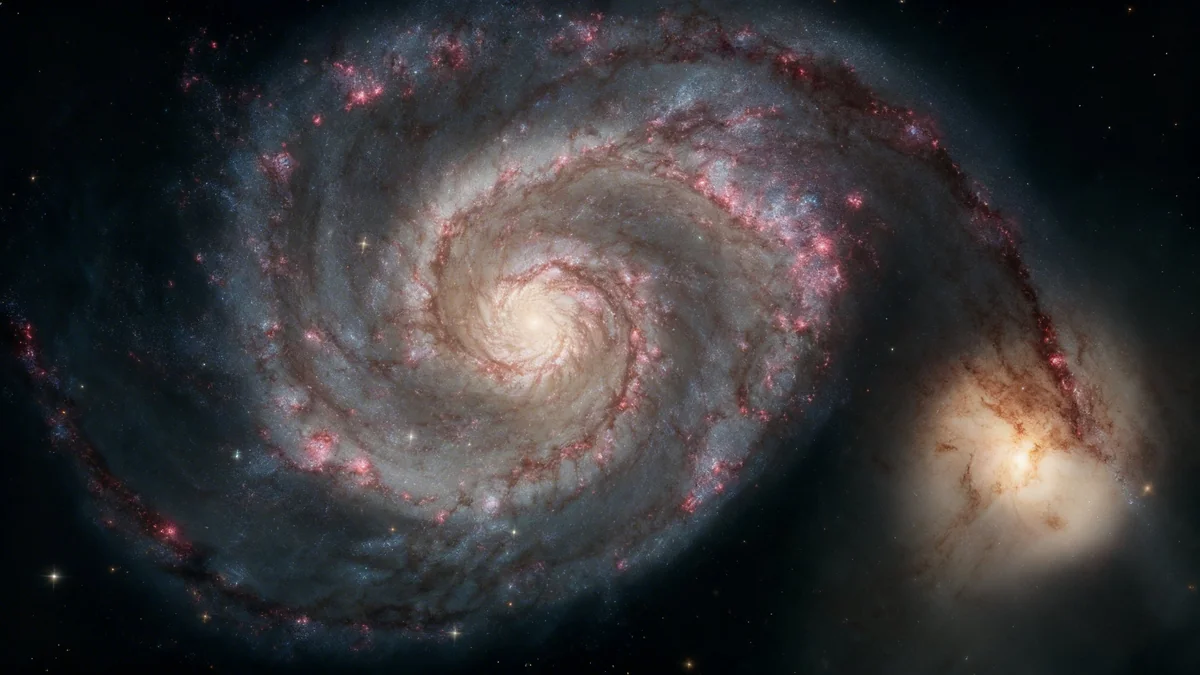
Astronomers use massive galaxy clusters—collections of hundreds or thousands of galaxies bound by gravity—as natural telescopes. The immense mass of a cluster, including its vast quantities of invisible dark matter, creates a powerful gravitational lens that magnifies the light from galaxies and stars located far behind it.
Extreme Magnification
In certain small regions behind a galaxy cluster, known as caustics, the magnification effect can be incredibly strong, amplifying light by factors of up to 10,000. If a Population III star happens to align perfectly with one of these caustics, JWST can get an otherwise impossible close-up view.
This method effectively transforms the Webb telescope into an instrument hundreds of times larger than it actually is, allowing it to peer into the farthest reaches of the cosmos with unprecedented detail.
Breakthrough Discoveries Point the Way
While a confirmed Population III star has yet to be found, the gravitational lensing technique has already yielded remarkable results, bringing astronomers closer than ever before.
In 2022, a team of researchers announced the discovery of Earendel, the most distant individual star ever observed. Its light traveled for 12.9 billion years to reach us, meaning we see it as it was when the universe was just 7 percent of its current age. Earendel was only visible because its light was magnified thousands of times by a massive galaxy cluster.
Before Earendel, the Hubble Space Telescope spotted a star named Icarus, which held the distance record for several years. More recently, observations of a galaxy called the Dragon Arc revealed over 40 individual lensed stars.
These discoveries prove the method works. They are stepping stones, pushing the observational frontier further back in time. Astronomers believe that by observing even more distant galaxies through these cosmic lenses, they will eventually find a star from that first, pristine generation.
Unlocking the Universe's Deepest Secrets
Finding the first stars is more than just a record-breaking exercise. It would provide crucial answers to some of the most fundamental questions in cosmology.
The Black Hole Puzzle
One of the biggest surprises from JWST's early observations was the discovery of supermassive black holes, millions of times the mass of the sun, existing when the universe was just a few hundred million years old. How these behemoths grew so large, so quickly, is a major puzzle.
One leading theory suggests they grew from the seeds of smaller black holes left behind when massive Population III stars died. Finding these stars and understanding their life cycles would provide critical evidence to support or challenge this idea.
Illuminating Dark Matter
The light from these ancient stars also carries information about the invisible universe. As starlight travels for billions of years across the cosmos, it passes through the vast structures of dark matter that hold galaxy clusters together. Small clumps of dark matter within the lensing cluster can subtly alter the star's light, causing it to twinkle or fluctuate in brightness.
"Lensed stars can help us map the distribution of dark matter and reveal some of its properties," explains astrophysicist José María Diego Rodríguez of the Institute of Physics of Cantabria in Spain.
By studying these fluctuations, scientists can measure the properties of dark matter in ways that are impossible with Earth-based experiments. This research has already begun to rule out certain theories about what dark matter could be, based on observations of lensed stars like Godzilla and Mothra.
The Next Generation of Observatories
The hunt for the first stars is set to accelerate. While JWST continues its search, future observatories are already being planned to expand our cosmic vision.
NASA's Nancy Grace Roman Space Telescope, scheduled to launch in late 2026, will survey huge swaths of the sky, identifying thousands of new gravitational lenses. JWST can then perform detailed follow-up observations on the most promising targets.
Further on the horizon, the proposed Habitable Worlds Observatory (HWO) would surpass even Webb's capabilities in certain wavelengths, potentially detecting the very hot, blue light expected from Population III stars. By the time HWO launches, astronomers will have a comprehensive map of the best natural lenses in the sky, ready to pinpoint where the universe's first light is hiding.