
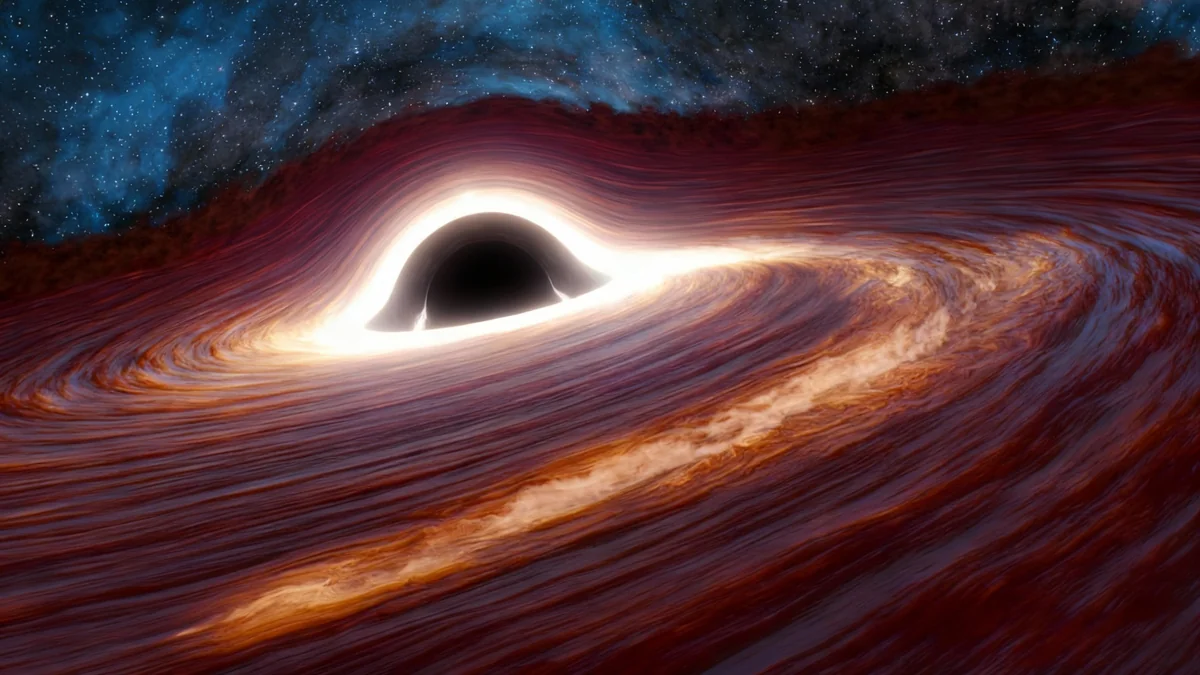

Astronomers have detected the most powerful and distant flare ever observed from a black hole, an event so bright it outshines our sun by a factor of 10 trillion. The colossal eruption of energy comes from a supermassive black hole located 10 billion light-years from Earth as it violently tears apart a massive star.
The event, first noticed in 2018, has been under observation as it continues to unfold. Researchers confirmed its record-breaking nature after years of analysis, providing a rare look into one of the most extreme phenomena in the universe. The flare is 30 times more powerful than the previous record-holder for such an event.
Key Takeaways
- Astronomers have identified the largest and most distant black hole flare ever recorded, located 10 billion light-years away.
- At its peak, the flare released energy equivalent to 10 trillion suns, making it 30 times brighter than any previously observed event of its kind.
- The flare is caused by a supermassive black hole, 500 million times the mass of our sun, shredding a star estimated to be 30 times the sun's mass.
- The event is still ongoing, with the black hole continuing to consume the star's material.
A Discovery of Cosmic Proportions
The flare originates from the center of a distant galaxy, a region known as an Active Galactic Nucleus (AGN) designated J2245+3743. At its heart lies a supermassive black hole with a mass 500 million times that of our sun. While this black hole was already known to be actively feeding on surrounding gas and dust, the sudden, dramatic increase in brightness caught scientists' attention.
First spotted by the Zwicky Transient Facility (ZTF) in 2018, the object brightened by a factor of 40 over just a few months. However, the true scale of the event was not understood until 2023, when data from the W. M. Keck Observatory in Hawaii revealed its extraordinary energy output.
"This is unlike any AGN we've ever seen," said Matthew Graham, a scientist at the California Institute of Technology (Caltech) who led the research team. "The energetics show this object is very far away and very bright."
By the Numbers
- Distance: 10 billion light-years
- Black Hole Mass: 500 million solar masses
- Star's Initial Mass: 30 solar masses
- Peak Brightness: Equivalent to 10 trillion suns
The Violent End of a Massive Star
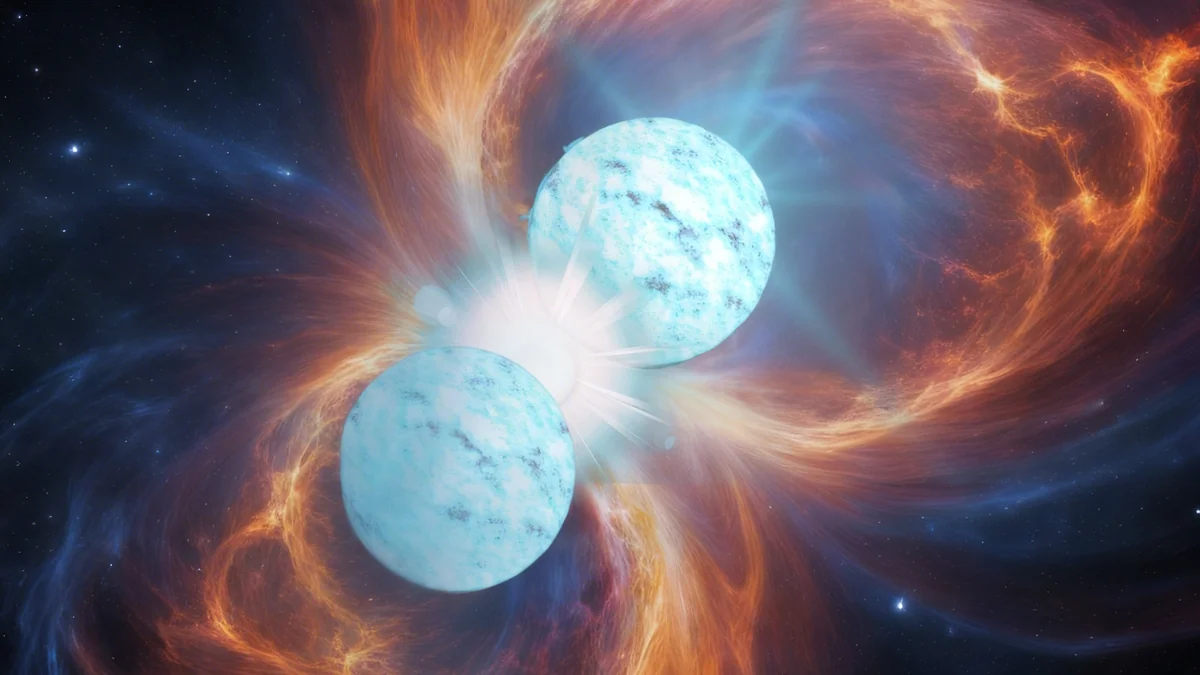
The immense flare is not from the black hole's usual activity but from a specific, violent occurrence known as a tidal disruption event (TDE). This happens when a star ventures too close to a supermassive black hole and is ripped apart by its immense gravitational forces.
The star involved in this event is exceptionally large, estimated to have an initial mass 30 times that of the sun. As the black hole's gravity shredded the star, its material was pulled into a swirling disk, heating up and releasing an incredible amount of light and energy.
K. E. Saavik Ford, a researcher at the City University of New York (CUNY) Graduate Center and a member of the team, put the energy output into perspective. "If you convert our entire sun to energy, using Albert Einstein's famous formula E = mc^2, that's how much energy has been pouring out from this flare since we began observing it," she stated.
The flare is still ongoing and slowly fading, which indicates that the cosmic meal is not yet finished. Graham described the process with a vivid analogy, saying it's like "a fish only halfway down the whale's gullet."
Observing an Event in Slow Motion
One of the most fascinating aspects of this discovery is the effect of cosmic distance on time. Because the light from J2245+3743 has traveled for 10 billion years through an expanding universe, time itself appears stretched from our perspective.
What is Cosmological Time Dilation?
As the universe expands, the fabric of spacetime stretches. Light waves traveling through this expanding space are also stretched, shifting them toward the red end of the spectrum (redshift). This stretching effect also applies to time, causing events in the distant universe to appear to unfold more slowly to observers on Earth.
This phenomenon, known as cosmological time dilation, means scientists are watching the event play out at a fraction of its actual speed. "Seven years here is two years there," Graham explained. "We are watching the event play back at quarter speed." This slow-motion view gives researchers a unique and extended opportunity to study the physics of a TDE in great detail.
A Rare Find in an Active Galaxy
Finding a TDE of this magnitude is significant, particularly because it occurred in an already active galactic nucleus. Most of the 100 or so TDEs detected so far have been around quiet, non-feeding black holes. The constant light from an active black hole's accretion disk can easily mask the flare from a TDE, making them difficult to spot.
The sheer size and brightness of this event allowed it to stand out against the background glow of its host AGN. Before confirming it as a TDE, the team had to rule out other possibilities. Data from NASA's Wide-field Infrared Survey Explorer (WISE) helped confirm the energy was radiating in all directions, not just a narrow beam pointed at Earth.
They also considered a massive supernova explosion, but the sustained brightness was far too great. "Supernovas are not bright enough to account for this," Ford noted. The team believes that stars within the dense disk of an AGN can grow to unusually large sizes by accumulating matter from the disk, making such extreme TDEs possible.
The discovery, published in the journal Nature Astronomy, suggests that many more of these powerful events may be happening across the universe, waiting to be found. Future observatories, like the Vera C. Rubin Observatory, are expected to uncover more of these rare and spectacular cosmic phenomena.