
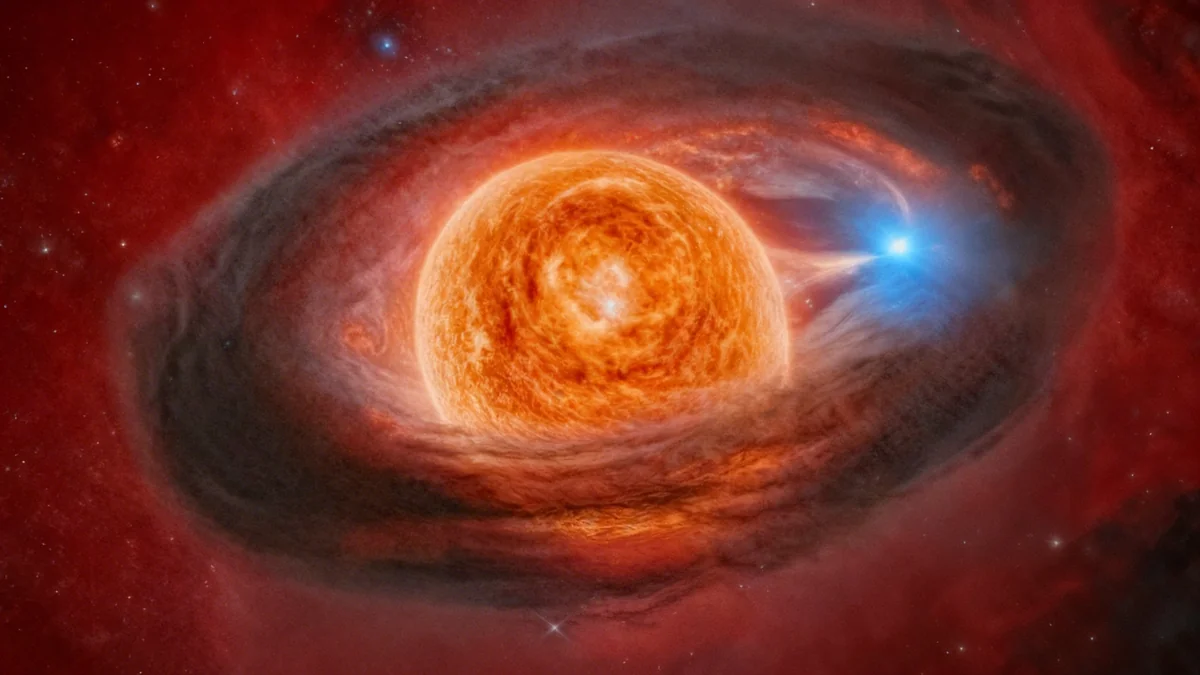
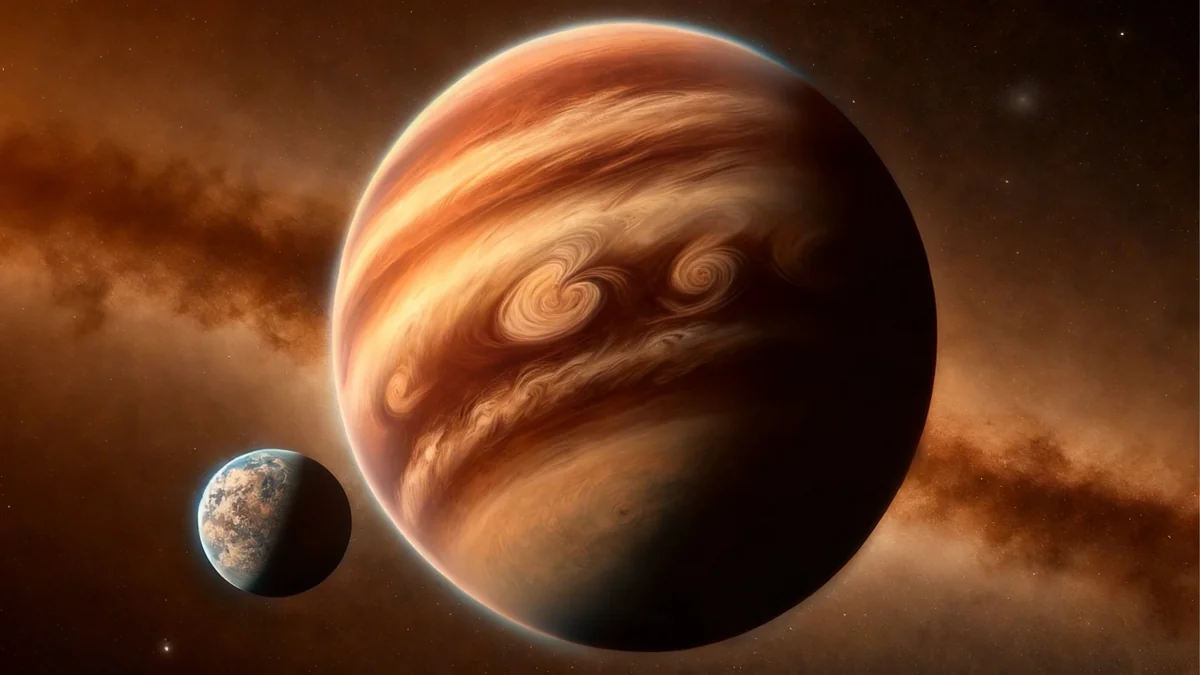

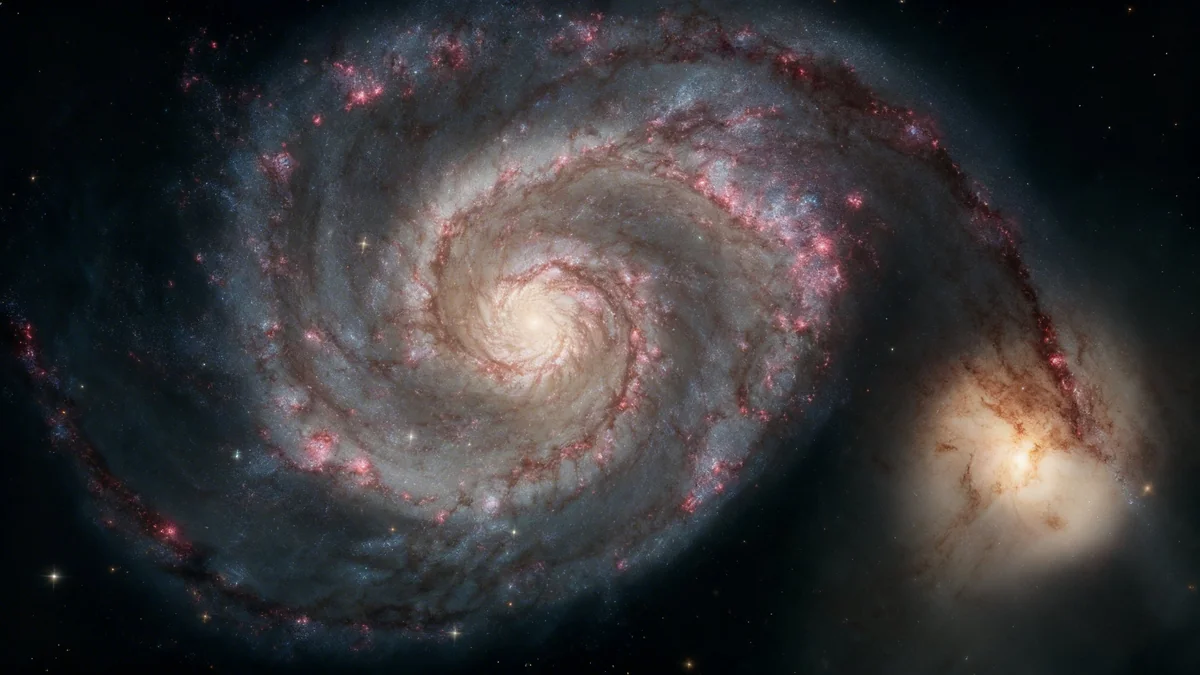
In a distant satellite galaxy of the Milky Way, astronomers are witnessing a cosmic event on a scale difficult to comprehend. A star 1,540 times the size of our sun has begun a rapid and unusual transformation, shifting from a red supergiant to a rare yellow hypergiant. This metamorphosis, observed in real time, could be the final stage before the star collapses into a black hole or explodes in a brilliant supernova.
The star, known as WOH G64, is located 163,000 light-years away in the Large Magellanic Cloud. Its sudden change offers a unique window into the final moments of the universe's most massive stars, a process that has long been a subject of theoretical debate among scientists.
Key Takeaways
- Astronomers have observed the star WOH G64 changing from a red supergiant to a yellow hypergiant.
- This star is immense, measuring 1,540 times the sun's size and possessing nearly 30 times its mass.
- The transformation is surprisingly quiet and smooth, unlike the violent events typically associated with rapid stellar changes.
- Scientists also discovered WOH G64 is part of a binary system with a companion star, complicating the cause of its evolution.
- The star's future is uncertain, but it may end in a supernova or collapse directly into a black hole within the next few thousand years.
A Cosmic Giant's Sudden Shift
For decades, WOH G64 was known as one of the most extreme red supergiants ever discovered. Located in a neighboring galaxy, it has always been a point of interest due to its sheer size and luminosity, which is a staggering 282,000 times greater than our sun's. Since its discovery in the 1970s, it appeared consistently as a massive red star enveloped in a thick torus, or ring, of dust.
However, beginning in 2014, astronomers noticed something had changed. Observations revealed that the star's color was shifting and its surface temperature was steadily increasing. A team led by Gonzalo Muñoz-Sanchez at the National Observatory of Athens concluded this was direct evidence of a stellar evolution phase change occurring on a human timescale.
"This is especially surprising because rapid changes in stars are typically associated with violent or abrupt processes," Muñoz-Sanchez explained, highlighting the unusual nature of this smooth transition.
The observation marks the first time such a peaceful evolution from red to yellow has been documented for an extreme stellar object. It suggests that the final chapters of a massive star's life may be more complex than previously understood.
WOH G64 by the Numbers
- Distance: 163,000 light-years from Earth
- Size: 1,540 times the diameter of the sun
- Mass: Approximately 28 solar masses
- Luminosity: 282,000 times brighter than the sun
- Age: Roughly 5 million years old
The Mystery of the Yellow Hypergiant
The transformation into a yellow hypergiant is a significant and fleeting stage in a star's life. These objects are exceptionally rare because this phase is a very short-lived transition between the red supergiant stage and the star's ultimate demise.
For a star to make this leap, it must shed its vast outer layers of gas. This process is driven by powerful stellar winds that strip away the envelope, causing the star's core to become more exposed and its surface temperature to rise. Only the most luminous and massive red supergiants are thought to be capable of generating winds strong enough for this to occur.
The discovery that WOH G64 is not alone adds another layer to the puzzle. The team confirmed the presence of a companion star, turning WOH G64 into a binary system. This opens up two primary possibilities for its dramatic change.
Two Paths to Transformation
The first scenario is that the change is intrinsic to the star itself. In this model, WOH G64's own internal processes drove an eruptive episode that shed its outer layers, and it is now settling into a more stable, hotter yellow phase.
The second, and perhaps more complex, scenario involves binary interaction. The gravitational pull of the companion star could be actively stripping material from WOH G64. It's possible the two stars were once hidden within a shared cloud of gas, known as a common envelope, making them appear as a single, larger red supergiant. The recent ejection of this envelope would have revealed the two individual stars and triggered the observed temperature change.
"Both possibilities are extremely rare, and witnessing either occur on human timescales is nearly unprecedented," Muñoz-Sanchez noted. Determining which process is at play is crucial for understanding how massive stars live and die.
Live Fast, Die Young
Stars as massive as WOH G64 have dramatically short lifespans. While our sun is a middle-aged star at 4.6 billion years old, WOH G64 is a mere 5 million years old and is already approaching the end of its life. This is because larger stars burn through their nuclear fuel at a much faster rate than smaller ones like our sun.
What Comes Next for WOH G64?
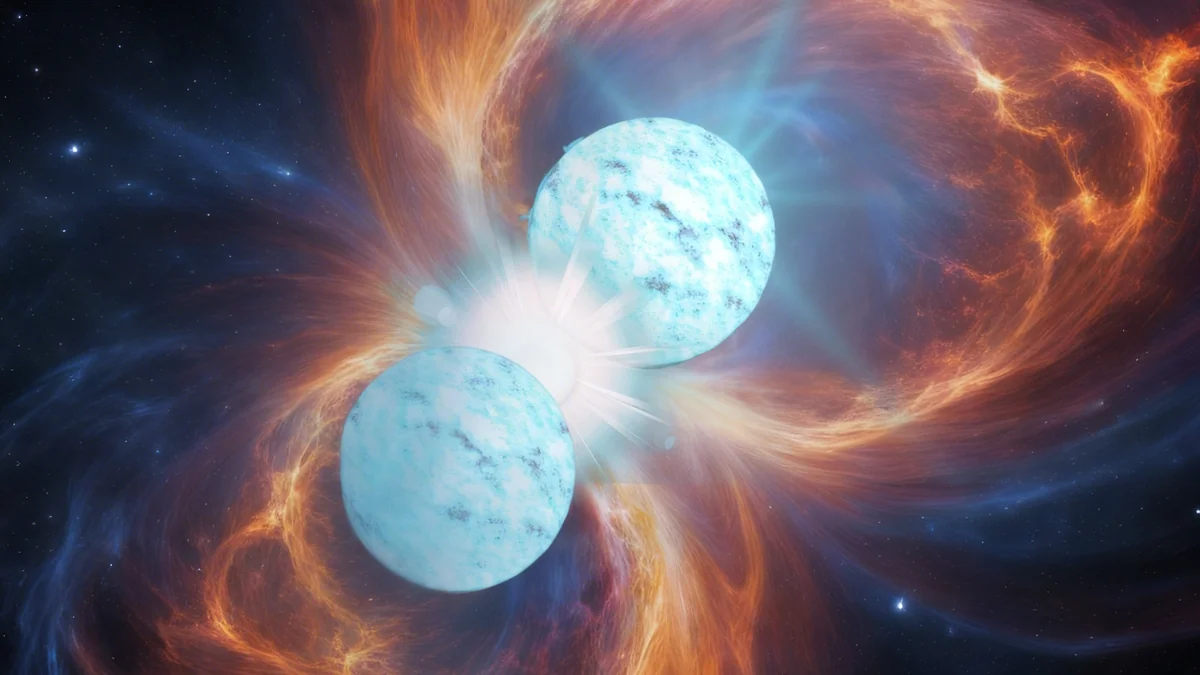
The future of WOH G64 remains uncertain, but its current path points toward a cataclysmic end. The discovery of its binary nature presents several potential outcomes. The continued exchange of mass between the two stars could eventually lead to their collision and merger into an even more massive object.
If the two stars do not significantly interact, the main star is expected to continue its evolution toward core collapse. This will result in one of two events: a spectacular supernova explosion, which would briefly outshine its entire galaxy, or a direct collapse into a black hole without a visible explosion.
Astronomers believe this final event is imminent in cosmic terms. According to Muñoz-Sanchez, the core collapse could happen "soon," which on an astronomical timescale ranges from a few hundred to a few thousand years. While this means it is highly unlikely to occur within our lifetimes, observing the prelude is an extraordinary opportunity.
The ongoing study of WOH G64 will provide invaluable data on the end-of-life stages of massive stars, helping to refine scientific models and answer long-standing questions about supernovas and the formation of black holes. For now, the universe has given us a front-row seat to one of its most dramatic transformations.