
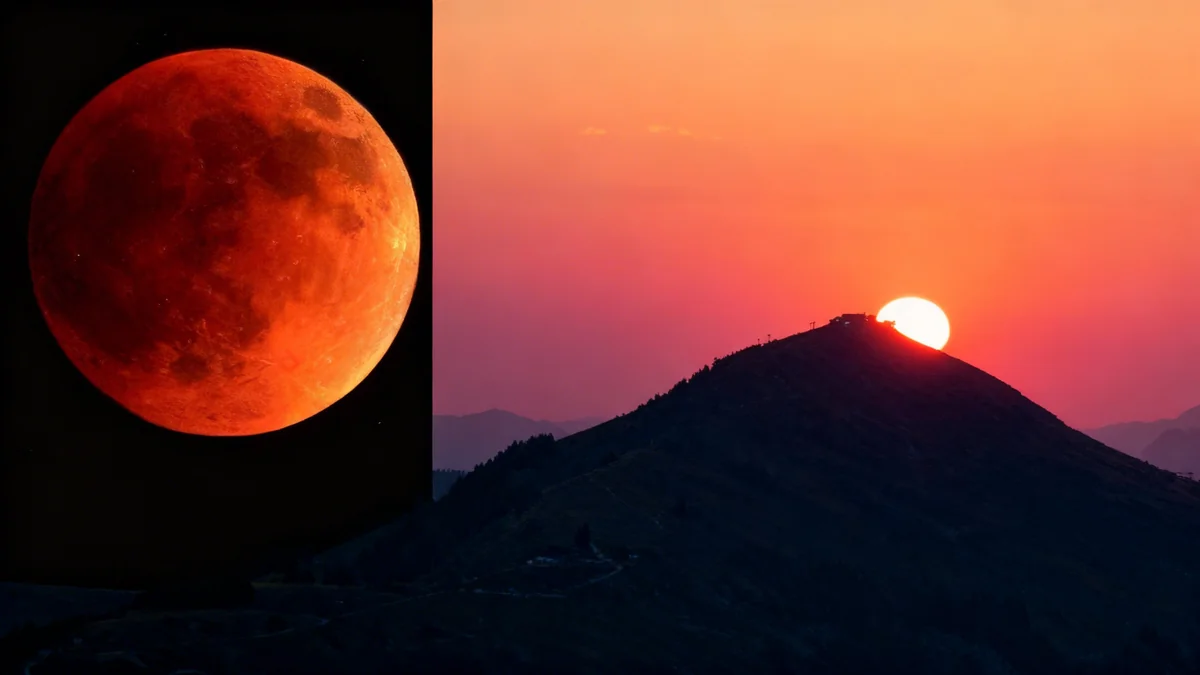

Skywatchers across eastern North America are preparing for a rare celestial event on Tuesday, March 3, that will allow them to see the sun rising in the east while a fully eclipsed moon sets in the west. This unusual phenomenon, known as a selenelion, defies simple geometry and is made possible by a trick of Earth's atmosphere.
The event coincides with the first total lunar eclipse of the year, offering a brief, memorable spectacle for those with a clear view of both horizons during the twilight hours.
Key Takeaways
- A total lunar eclipse will occur in the early hours of Tuesday, March 3.
- A rare phenomenon called a selenelion will allow some observers to see the rising sun and the setting eclipsed moon simultaneously.
- The effect is caused by atmospheric refraction, which bends light and makes celestial objects appear higher in the sky.
- The best chance to witness the selenelion is in the Eastern Time Zone of the United States and Canada.
An 'Impossible' Celestial Alignment
A lunar eclipse occurs when the Earth passes directly between the sun and the moon, casting its shadow onto the lunar surface. By definition, this alignment, called a syzygy, means the sun and moon are exactly 180 degrees apart in the sky. Logically, if the sun is visible above the horizon, the moon should be below it.
However, the Earth's atmosphere acts like a lens, bending the light from celestial bodies. This effect, known as atmospheric refraction, is why we can still see the sun for a few minutes after it has physically dipped below the horizon.
This same principle applies to the moon. Refraction raises the apparent position of both the rising sun and the setting moon. This creates a brief window, lasting from one to three minutes, where both can be seen at the same time, despite being geometrically opposite each other.
What is a Selenelion?
The term selenelion, sometimes called selenehelion, describes the specific occurrence of viewing the sun and a fully eclipsed moon in the sky at the same moment. It is an optical illusion created entirely by Earth's atmosphere bending light around the curve of the planet.
Where and When to Watch
The visibility of this unique event is highly dependent on geographic location. While the total phase of the lunar eclipse itself favors observers around the Pacific Rim, the opportunity to see the selenelion is concentrated in the eastern half of North America.
The total eclipse begins at 3:03 a.m. Pacific Standard Time and will last for 59 minutes. For those in the Eastern Time Zone, this timing means the moon will be fully immersed in Earth's dark shadow as it sets during sunrise.
Viewing Prospects Across North America
Eastern Time Zone: Locations like Boston, New York, and Washington, D.C., are prime candidates for the selenelion. The moon will set while it is still in total eclipse. For example, in New York City, the sun rises at 6:26 a.m., while the eclipsed moon sets just two minutes later at 6:28 a.m.
Central Time Zone: Observers in cities such as Chicago and New Orleans will see the moon setting as it is emerging from the darkest part of Earth's shadow, the umbra. In Chicago, the moon will be 72% covered by the umbra when it sets at 6:24 a.m., just after the 6:22 a.m. sunrise.
Mountain and Pacific Time Zones: Unfortunately, skywatchers farther west will likely miss the effect. By the time the sun rises in these regions, the moon will have moved mostly or completely out of the umbra, appearing as a normal or only slightly shaded full moon before it sets.
Sunrise and Moonset Times for Key Cities
- Boston, MA (EST): Sunrise at 6:16 a.m., Moonset at 6:17 a.m. (Total Eclipse)
- Atlanta, GA (EST): Sunrise at 7:03 a.m., Moonset at 7:05 a.m. (97% Eclipsed)
- Chicago, IL (CST): Sunrise at 6:22 a.m., Moonset at 6:24 a.m. (72% Eclipsed)
- New Orleans, LA (CST): Sunrise at 6:24 a.m., Moonset at 6:26 a.m. (69% Eclipsed)
Eclipse percentages indicate how much of the moon's diameter is inside the Earth's dark umbral shadow at the time of moonset.
Tips for a Successful Observation
Witnessing the selenelion requires some preparation. The most critical factor is having an unobstructed view of both the eastern and western horizons. Any tall buildings, trees, or hills can block the view of either the rising sun or the setting moon.
Observers should find a high vantage point, such as a hilltop or the top floor of a tall building with clear sightlines in both directions.
It is also important to be aware of atmospheric conditions. The brightening morning twilight can make the dim, reddish eclipsed moon very difficult to spot. Horizon haze can further obscure the view, potentially causing the moon to disappear from sight 10 to 15 minutes before it technically sets.
"If the moon is totally eclipsed at moonset, you will probably have to scan the western horizon as the twilight increases to detect the darkened moon, which will perhaps resemble a dim and eerily illuminated softball."
Using binoculars or a small telescope may help in locating the faint, coppery disk of the eclipsed moon against the brightening sky. As always when the sun is near the horizon, never look directly at the sun without proper solar filters.
This rare alignment of celestial mechanics and atmospheric physics offers a fleeting but remarkable opportunity for those positioned in the right place at the right time. For a few brief moments, the impossible will become visible in the morning sky.