
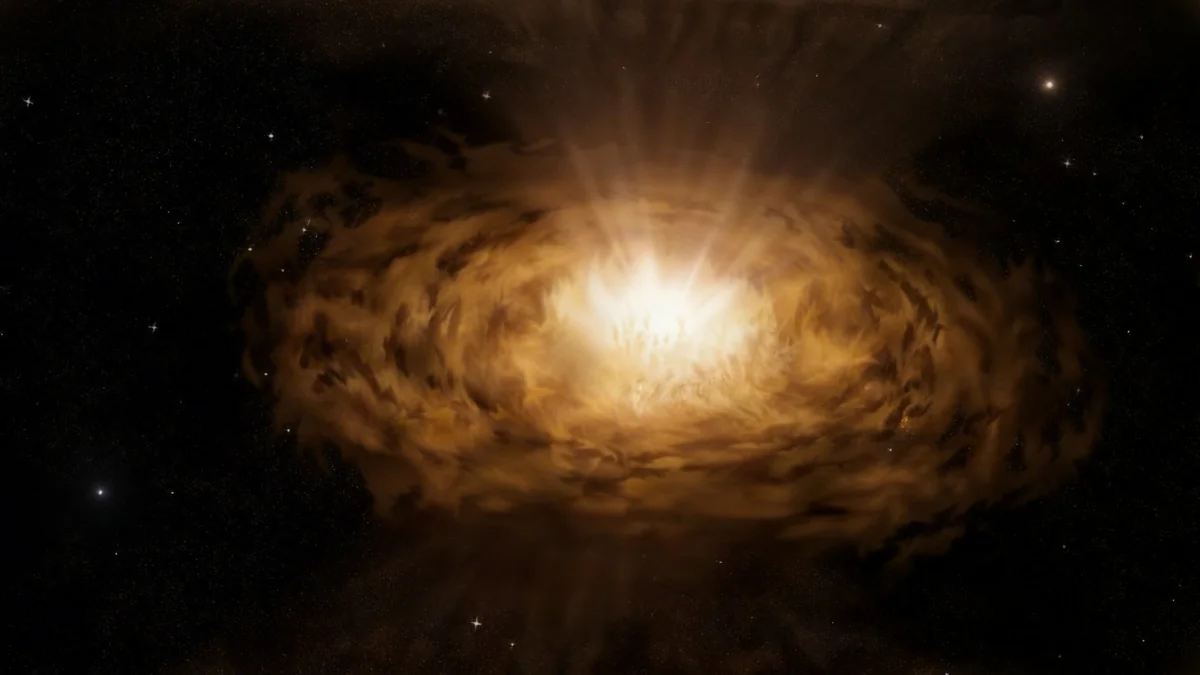

New observations from the James Webb Space Telescope (JWST) are challenging long-held assumptions about the universe's most massive objects. Researchers have found that seemingly dormant supermassive black holes at the center of some galaxies are far more active than previously believed, quietly influencing star formation and galactic evolution.
By peering through cosmic dust clouds using infrared light, the telescope has uncovered evidence that these galactic engines, even when idling, are powerful enough to heat surrounding gas and drive significant changes within their host galaxies.
Key Takeaways
- The James Webb Space Telescope is studying a class of objects known as Low-Luminosity Active Galactic Nuclei (LLAGN).
- These supposedly "quiet" supermassive black holes are actively shaping their galactic environments.
- JWST's infrared capabilities allow it to see through dense dust that obscures these galactic centers from other telescopes.
- A key finding is the presence of unusually warm molecular hydrogen gas, indicating a significant heating effect from the black holes.
A New View of Galactic Centers
At the heart of nearly every large galaxy, including our own Milky Way, lies a supermassive black hole. While some of these cosmic giants are known for their spectacular displays of energy, many appear to be relatively quiet. These are classified by astronomers as Low-Luminosity Active Galactic Nuclei, or LLAGN.
For years, scientists considered these LLAGN to be largely inert, their immense power having faded into the background of cosmic activity. However, new research is painting a very different picture. Using the powerful infrared instruments aboard the James Webb Space Telescope, astronomers are now able to bypass the thick veils of gas and dust that have historically hidden these galactic cores from view.
Why Infrared Vision is Crucial
Visible light, the kind our eyes can see, is easily blocked by the dense clouds of dust and gas that swirl around a galaxy's center. Infrared light, which has longer wavelengths, can penetrate these obstructions. This gives JWST an unprecedented ability to observe the processes happening in the immediate vicinity of these supermassive black holes.
This capability allows scientists to study the subtle signatures of activity that were previously undetectable, revealing a universe that is far more dynamic than it first appears.
Decoding Cosmic Whispers
To understand the activity around a black hole, scientists analyze the light emitted by the surrounding gas. As the black hole's immense gravity and energy output energize this gas, atoms become excited and then release light at very specific wavelengths, or colors. These are known as emission lines.
These lines act like a cosmic fingerprint, providing a wealth of information. They can tell researchers what elements the gas is made of, its temperature, its density, and even how fast it is moving. The latest study provides comprehensive measurements of these emission lines from seven LLAGN, offering a detailed look at their inner workings.
The Power of an Idling Engine
Even a low-luminosity black hole releases a stream of high-energy radiation known as an ionizing continuum. This acts like a powerful flashlight, stripping electrons from nearby atoms and causing the gas to glow, which is what JWST observes through the emission lines.
By analyzing these fingerprints, scientists can piece together the story of how these quiet giants interact with their surroundings. The data shows that even at low power, these black holes are actively pushing and stirring the gas and dust around them.
An Unexpected Discovery
One of the most striking findings from the recent observations is the presence of unusually warm molecular hydrogen gas in the galaxies hosting these LLAGN. The excitation temperatures of this gas were found to be systematically higher than in other types of galaxies.
This suggests that even an idling black hole can significantly heat its immediate environment. This heating process has profound implications for the galaxy as a whole. It can influence how, when, and where new stars are born in a process known as kinetic feedback.
The research team also measured the width of the emission lines, a property known as the "full width at half maximum" (FWHM). A wider line indicates that the gas is either very hot or moving chaotically at high speeds. These measurements provide crucial data on the turbulent conditions near the black hole, confirming a high level of activity.
The Impact on Star Formation
The influence of a supermassive black hole extends far beyond its immediate vicinity. By heating and pushing gas, it can create a complex feedback loop that regulates star formation across the galaxy.
- Clearing Gas: The outflow of energy can clear out vast regions of gas, preventing new stars from forming in those areas.
- Triggering Starbursts: In other instances, this same energy can compress clouds of gas, triggering a rapid burst of star formation.
This delicate balance shows that LLAGN are not passive bystanders but active architects of their galactic homes. They are constantly sculpting the cosmic landscape, playing a crucial role in the long-term evolution of the galaxies they inhabit.
Redefining Galactic Evolution
This new research fundamentally changes our understanding of how galaxies evolve. The previous assumption that LLAGN were mostly dormant meant their impact was often overlooked in models of galactic development. This work demonstrates that their subtle but persistent influence is a key piece of the puzzle.
The data suggests that even when not at full power, these supermassive black holes are active players. They eject material, energize gas, and create conditions that dictate how and where stars form, shaping the very structure of their galaxies over billions of years.
This ongoing research opens up new avenues of inquiry. Scientists are now eager to determine how common this warm molecular hydrogen is across the universe and what other subtle effects these quiet black holes might have on their environments.
With each new observation from instruments like the James Webb Space Telescope, we are learning to interpret the intricate languages of the cosmos. The quiet whispers from the hearts of distant galaxies are revealing a universe that is constantly changing, shaped by powerful forces that were, until now, hidden from our view.