

Researchers from Kyoto University have proposed a new theoretical model suggesting a potential link between solar activity and seismic events. The study explores how electrical disturbances in the Earth's ionosphere, driven by solar flares, could exert physical pressure on fault lines already close to their breaking point.
This research does not present an earthquake prediction method. Instead, it offers a novel physical framework that connects phenomena in space with geological processes deep within the Earth's crust, potentially broadening our understanding of the complex forces that can contribute to earthquakes.
Key Takeaways
- A new theoretical model from Kyoto University proposes a link between solar activity and seismic events.
- The theory suggests solar flares alter the ionosphere, creating electrostatic forces.
- These forces could be transmitted to fragile rock formations in the Earth's crust through a process called capacitive coupling.
- The resulting pressure could be enough to influence faults that are already critically stressed.
- This is a conceptual framework for further research, not an earthquake prediction tool.
A New Perspective on Seismic Triggers
For centuries, earthquakes have been understood as a purely terrestrial phenomenon, driven by the slow, powerful movement of tectonic plates. Scientists study stress accumulation in the Earth's crust to understand seismic hazards. However, a new study introduces an external factor: the sun.
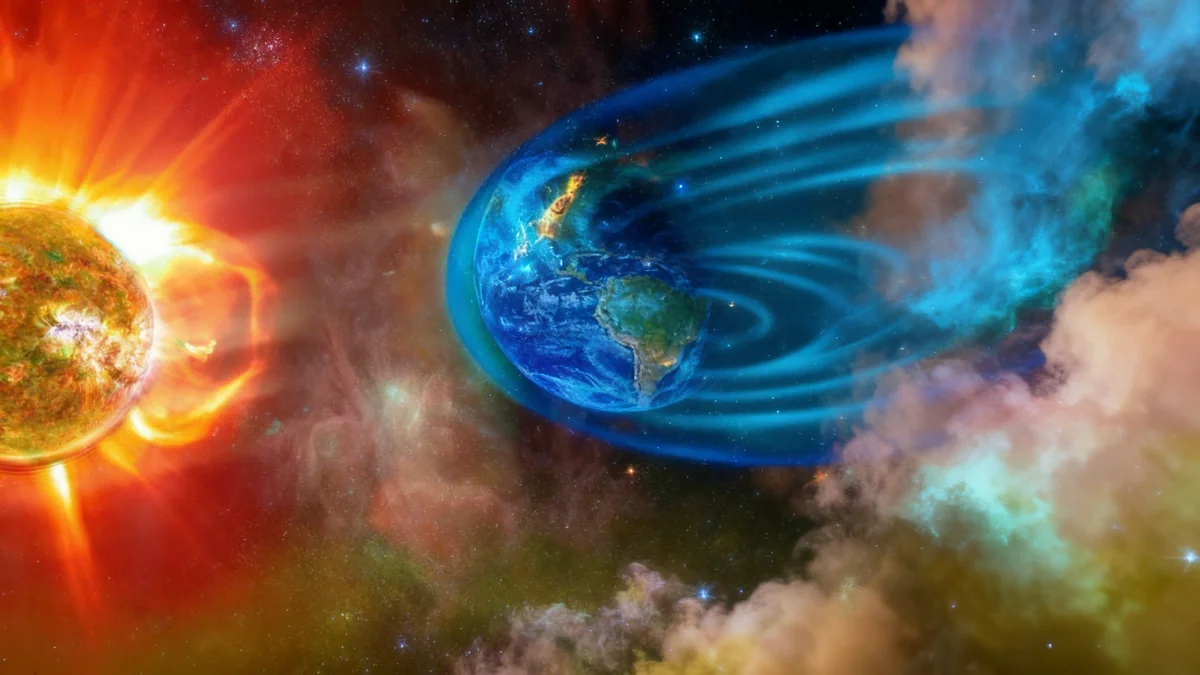
Researchers are now considering whether intense space weather events could be one of the many subtle forces that contribute to the timing of an earthquake. The theory centers on the ionosphere, a layer of Earth's upper atmosphere filled with charged particles, which is highly sensitive to solar activity.
While some previous studies have noted unusual ionospheric behavior before major earthquakes, these were often interpreted as signals rising from the stressed crust. The new model flips this idea, suggesting the influence could also travel in the opposite direction—from the sky down to the ground.
The Proposed Electrostatic Mechanism
The core of the Kyoto University model is a chain of events that translates solar energy into physical force within the planet's crust. It proposes a complete electrostatic system connecting the sky and the ground.
How Solar Activity Begins the Process
The process starts with a significant solar event, such as a solar flare. These eruptions send vast amounts of energy and charged particles toward Earth, causing rapid changes in the ionosphere. Specifically, they can increase the density of electrons, creating a more negatively charged layer at lower altitudes.
Scientists monitor these changes constantly using satellite navigation signals, as the shifts in the ionosphere affect GPS accuracy. This data, known as total electron content (TEC), provides a direct measurement of the ionosphere's electrical state.
What is Capacitive Coupling?
The model treats the Earth's crust and the ionosphere as two conductive plates separated by the atmosphere, which acts as an insulator. This setup is similar to an electrical component called a capacitor. A change in the electrical charge on one plate (the ionosphere) can induce a corresponding change on the other plate (the Earth's crust), even without a direct physical connection.
From the Ionosphere to the Crust
The model suggests that the ground and the ionosphere are connected through what is known as capacitive coupling. This means that a significant electrical change in the ionosphere can induce an electrical response on the Earth's surface and even within the crust itself.
The focus then shifts to fractured rock zones deep underground. These areas can contain water trapped under extreme pressure and temperature. The researchers theorize that these damaged regions can act like tiny capacitors embedded within the crust.
When the ionosphere's charge shifts dramatically, this model suggests it can intensify the electric fields within the microscopic voids of these fractured rocks. This intensification creates a physical force known as electrostatic pressure.
The study proposes a bidirectional interaction: while crustal processes may affect the ionosphere, ionospheric disturbances themselves may also exert feedback forces on the crust.
Quantifying the Potential Force
A key part of the study was calculating whether this electrostatic pressure could be strong enough to matter. For a fault zone that is already under immense tectonic stress and nearing the point of failure, even a small additional push could theoretically be enough to initiate a rupture.
The researchers' calculations connect the effect to large solar flare events that cause an increase in total electron content by several tens of TEC units. Under these specific conditions, the model shows that the electrostatic pressure inside crustal voids could reach several megapascals.
Context: Megapascals and Fault Stability
A pressure of several megapascals is significant in geological terms. It is comparable to other subtle but recognized earthquake triggers, such as the stresses induced by ocean tides or changes in atmospheric pressure. This suggests the proposed force is, at least in theory, mechanically relevant.
The study notes that the 2024 Noto Peninsula earthquake in Japan, among others, was preceded by intense solar flare activity. The authors are careful to state that this temporal coincidence does not prove causation. However, it is consistent with a scenario where an external disturbance from the ionosphere could act as a contributing factor when the crust is already in a critical state.
Implications for Future Research
This model represents a significant shift in thinking by integrating concepts from plasma physics, atmospheric science, and geophysics. It reframes earthquakes not just as isolated geological events but as part of a larger, interconnected Earth system that is sensitive to influences from space.
The findings could open new avenues for seismic research. Future work will focus on validating the theory by combining high-resolution ionospheric data with detailed geological observations. By monitoring both space weather and subsurface conditions in tandem, scientists hope to gain a clearer picture of all the forces at play during earthquake initiation.
If a connection is further established, it could one day help improve our understanding of seismic hazards. While not a prediction tool, this research highlights the intricate and sometimes surprising connections that govern our dynamic planet.