
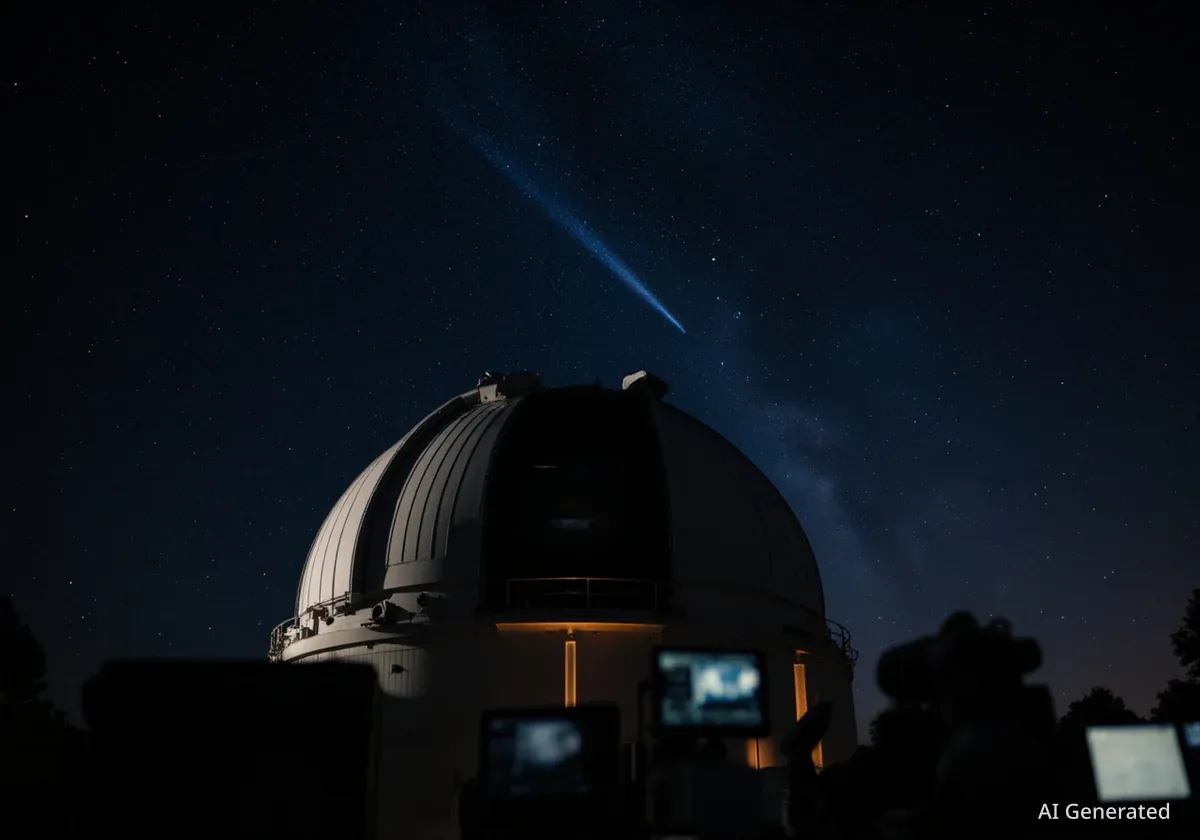

A visitor from another star system, comet 3I/ATLAS, has provided scientists with an unprecedented look into the chemical makeup of distant worlds. After surviving a close flyby of our sun, the comet has revealed crucial data about heavy elements that are the fundamental building blocks of rocky planets.
Observations of the comet before and after its closest approach to the sun on October 30, 2025, have allowed for the detailed tracking of atomic nickel and iron. This analysis offers a rare window into the primordial ingredients available in the comet's home star system, advancing our understanding of how planets might form across the galaxy.
Key Takeaways
- Astronomers successfully tracked atomic nickel and iron emissions from interstellar comet 3I/ATLAS both before and after its pass around the sun.
- This level of detailed observation on an interstellar object is a first, providing unique data on the building blocks of planets from another star system.
- After its solar flyby, the comet's chemistry, including detections of methanol and ethane, appeared similar to comets from our own solar system.
- This suggests the sun's radiation significantly altered the comet's outer layers, complicating the direct analysis of its original, pristine material.
A Messenger from a Distant Star
Imagine receiving a package from a place you've never been, containing the raw materials used to build everything there. That is essentially what interstellar comets like 3I/ATLAS represent. These objects are cosmic time capsules, traveling for immense periods from their home stars, carrying the elemental fingerprints of their birthplaces.
For scientists trying to understand the universal recipe for planet formation, these visitors are invaluable. They offer a direct sample of the materials present in other stellar nurseries. By studying their composition, we can begin to answer a fundamental question: Are the ingredients that formed Earth, Mars, and our other planetary neighbors common throughout the cosmos?
The successful observation of 3I/ATLAS marks a significant milestone in this quest. The ability to track specific heavy elements provides a new and powerful tool for this cosmic investigation.
What Makes an Interstellar Comet Special?
Most comets we observe originate from within our own solar system, either from the Kuiper Belt beyond Neptune or the distant Oort Cloud. Interstellar comets, identified by their unique trajectories, are not gravitationally bound to our sun. They are travelers that have been ejected from their own star systems and are just passing through ours, offering a rare sample of extraterrestrial material.
The Significance of Nickel and Iron
The focus of the recent study was on two specific heavy elements: nickel (Ni) and iron (Fe). These metals are crucial because they are foundational components of terrestrial, or rocky, planets like our own.
Tracking their emissions from a comet, especially before and after it is heated by a star, gives scientists a wealth of information. The heat from the sun vaporizes materials on the comet's surface, releasing them into a surrounding cloud called a coma, where they can be analyzed by telescopes.
An Unprecedented Dataset
The comprehensive tracking of nickel and iron in 3I/ATLAS is exceptionally rare. In fact, only one comet from our own solar system, C/2002 V1 (NEAT), has ever provided a comparable set of data. Achieving this with an object from another star is a major breakthrough for planetary science.
This data helps astronomers determine the "primordial metallicity" of the comet's home system. In simple terms, it reveals the abundance of heavy elements that were available when its planets were first forming. By comparing this alien recipe to our own, we can see if the universe has a standard set of ingredients for building worlds.
A Sun-Baked Complication
While the initial data was a scientific triumph, the universe rarely provides simple answers. Observations of 3I/ATLAS after it passed the sun presented a new puzzle. The chemical signature of its coma began to look surprisingly familiar.
New analyses from instruments like NASA's SPHEREx telescope, which captured infrared observations in December 2025, detected compounds such as methanol, ethane, and dark dust. These are all common components of comets born right here in our solar system.
This similarity leads to a critical conclusion: the sun's intense radiation had significantly processed the comet's outer layers. The material being observed was not the pristine, untouched core of the comet but a sun-baked crust that had been chemically altered during its close encounter.
"This complicates our quest to directly read the 'primordial metallicity' from its surface. It means we cannot just look at the emissions and declare, 'Aha, this is exactly what their star system is made of.' We have to account for the sun's influence," explained one researcher involved in the study.
Peeling Back the Layers
This development does not diminish the value of the findings; it simply adds a new layer of complexity to the analysis. Scientists must now work to understand the effects of this solar processing. By modeling how the sun's heat and radiation would change the original materials, they can work backward to infer the comet's initial composition.
This process is like a cosmic detective trying to figure out the original ingredients of a cake after it has already been baked. It's more challenging, but the clues are still there.
Connecting Our Home to the Cosmos
The study of 3I/ATLAS, even with its complexities, represents a crucial step forward in connecting our own solar system to the vast expanse of the galaxy. Every piece of data from these interstellar messengers helps build a more complete picture of cosmic origins.
We are learning how interstellar objects behave and evolve when they encounter a star like our sun. More importantly, these observations are refining our methods for studying the fundamental building blocks of other worlds.
The ultimate goal is to understand the grand narrative of how the universe builds planets. By dissecting the metallic whispers carried by travelers like 3I/ATLAS, we are piecing together that story, one element at a time. These objects are not just chunks of ice and rock; they are messengers carrying tales of distant stellar nurseries, helping us understand our own place in the cosmos.