

Scientists have identified what appears to be a massive underground tunnel on Venus, potentially a lava tube, by analyzing radar data that is more than three decades old. The discovery, made using imagery from NASA’s Magellan mission, adds significant weight to the theory that Earth’s so-called twin planet is not the geologically dormant world it was once thought to be.
If confirmed, this would be only the second such structure ever reported on Venus, offering a rare glimpse beneath the planet's thick, toxic atmosphere and challenging our understanding of its volcanic history.
Key Takeaways
- Researchers identified a potential lava tube on Venus by analyzing radar data from NASA's Magellan mission from the early 1990s.
- The structure is located on the flank of Nyx Mons, one of Venus's 1,600 major volcanoes.
- This finding supports growing evidence that Venus may still be geologically active.
- Future missions, like the European Space Agency's EnVision, will use advanced radar to confirm and explore these subsurface features.
A Discovery Decades in the Making
The breakthrough came from a detailed re-examination of a vast archive of radar images captured by the NASA Magellan orbiter between 1990 and 1992. Because Venus is perpetually covered by dense clouds, direct optical observation of its surface is impossible. Magellan used radar to pierce this veil, mapping the planet's topography in unprecedented detail.
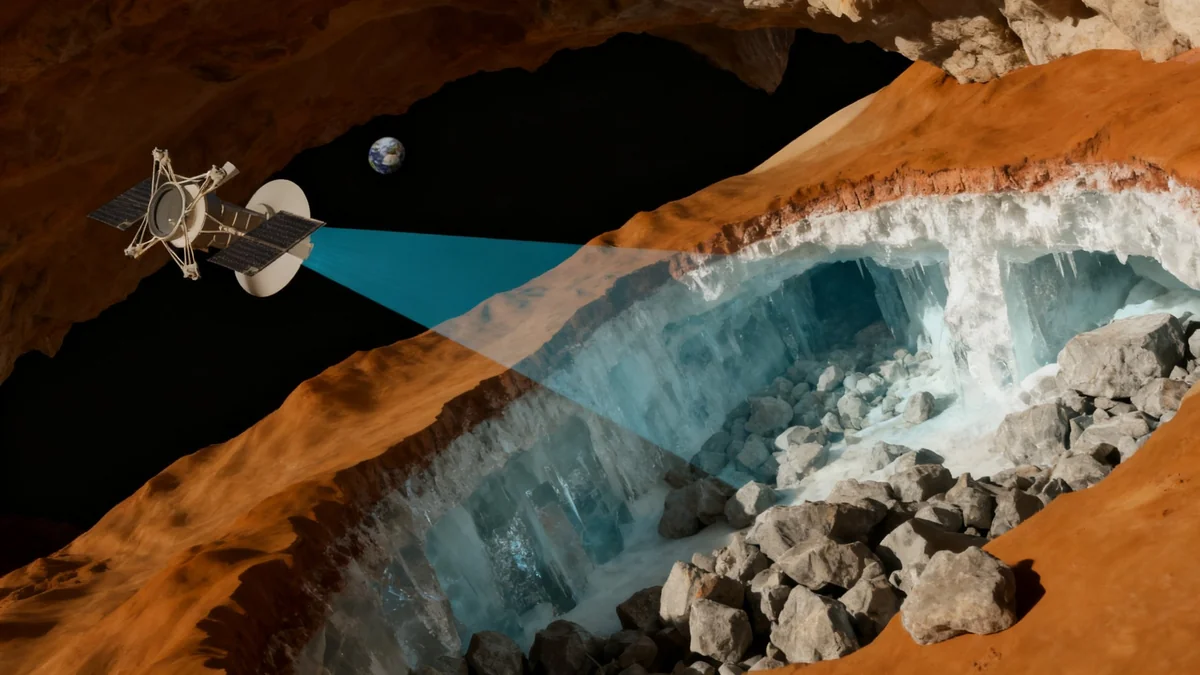
A team of scientists, led by researchers from the University of Trento in Italy, focused on specific surface features that hinted at what might lie beneath. They identified a collapsed area, similar to a skylight, on the western side of a large volcano known as Nyx Mons. This collapse produced a unique radar signature that strongly matches patterns seen on Earth from the collapsed roofs of lava tubes.
"Our knowledge of Venus is still limited, and until now we have never had the opportunity to directly observe processes occurring beneath the surface of Earth's twin planet," said Lorenzo Bruzzone of the University of Trento, a co-author of the study.
This kind of archival research highlights the enduring value of data collected by past space missions. Even with today's advanced technology, the foundational maps created by Magellan continue to yield new and important discoveries about our planetary neighbor.
What is a Lava Tube?
Lava tubes are natural tunnels formed when the outer surface of a flowing river of lava cools and hardens, creating a crust. The molten rock inside continues to flow, and when the eruption ceases, it drains away, leaving behind a hollow cave-like structure.
Volcanic Worlds
Lava tubes are not unique to Earth. Similar features have been identified on the Moon and Mars, where they are considered prime candidates for future human habitats. These subterranean caverns could provide natural protection from harsh surface conditions, including extreme temperatures, cosmic radiation, and micrometeoroid impacts. The discovery on Venus expands our understanding of how these structures form on different planetary bodies.
On Venus, a planet with a crushing atmosphere and surface temperatures hot enough to melt lead, such underground conduits could be massive. The analysis of the terrain surrounding the newly found feature suggests the tunnel could extend for several dozen kilometers. For now, only a portion of the structure can be confirmed through the existing data.
Clues to a Living Planet
For many years, Venus was often viewed as a geologically quiet world. However, a string of recent findings has begun to paint a different picture—one of a planet that may still be volcanically active.
The identification of this potential lava tube is another piece of that puzzle. These structures are direct evidence of past, and possibly extensive, volcanic activity. The existence of long chains of pits and collapsed areas across the Venusian surface has long suggested that a network of these tubes might exist. This new, specific identification provides a concrete target for further study.
A World of Volcanoes
The surface of Venus is dominated by volcanic features. Scientists have identified over 1,600 major volcanoes and estimate there could be nearly a million smaller ones. This makes Venus the most volcanically active planet in our solar system, at least in terms of the number of volcanoes.
The discovery is significant because it validates theories that have been hypothesized for years. "The identification of a volcanic cavity is therefore of particular importance," Bruzzone noted, explaining that it moves the concept from theory to observable evidence.
The Future of Venus Exploration
Confirming the full extent, shape, and stability of this lava tube will require new and more powerful instruments. Fortunately, a new era of Venus exploration is on the horizon.
Several upcoming missions are designed to study the planet in greater detail than ever before. A key instrument in this effort will be the Subsurface Radar Sounder (SRS) planned for the European Space Agency's (ESA) EnVision mission. This advanced radar is designed to penetrate the surface of Venus to depths of several hundred meters.
This capability will be a game-changer for planetary scientists.
- Confirmation: The SRS could confirm whether this feature is indeed a lava tube and map its dimensions.
- Discovery: It could detect other, completely hidden conduits that have no surface openings or collapses.
- Understanding Geology: Data from these instruments will provide crucial insights into the volcanic processes that have shaped Venus over billions of years.
According to Bruzzone, this technology can probe the subsurface "even in the absence of surface openings." He sees the current finding as just the beginning of a new chapter in our exploration of Venus.
As new missions prepare to launch, this discovery made from old data serves as a powerful reminder of the secrets Venus still holds, hidden just beneath its fiery surface.