
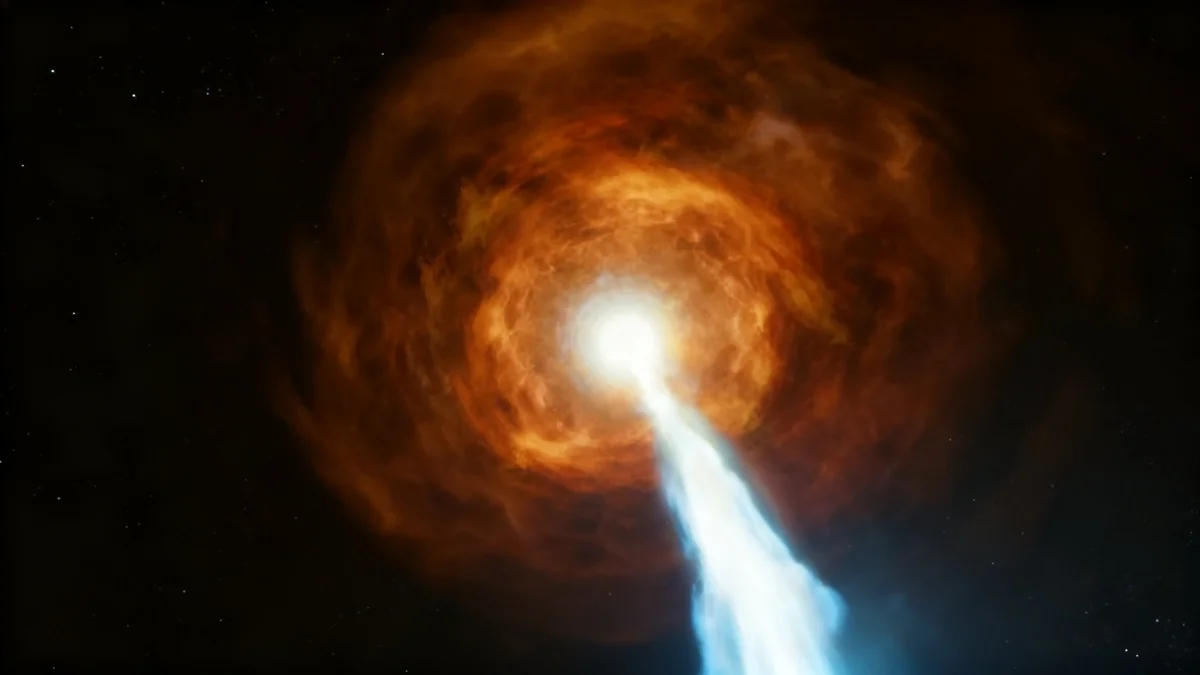

Astronomers have detected the longest-lasting gamma-ray burst ever recorded, a colossal cosmic explosion that persisted for seven hours. The event, named GRB 250702B, challenges conventional understanding of how these powerful bursts are created and points to a rare and violent stellar death.
The signal, which traveled across the universe before reaching Earth, has prompted scientists to propose a new model for the destruction of a star, involving a black hole consuming its companion from the inside out.
Key Takeaways
- A gamma-ray burst designated GRB 250702B lasted for approximately seven hours (25,000 seconds), making it the longest ever observed.
- The duration far exceeds typical GRBs, which usually last from a few seconds to several minutes.
- Scientists propose a new origin theory: a 'helium merger,' where a black hole consumes an orbiting helium star.
- The discovery was made by combining data from five space telescopes, including NASA's Fermi Gamma-ray Space Telescope.
An Unprecedented Cosmic Signal
In early 2025, a series of alerts flagged an unusual event in the distant universe. Space telescopes designed to scan the sky for high-energy radiation detected a powerful flash of gamma rays. But this was no ordinary signal. Instead of fading after a few minutes, the burst continued for hours.
The event, GRB 250702B, was monitored by a global network of observatories. By combining data, researchers confirmed its staggering duration of nearly 25,000 seconds. This is significantly longer than the previous record-holder, which lasted around 15,000 seconds. Most gamma-ray bursts, or GRBs, are over in less than two minutes.
What Are Gamma-Ray Bursts?
Gamma-ray bursts are the most powerful explosions known in the universe. First detected by military satellites in the 1960s, they are intense beams of high-energy light. When these jets are pointed directly at Earth, our telescopes can detect them as a brief but brilliant flash of gamma rays, outshining entire galaxies for a short time.
The Hunt for an Explanation
The extreme length of GRB 250702B immediately told scientists that something was different. The two established models for how GRBs form could not account for a seven-hour-long event.
Eliza Neights, a researcher at NASA's Goddard Space Flight Center and a 'burst advocate' for the Fermi telescope, was on duty when the signal arrived. Her role involves analyzing incoming data to determine if an event is a genuine GRB and alerting the scientific community.
"I was on duty at the time the instrument detected its very unusual pattern: three gamma-ray bursts that appeared to be coming from the same place in the sky," Neights explained.
This observation confirmed that a single, prolonged event was underway, one that required a novel explanation.
Standard Causes of GRBs
Scientists have identified two primary scenarios that can produce the energy required for a gamma-ray burst. Both involve the creation of a new black hole and powerful jets of material.
- Collapsing Massive Stars: The most common type of GRB occurs when a star more than 30 times the mass of our sun runs out of fuel. Its core collapses into a black hole, which then launches powerful jets of plasma that blast through the star's outer layers.
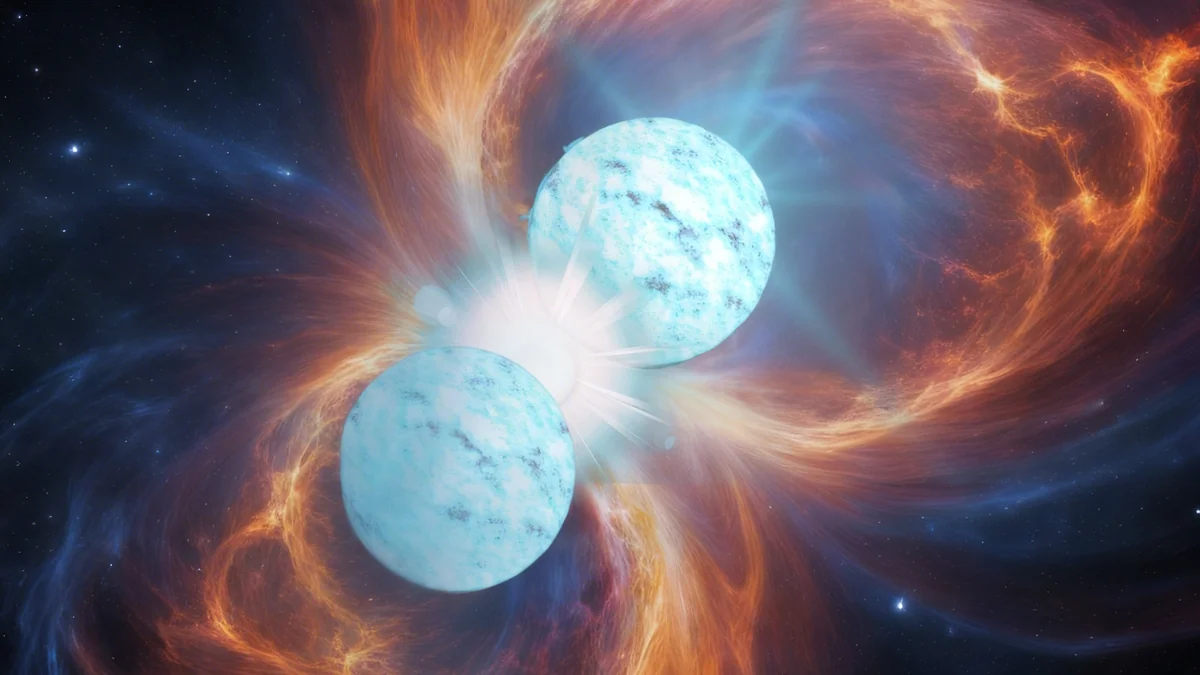
- Neutron Star Mergers: A shorter-duration GRB can happen when two super-dense neutron stars, the remnants of dead stars, spiral into each other and merge. This cataclysmic collision also forms a black hole and emits a burst of gamma rays.
Neither of these processes can sustain a jet for seven hours, pushing researchers to explore more exotic possibilities.
A Record-Shattering Event
GRB 250702B's duration of 7 hours is more than 60% longer than the previous record. For context, an average long GRB lasts for about 30 seconds. This new event lasted nearly 850 times longer than average.
A New Theory: The Helium Merger
To explain the marathon explosion, Neights and her colleagues have proposed a 'helium merger' model. This scenario involves a binary system containing a stellar-mass black hole and a special type of companion star known as a helium star.
A helium star is the dense core of a massive star that has already had its outer layers of hydrogen stripped away. These stars can go through phases of expansion. According to the theory, as the helium star expanded, it engulfed its orbiting black hole companion.
Once inside the star, the black hole began to rapidly consume material from the core. This process transferred an immense amount of angular momentum to the black hole, powering a sustained jet that punched its way out of the star and produced the long-lasting gamma-ray burst.
"Suddenly, you have all of this angular momentum being transferred into the black hole, which can give rise to a jet which lasts a long time," Neights noted, explaining why this model fits the observation so well.
Why Are These Events So Rare?
The discovery of GRB 250702B raises a critical question: if these events happen, why have we not seen more of them?
Researchers suggest two main reasons. First, the specific conditions required for a helium merger may be less common than those for other types of GRBs. The binary system must have the right combination of masses and orbital distance for the event to occur.
Second, these extremely long bursts are inherently difficult to detect. Most survey telescopes are optimized to find short, bright flashes against the background noise of space. A dimmer, more prolonged signal can be easily missed or misidentified.
"They’re also dimmer, which limits the distance we can detect them over," Neights added, highlighting the observational challenges.
Future Telescopes and New Discoveries
The scientific community is now looking ahead to new instruments that could help find more of these rare events. Neights is involved with the upcoming Compton Spectrometer and Imager (COSI) telescope, a gamma-ray survey mission scheduled for launch in 2027.
A key goal is to ensure that COSI's software and detection protocols are equipped to identify these unusual, long-duration signals. By specifically searching for these marathon bursts, astronomers hope to determine how frequently they occur and build a more complete picture of the violent ways stars can die.
The discovery of GRB 250702B has opened a new window into the extreme physics of the cosmos, reminding us that the universe still holds profound surprises.