
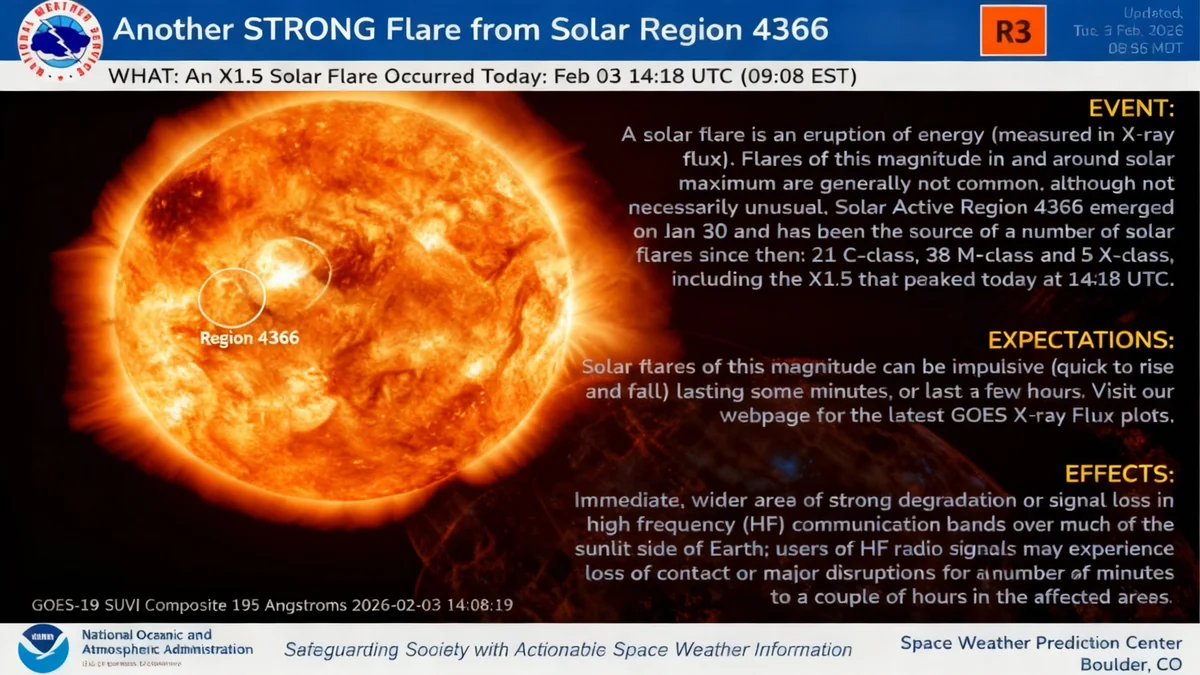

An unusually active region on the Sun, identified as Active Region 4366, has produced another powerful solar flare. The event, classified as an X1.5 flare, peaked on Tuesday, February 3, 2026, at approximately 14:18 Coordinated Universal Time (UTC). This marks the fifth X-class flare from this single, volatile sunspot region since it appeared on the solar disk.
This latest eruption continues a period of intense solar activity that has put space weather forecasters on alert. The region is being closely watched for its potential to affect Earth-based technologies and satellite operations, particularly following an even stronger flare days earlier that hurled a cloud of plasma toward our planet.
Key Takeaways
- A powerful X1.5 solar flare was released from Active Region 4366 on February 3rd.
- This sunspot has been extraordinarily active, producing 5 X-class flares, 38 M-class flares, and 21 C-class flares since January 30th.
- A Coronal Mass Ejection (CME) from a previous X8.1 flare on February 1st may have a minor impact on Earth around February 5th-6th.
- Experts at the Space Weather Prediction Center (SWPC) are continuously monitoring the region.
A Hyperactive Solar Region
Active Region 4366 has proven to be a significant source of solar activity since it rotated into view on January 30th. In less than a week, its magnetic complexity has generated a remarkable number of solar events, making it one of the most active sunspots of the current solar cycle.
The frequency and intensity of its output are notable. While smaller C-class and M-class flares are relatively common, producing five X-class flares in such a short period is exceptional. X-class flares are the most powerful category of solar eruptions, capable of causing widespread radio blackouts and long-lasting radiation storms.
AR 4366 Activity Log (Since Jan 30)
- X-class Flares: 5
- M-class Flares: 38
- C-class Flares: 21
This high level of activity highlights the dynamic and unpredictable nature of our Sun as it approaches the peak of its current cycle.
Understanding Solar Flare Classification
Solar flares are immense explosions on the Sun's surface, releasing energy, light, and high-speed particles into space. They are categorized by their intensity, measured in watts per square meter.
The ABCs of Solar Flares
Scientists use a classification system to grade the strength of solar flares. The main classes are A, B, C, M, and X.
- C-class: Minor flares with few noticeable effects on Earth.
- M-class: Medium-sized flares that can cause brief radio blackouts at the poles and minor radiation storms.
- X-class: The most intense flares. They can trigger planet-wide radio blackouts and significant radiation storms.
Within each class, numbers from 1 to 9 provide a finer scale of intensity. An X2 flare is twice as powerful as an X1, and an X10 is ten times as powerful.
The recent X1.5 flare is considered a strong event. The most powerful flare from this region, an X8.1 recorded on February 1st, was more than five times stronger and had a more significant consequence: a Coronal Mass Ejection.
Potential Impacts on Earth
While the latest X1.5 flare was not aimed directly at Earth, the earlier X8.1 flare on February 1st was accompanied by a Coronal Mass Ejection (CME). A CME is a massive eruption of solar plasma and magnetic fields from the Sun's corona that travels through space.
When a CME strikes Earth, it can interact with our planet's magnetic field, causing geomagnetic storms. These storms can have several effects:
- Vibrant Auroras: The Northern and Southern Lights can become much more intense and visible at lower latitudes than usual.
- Satellite Disruptions: The charged particles can interfere with satellite electronics, affecting GPS, communications, and weather forecasting.
- Power Grid Fluctuations: Strong geomagnetic storms can induce currents in power lines, potentially threatening grid stability.
- Radio Blackouts: High-frequency radio communications, used by airlines and amateur radio operators, can be disrupted.
Forecasters predict that the CME from the February 1st event will deliver a "glancing blow" to Earth's magnetic field between February 5th and 6th. This means the main force of the plasma cloud will likely miss our planet, resulting in minor to moderate effects rather than a major geomagnetic storm.
Continuous Monitoring is Key
Agencies like the U.S. Space Weather Prediction Center (SWPC) play a critical role in monitoring the Sun. Using a network of ground-based and space-based observatories, they track active regions like 4366 around the clock.
"Given the sustained activity from this region, we are maintaining a close watch," an SWPC statement noted. "Our forecasts provide crucial early warnings to satellite operators, power grid managers, and airlines to help them mitigate potential impacts from space weather events."
As long as Active Region 4366 remains on the Earth-facing side of the Sun, the potential for further strong flares and CMEs remains elevated. Experts will continue to analyze data from solar observatories to predict its behavior and issue alerts as needed. For now, the focus remains on the incoming CME and the continued volatility of this powerful sunspot.