

Skywatchers across the globe were treated to a spectacular celestial event as February's full moon, known as the Snow Moon, reached its peak brightness. The lunar disk appeared opposite the sun, flooding the night sky with its light and providing a stunning subject for photographers from the Italian Alps to the cityscapes of North America.
The event coincided with the aftermath of severe winter weather in parts of the United States, a fitting backdrop for a moon named after the season's heavy snowfall. The full moon officially occurred in the early hours of February 1, but its bright, full appearance will continue to dominate the night sky for several subsequent days.
Key Takeaways
- February's full moon, the Snow Moon, reached its peak illumination on February 1.
- Photographers and stargazers captured stunning images of the event from multiple continents.
- Notable photographs include the moon rising over the Italian Alps, Panama City, and NASA's Artemis 2 rocket.
- The name 'Snow Moon' is traditionally linked to the heavy snowfall common in February in the Northern Hemisphere.
- The next full moon, the Worm Moon in March, will feature a total lunar eclipse.
A Celestial Event with Earthly Names
The full moon of February is traditionally called the Snow Moon. This name originates from Native American and colonial European traditions, reflecting the heavy snowfall that often characterizes this month in the Northern Hemisphere. As the moon climbed into the sky, it was positioned among the stars of the constellation Leo, the lion.
This celestial alignment occurs when the moon is on the opposite side of Earth from the sun, allowing its entire face to be illuminated. While the peak fullness is a specific moment, the moon appears full to the naked eye for about three days, giving observers a wide window to enjoy the view.
The appearance of the moon can vary depending on its position in the sky. When it is low on the horizon, atmospheric scattering causes it to take on a yellowish or orange hue. This happens because Earth's atmosphere scatters shorter, blue wavelengths of light while allowing longer, redder wavelengths to pass through to the observer's eye.
A Gallery of Global Views
The Snow Moon's journey across the night sky was documented by photographers worldwide, each capturing a unique perspective of the lunar display. The images highlight how the same celestial object can appear vastly different depending on the terrestrial landscape it accompanies.
European Vistas
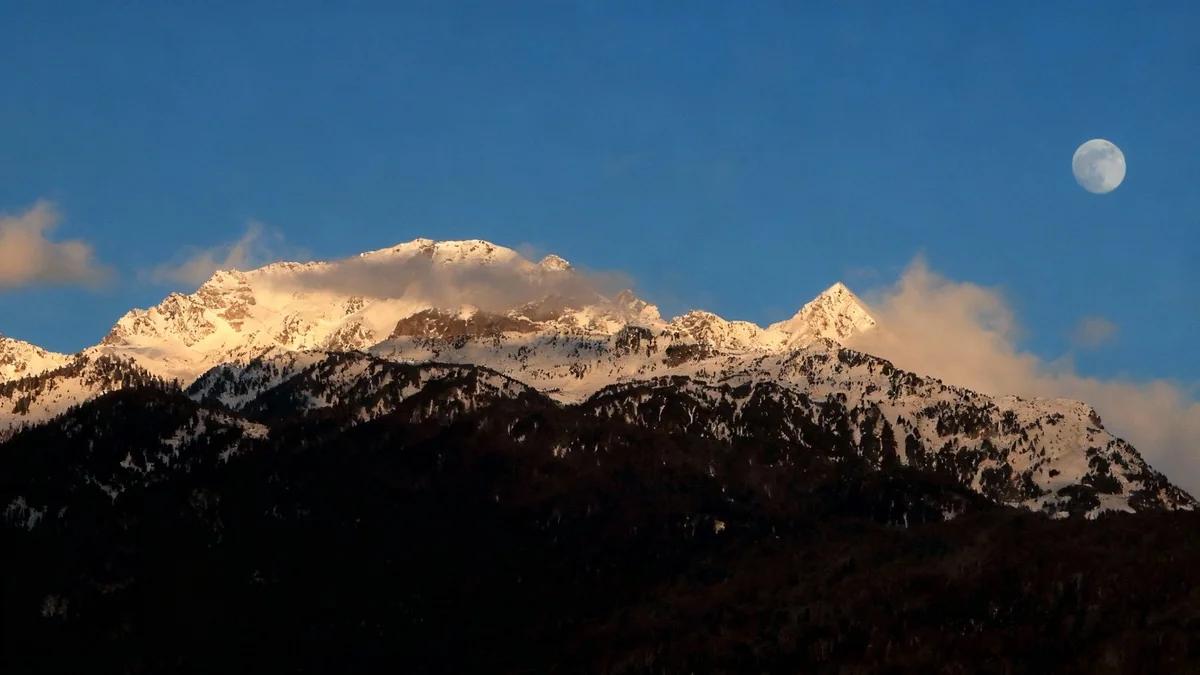
In Northern Italy, photographer Michael Heiman captured the moon as it hung above the snow-dusted slopes of the Italian Alps near the town of Tirano. The image, taken just before sunset on January 31, showcases the moon's golden glow against the fading daylight.
A few hundred miles east, Mattia Ozbot photographed the moon rising behind a hill lined with evergreen trees in Cortina D'Ampezzo, its bright disk peeking through the winter landscape. In Venice, Lorenzo Di Cola framed the moon perfectly above the iconic dome of the Santa Maria della Salute Church, its yellowish color intensified by its low position in the sky.
Further east in Albania, Vlasov Sulaj snapped a dramatic shot of the moon above the dark silhouette of Mount Dajti near the capital city of Tirana, providing a stark contrast between the bright lunar surface and the rugged mountain terrain.
Photographing the Moon
Astrophotography enthusiasts often use long-focus lenses or telescopes to capture detailed images of the moon. Factors like atmospheric clarity, location, and the moon's phase play a crucial role. For those new to the hobby, modern smartphone apps can help predict the moon's position and rise times, making it easier to plan the perfect shot.
American Skylines and Landscapes
Across the Atlantic, the Snow Moon made equally impressive appearances. In Panama City, photographer Martin Bernetti captured two distinct views: a close-up of the moon shining through thin clouds and a wide-angle shot where it backlit the clouds above the city's illuminated skyscrapers.
In the United States, a particularly symbolic image was captured by Miguel J. Rodriguez Carrillo at NASA's Kennedy Space Center in Florida. The Snow Moon was pictured shining directly over the Space Launch System (SLS) rocket for the Artemis 2 mission. This rocket is slated to carry astronauts on a journey around the moon, the first such crewed mission in over 50 years.
"The skies were amazingly clear, allowing for a lot of detail. However, there was no snow in sight," photographer Greg Gage noted after capturing the moon over the Little Florida Mountains in New Mexico.
Gage's image revealed the dark lunar maria, or ancient volcanic plains, on the moon's surface. Meanwhile, in San Mateo, California, Tayfun Coskun captured a perfectly timed photograph of a passenger airplane crossing the face of the hazy full moon shortly after takeoff.
In Canada, Mert Alper Dervis photographed the Snow Moon rising over the bustling Toronto skyline, with the iconic CN Tower silhouetted to its left, blending the natural satellite with modern architectural achievements.
Looking Ahead to the Next Lunar Event
For those who missed the Snow Moon or are eager for the next celestial show, the upcoming full moon in March promises another remarkable event. The March full moon, known as the Worm Moon, will occur on March 3.
Upcoming: The Worm Moon and a 'Blood Moon' Eclipse
- Next Full Moon: March 3
- Name: Worm Moon
- Special Event: Total Lunar Eclipse
- Phenomenon: The eclipse will turn the moon a reddish color, an event often called a "Blood Moon."
This event will be particularly special as it will coincide with a total lunar eclipse. During this eclipse, Earth will pass directly between the sun and the moon, casting its shadow over the lunar surface. The Earth's atmosphere will filter the sunlight, scattering the blue light and refracting red light onto the moon, giving it a dramatic reddish appearance. This phenomenon is popularly known as a "Blood Moon" and is one of the most anticipated astronomical events for skywatchers.
As technology makes astrophotography more accessible, more people than ever are capturing and sharing these beautiful moments, connecting us all under the same sky. Whether with a professional camera or a simple smartphone, looking up at the moon remains a universal human experience.