

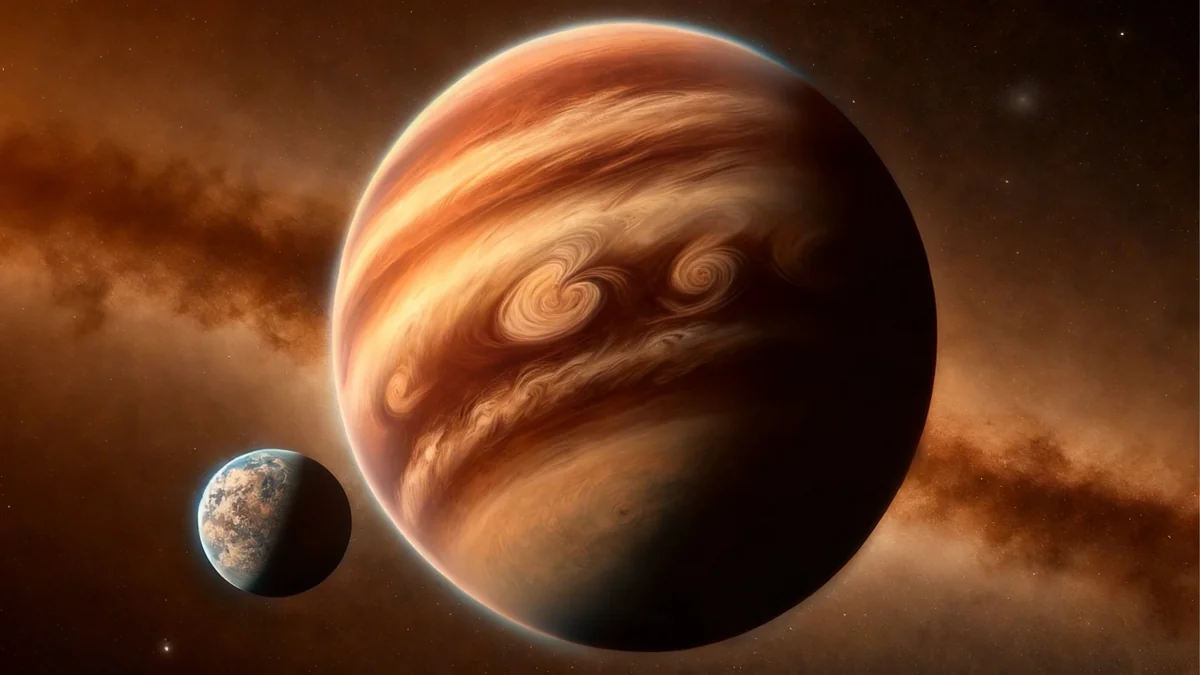

A faint signal discovered in archival telescope data has revealed a potential planet, HD 137010 b, located 146 light-years from our solar system. This celestial body shows remarkable similarities to Earth in size and orbital period, orbiting a star much like our own sun.
Published in The Astrophysical Journal Letters, the study details a world just six percent larger than Earth with a year lasting 355 days. While these characteristics are striking, the planet is believed to be an extremely cold world, raising questions about its potential to support life.
Key Takeaways
- A new exoplanet candidate, HD 137010 b, has been identified 146 light-years away.
- The planet is only 6% larger than Earth and has a 355-day year, closely mirroring our own.
- It orbits a sun-like star but receives significantly less energy, resulting in surface temperatures around -70° Celsius.
- Scientists believe a dense, carbon dioxide-rich atmosphere could potentially warm the surface enough to support liquid water.
- The discovery was made by citizen scientists using old data from the Kepler space telescope.
A Striking Resemblance to Home
In the vast catalogue of over 6,000 known exoplanets, finding one that mirrors Earth is exceptionally rare. Most distant worlds are gas giants or scorching hot planets orbiting perilously close to their stars. However, HD 137010 b stands out as a compelling candidate for an Earth-like world.
Its size is nearly identical to our own planet, a feature that immediately captured the attention of astronomers. Furthermore, its 355-day journey around its parent star is just ten days shorter than an Earth year. This orbital resonance is a significant finding, as it places the planet in a stable, predictable path.
The planet's star is also similar to our sun, though it is about 1,000 degrees cooler and emits considerably less light. This detail is crucial for understanding the conditions on the planet's surface.
By the Numbers: HD 137010 b
- Distance from Earth: 146 light-years
- Size Comparison: ~6% larger than Earth
- Orbital Period (Year): 355 days
- Estimated Surface Temperature: -68° to -70° Celsius
- Energy Received from Star: Less than 33% of what Earth receives
An Icy World on the Habitable Fringe
Despite its Earth-like size and year, HD 137010 b is far from a tropical paradise. Due to its star's lower luminosity, the planet receives less than a third of the solar energy that Earth does. This energy deficit results in a frigid surface, with temperatures estimated to hover around a harsh -70 degrees Celsius.
These conditions place the planet at the very outer edge of its star's habitable zone—the region where temperatures could theoretically allow liquid water to exist on a planet's surface. In its current state, HD 137010 b is likely a frozen world, covered in ice.
The Greenhouse Effect Hypothesis
Researchers suggest that the planet is not necessarily a lifeless ice ball. Climate models indicate that if HD 137010 b possesses a dense atmosphere with high concentrations of carbon dioxide, a powerful greenhouse effect could occur. This process would trap heat and could raise surface temperatures significantly, potentially enough for liquid water to form, at least temporarily. This possibility keeps the planet in the conversation about potentially habitable worlds.
A Citizen Science Discovery
The initial clue to this planet's existence did not come from a major observatory's latest survey but from the efforts of volunteers. The citizen science project, known as "Planet Hunters," enlists the public to sift through vast amounts of data from space telescopes, searching for signals that automated systems might have missed.
Volunteers analyzed archival data from NASA's Kepler space telescope, which monitored hundreds of thousands of stars between 2009 and 2018. In 2017, Kepler recorded a single, subtle dimming of the star HD 137010 that lasted for approximately 10 hours. This event, known as a transit, is the tell-tale sign of a planet passing in front of its star.
"Normally, several such transits are necessary to detect a planet beyond doubt. However, the researchers were able to draw conclusions about the size and orbital period from the duration and depth of this single signal," explained an international team led by Alexander Venner, formerly of the University of Southern Queensland and now at the Max Planck Institute for Astronomy.
Because only one transit has been observed, HD 137010 b remains officially classified as a planet candidate. Confirmation will require observing at least one more transit, a challenging task given its nearly year-long orbit means such events are rare.
Why This Planet Matters for Science
The potential discovery of HD 137010 b is significant not just for its similarities to Earth, but for its relative proximity. At 146 light-years away, it is considered close on a cosmic scale. This makes it an ideal target for study with next-generation telescopes.
If the planet is confirmed, scientists will be eager to analyze its atmosphere. Future observations could search for biosignatures—gases like oxygen or methane that could indicate the presence of biological processes. Its bright parent star would make such atmospheric studies easier compared to other distant exoplanets.
While this distant world offers a tantalizing glimpse of a potential second Earth, it remains firmly out of our physical reach. Current technology would require tens of thousands, if not hundreds of thousands, of years to travel there. For now, it serves as a crucial target for understanding how many other Earth-like planets might exist in our galaxy.