

Scientists have detected the largest sulfur-bearing organic molecule ever found in interstellar space, a 13-atom structure located 27,000 light-years from Earth. The discovery provides a crucial link in understanding how the chemical ingredients for life may have formed in the cosmos and eventually arrived on our planet.
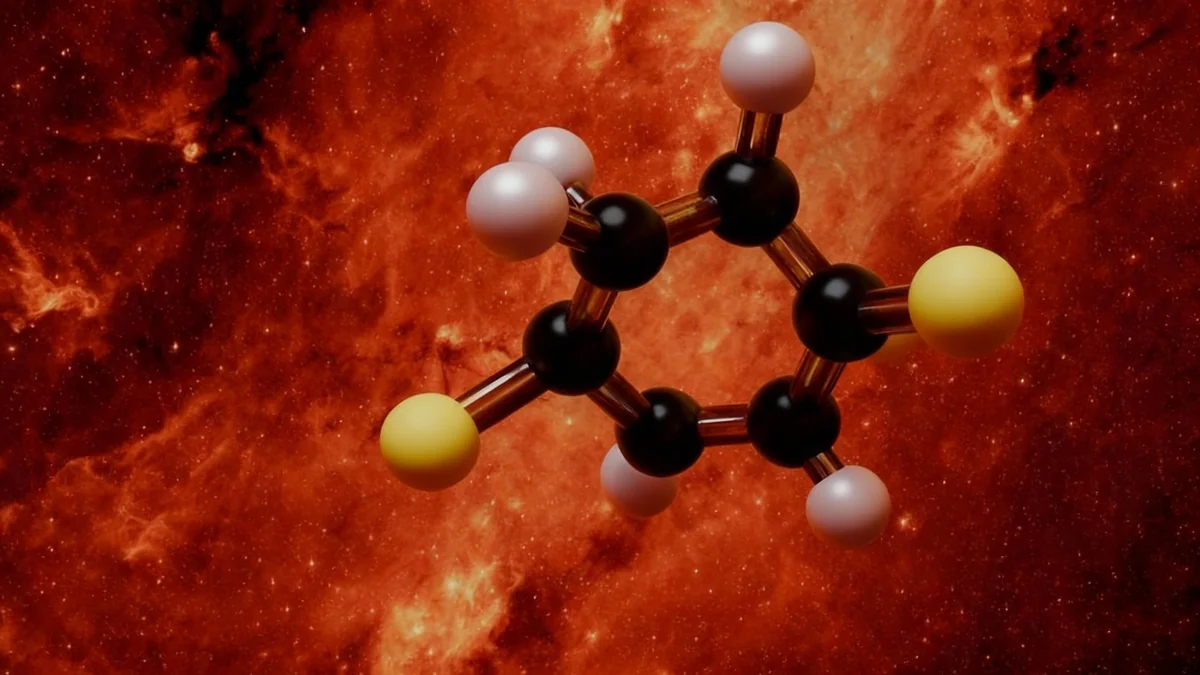
The molecule, identified as 2,5-cyclohexadiene-1-thione, was discovered in a dense cloud of gas and dust near the center of the Milky Way. This finding helps solve a long-standing puzzle about the apparent scarcity of large sulfur molecules in space, despite sulfur being a vital element for life as we know it.
Key Takeaways
- A 13-atom molecule containing sulfur, carbon, and hydrogen has been identified in a molecular cloud for the first time.
- This is the largest sulfur-bearing molecule ever detected in interstellar space, significantly larger than the previous record-holder of nine atoms.
- The discovery was made in the molecular cloud G+0.693–0.027, a stellar nursery near the galactic center.
- This finding helps bridge the gap between simple molecules found in space and the more complex organic compounds found in meteorites, which are thought to have seeded early Earth with life's building blocks.
A Cosmic Detective Story
For years, astronomers have been puzzled by a cosmic inconsistency. Sulfur is the tenth most abundant element in the universe and a critical component of life on Earth, forming essential amino acids and proteins. While sulfur compounds are commonly found in meteorites and comets, their larger molecular forms have been mysteriously absent in the vast interstellar clouds where stars and planets are born.
This new detection offers a significant clue. Researchers from the Max Planck Institute for Extraterrestrial Physics identified the complex molecule by first creating it in a laboratory. By passing an electric discharge through a substance called thiophenol, they were able to map the molecule's unique radio signature.
Armed with this 'radio fingerprint,' the team scanned archival data from the IRAM-30m and Yebes radio telescopes in Spain. They found a perfect match in observations of a molecular cloud named G+0.693–0.027, confirming the molecule's presence in deep space.
By the Numbers
- 13 atoms: The size of the newly discovered molecule.
- 9 atoms: The size of the previous largest sulfur molecule found in space.
- 27,000 light-years: The approximate distance from Earth to the molecular cloud where the molecule was found.
- Over 300: The number of different molecules now identified in interstellar space.
The Significance of Sulfur
The discovery of 2,5-cyclohexadiene-1-thione is more than just a new entry in the catalog of cosmic molecules. It represents a key step in understanding prebiotic chemistry—the processes that led to the emergence of life.
Mitsunori Araki, lead author of the study published in Nature Astronomy, highlighted the molecule's importance. "This is the largest sulfur-bearing molecule ever found in space," he explained. "Before this one, the largest only had nine atoms, but it was already a rare case, because most detected sulfur-bearing molecules only had three, four, or five atoms."
"Sulfur came to Earth from space long, long ago. However, we have only found a very limited amount of sulfur-bearing molecules in space, which is strange. It should exist in huge amounts, but it’s very difficult to find."
The finding suggests that previous searches may have been looking for simpler structures, and that much larger, more complex sulfur compounds could be widespread but hidden. Some theories propose that sulfur is trapped within cosmic ice grains, which would explain why it has been so elusive.
From Stellar Nurseries to Planets
The molecule was located in what is known as a molecular cloud. These are immense, cold, and dense regions of gas and dust that serve as the birthplaces of stars and planetary systems. It is within these cosmic nurseries that simple atoms combine to form the complex molecules that eventually become part of new worlds.
What Are Molecular Clouds?
Molecular clouds are interstellar clouds whose size, density, and low temperature allow for the formation of molecules, most commonly molecular hydrogen (H2). Gravity causes clumps within these clouds to collapse, forming protostars. The remaining material forms a disk around the new star, from which planets, asteroids, and comets can form. They are essentially the chemical factories of the galaxy.
Valerio Lattanzi, a co-author of the study, described the process. "The ingredients that are embedded in the molecular cloud will be transferred to the planets," he said. "We are trying to find out what the ingredients that will eventually form life are, trying to understand how from simple molecules we get to life as we know it on Earth."
The prevailing theory is that comets and meteorites delivered these essential organic materials, including sulfur compounds, to a young Earth billions of years ago. Finding a large, complex molecule like this one in a stellar nursery strengthens the connection between the chemistry of deep space and the origins of life in our own solar system.
Implications for Life Elsewhere
This discovery has excited scientists both within and outside the research team. It not only fills a gap in our understanding of our own origins but also broadens the possibilities for life elsewhere in the universe.
Sara Russell, a professor of planetary sciences at the Natural History Museum in London who was not involved in the study, noted the broader implications. "The presence of complex organic molecules in the centre of our Milky Way implies that biologically important materials may be everywhere in space," she commented. This makes the prospect of life on other planets slightly more probable.
Ryan Fortenberry, an associate professor of chemistry at the University of Mississippi, emphasized sulfur's unique chemical properties. He explained that sulfur's position on the periodic table allows it to form molecules with capabilities beyond what carbon, oxygen, and nitrogen alone can achieve.
"Finding molecules with sulfur in them helps us to better gauge where life could’ve started, and where it could end up," Fortenberry stated. The resilience of such a large molecule in the harsh environment of space challenges previous assumptions and shows that cosmic chemistry is far more complex than once imagined. With increasingly powerful telescopes, scientists are hopeful that even more complex molecules, perhaps even amino acids, will be detected beyond our solar system in the near future.