


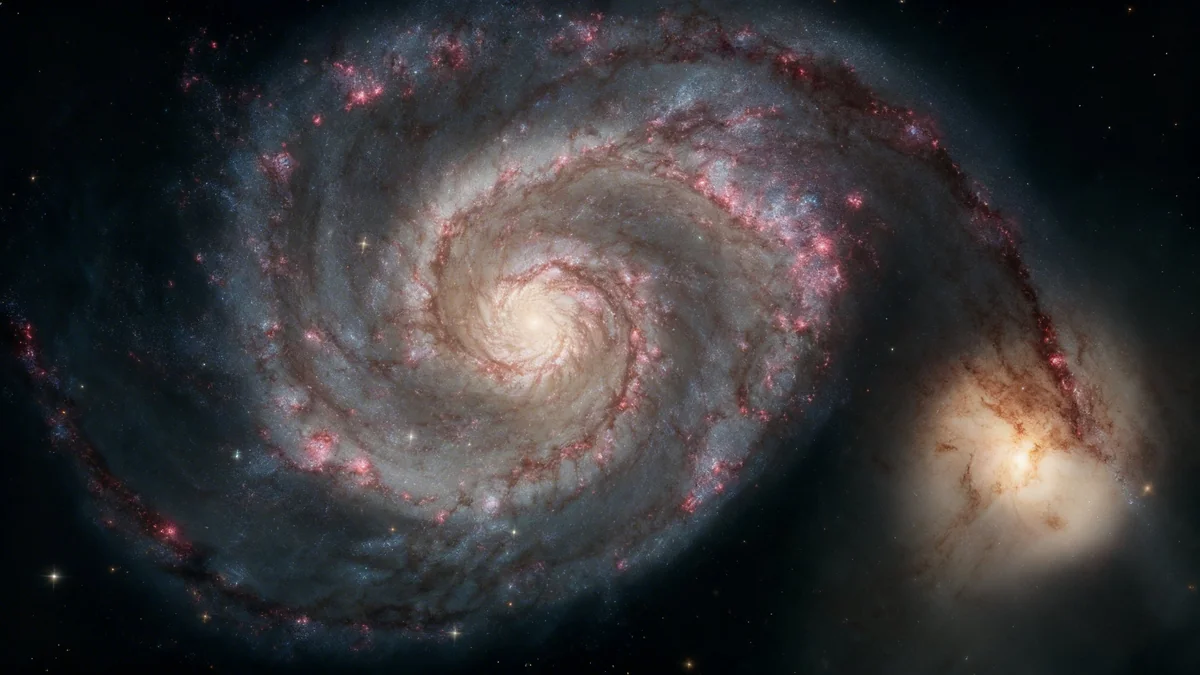
The European Space Agency's Euclid telescope has released a striking new image of a distant spiral galaxy, offering another glimpse into the observatory's powerful capabilities. The image features the galaxy NGC 646, located approximately 392 million light-years from Earth, as part of the telescope's ongoing mission to map the universe and unravel the mysteries of dark matter and dark energy.
Key Takeaways
- The Euclid telescope captured a detailed image of the spiral galaxy NGC 646.
- The galaxy is 392 million light-years away and moving away from Earth at over 5,000 miles per second.
- The image also shows another galaxy, PGC 6014, which appears close but is actually 45 million light-years nearer to us.
- Euclid's primary mission is to study dark matter and dark energy by mapping billions of galaxies.
- The first major data release from the telescope is expected next year.
A New Cosmic Portrait
The latest image from the Euclid mission showcases NGC 646, an elegant spiral galaxy draped across the blackness of space. The photograph reveals the galaxy's structure in remarkable detail, highlighting its swirling arms filled with countless stars. This celestial object is not static; it is receding from our planet at a tremendous speed, calculated to be more than 5,000 miles per second.
Launched in 2023, the Euclid telescope is on a six-year journey to create the largest and most accurate 3D map of the universe. By observing galaxies up to 10 billion light-years away, scientists aim to understand how the cosmos has expanded and how its large-scale structure has evolved over time. This new image of NGC 646 serves as a preview of the quality and depth of data the mission will provide.
Understanding Dark Matter and Dark Energy
Euclid's mission is focused on two of the biggest puzzles in modern physics. Dark matter is an invisible substance that doesn't emit light but has a gravitational pull, which is essential for holding galaxies together. Dark energy is a mysterious force believed to be responsible for the accelerating expansion of the universe. By mapping the distribution of galaxies, Euclid will help scientists infer the presence and effects of these unseen components.
An Optical Illusion in Deep Space
One of the most intriguing aspects of the new image is the presence of a second, smaller galaxy. Appearing near the left edge of NGC 646 is a galaxy identified as PGC 6014. At first glance, the two appear to be interacting or perhaps in the process of merging.
However, this apparent closeness is merely a trick of perspective. Astronomers have confirmed that the two galaxies are separated by a vast distance. PGC 6014 is actually about 45 million light-years closer to Earth than NGC 646. This alignment, a chance line-of-sight effect, underscores the challenges and wonders of observing a three-dimensional universe from our two-dimensional viewpoint.
Euclid's Mission by the Numbers
- Mission Duration: 6 years
- Observation Range: Up to 10 billion light-years
- Target Galaxies: Billions
- NGC 646 Distance: 392 million light-years
- PGC 6014 Distance Difference: 45 million light-years closer than NGC 646
The Broader Scientific Goal
The image of NGC 646 is more than just a beautiful astronomical photograph; it is a testament to the telescope's scientific purpose. The Euclid mission aims to address fundamental questions about the cosmos. By precisely measuring the shapes and positions of billions of galaxies, scientists can trace the influence of gravity and, by extension, the distribution of dark matter.
"Each image from Euclid is not just a picture, but a piece of a much larger puzzle about the universe's structure and history. We are building a map that will allow us to see the unseen architecture of the cosmos, shaped by dark matter and stretched apart by dark energy."
The data will also help refine our understanding of dark energy. By observing how clusters of galaxies have formed and spread out over cosmic history, researchers can study the effects of this accelerating expansion. The mission's findings could potentially confirm our current cosmological models or point toward new physics.
What's Next for the Euclid Mission
While teaser images like this one generate excitement, the main scientific work is set to begin in earnest. The Euclid team is preparing for its first major data release, scheduled for next year. This initial batch of information will cover approximately 14 percent of the telescope's total planned survey area.
This release will provide astronomers worldwide with an unprecedented dataset to begin their investigations into galaxy evolution, cosmology, and the fundamental nature of the universe. As Euclid continues its six-year survey, it will steadily build a cosmic map of unparalleled scale and precision, promising to reshape our understanding of the universe for decades to come.