

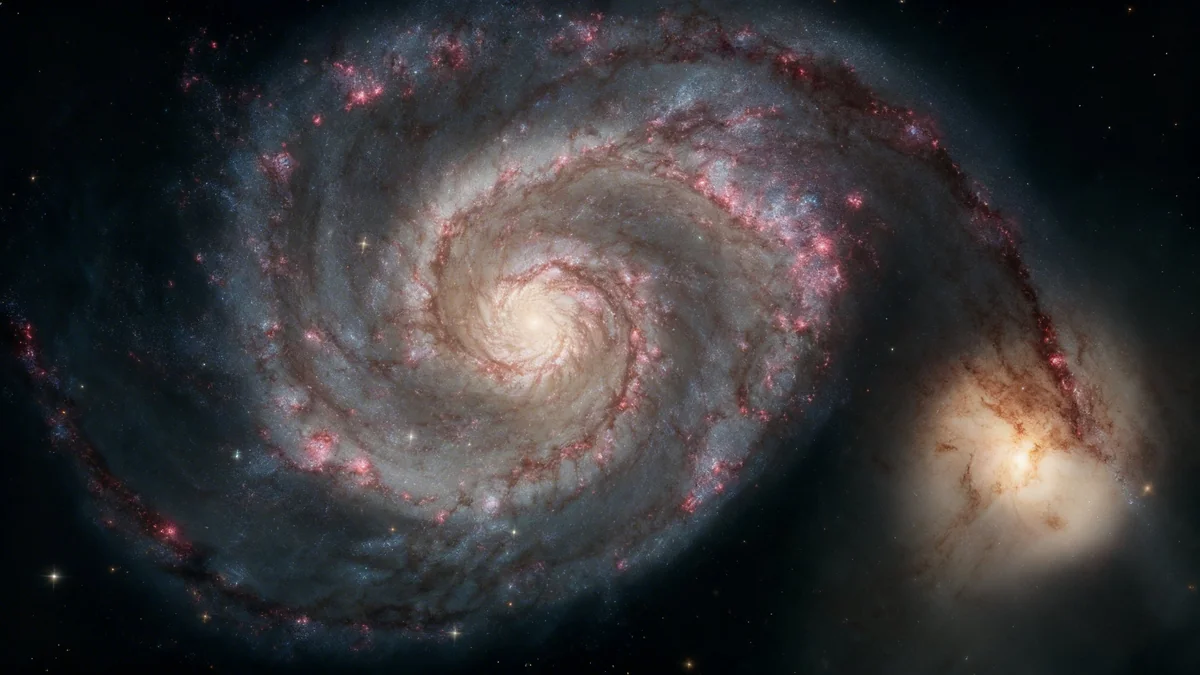
The Hubble Space Telescope has captured a detailed image of the spiral galaxy NGC 6000, located 102 million light-years away. While the primary mission was to observe the remnants of past supernovas, the resulting photograph not only illustrates the life cycle of stars through color but also features the unexpected trail of an asteroid passing through the field of view.
Key Takeaways
- A recent Hubble image of galaxy NGC 6000 shows the different ages of its star populations.
- The galaxy's yellow core contains older, cooler stars, while its blue spiral arms host younger, hotter stars.
- The telescope inadvertently captured the path of an asteroid, which appears as four distinct streaks of light.
- Hubble was originally observing the area to study the faint afterglow of two supernovas from 2007 and 2010.
A Cosmic Tale of Two Colors
The image of NGC 6000 serves as a visual map of stellar evolution. The distinct colors within the galaxy provide astronomers with crucial information about the age, mass, and temperature of its stars. This technique allows scientists to understand the history and structure of distant galaxies without observing individual stars directly.
The Old and the New
At the center of NGC 6000, a dense cluster of stars emits a prominent yellow glow. This light comes from an older population of stars that are relatively cool and smaller in size. These stars have been burning for billions of years, gradually consuming their fuel.
In contrast, the galaxy's sprawling spiral arms are painted in vibrant shades of blue. This blue light is the signature of massive, young, and extremely hot stars. These are cosmic newborns, having formed much more recently in the galaxy's active star-forming regions.
Understanding Stellar Color and Temperature
In astronomy, a star's color is a direct indicator of its surface temperature. The hottest and most massive stars burn with a brilliant blue or white light, while cooler, less massive stars appear yellow, orange, or red. This principle is fundamental to studying stellar populations in distant galaxies.
A Mission to Find Fading Explosions
The observation of NGC 6000 was part of a larger project to study the aftermath of supernova explosions. Hubble was specifically tasked with targeting the locations of two past events, SN 2007ch and SN 2010as, which were stellar explosions that occurred in 2007 and 2010, respectively. The goal was to study the faint, lingering glow from these cataclysmic events.
This specific objective explains the image's framing, which appears slightly off-center and incomplete. The telescope was focused on a particular region of the galaxy relevant to the supernova search rather than capturing a perfectly composed portrait of the entire structure.
NGC 6000 Quick Facts
- Type: Barred Spiral Galaxy
- Constellation: Scorpius
- Distance: Approximately 102 million light-years from Earth
- Visibility: Best viewed from the Southern Hemisphere with a large-aperture telescope.
An Unforeseen Visitor
While conducting its primary mission, Hubble captured something much closer to home. On the right side of the image, four faint, broken lines are visible against the backdrop of deep space. These streaks are not distant cosmic phenomena but the trail of a single asteroid from our own solar system that drifted across the telescope's line of sight.
Why the Asteroid Appears as Broken Lines
The image of NGC 6000 is a composite, created by combining four separate long-exposure shots. As Hubble stared at the distant galaxy, the nearby asteroid moved across its field of view, leaving a trail in each of the four exposures. This created the appearance of four distinct segments of light.
Furthermore, the streaks show different colors. The lines appear red and blue because Hubble's camera used different color filters for the exposures. Astronomers use these filters to isolate specific wavelengths of light, which helps them analyze the properties of celestial objects, such as the temperature and composition of stars. In this case, it also color-coded the path of the passing asteroid.
How to Spot NGC 6000
While Hubble provides a stunning view, NGC 6000 is also an object of interest for amateur astronomers. The galaxy is located in the constellation Scorpius, which is visible during the summer from the Northern Hemisphere. However, its position south of the celestial equator makes it a much easier target for observers in the Southern Hemisphere.
Viewing this distant galaxy is a challenge. According to The Sky Live, it requires a dark sky, far from city light pollution, and a telescope with an aperture of at least 10 inches. Even with the right equipment, it will appear as a faint, hazy patch of light to the human eye, a stark contrast to the detailed and colorful image captured by the Hubble Space Telescope.