
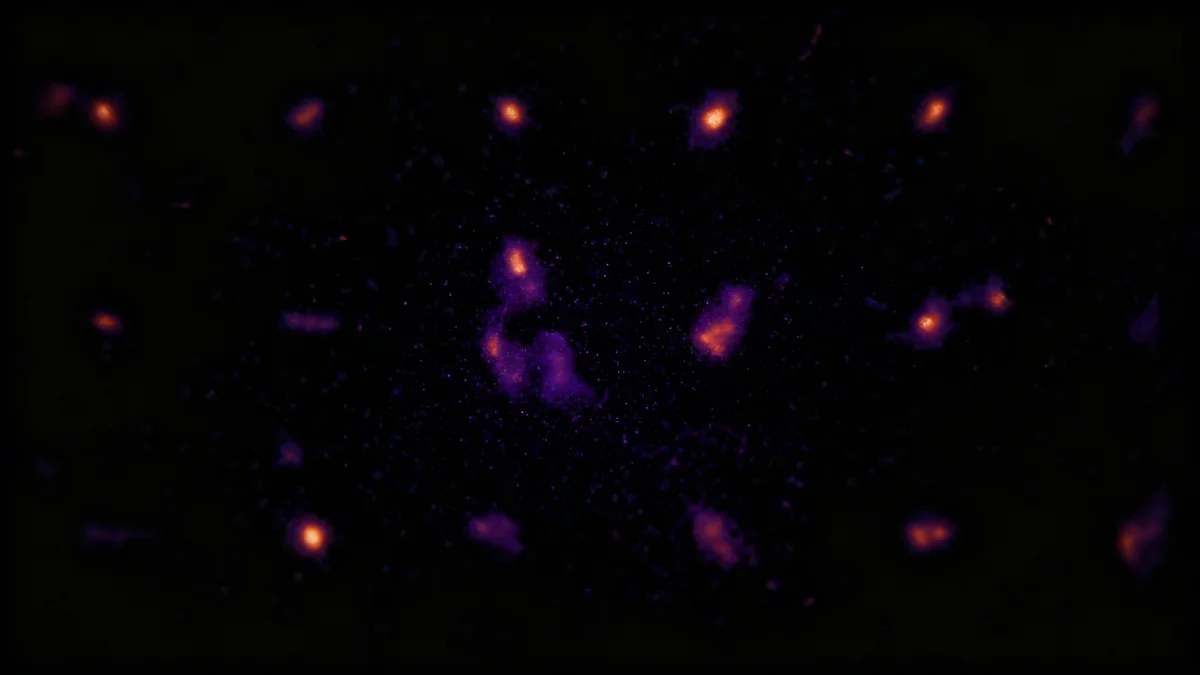

Astronomers using the James Webb Space Telescope have found that some of the universe's earliest galaxies grew up far more quickly than previously believed. A detailed study of 18 galaxies, seen as they were just over a billion years after the Big Bang, reveals they were already chemically and structurally mature, a finding that challenges current models of cosmic evolution.
The observations, made in collaboration with the Hubble Space Telescope and the Atacama Large Millimeter/submillimeter Array, provide an unprecedented look at a crucial period in the universe's history. These young galaxies, located approximately 12.5 billion light-years away, are unexpectedly rich in heavy elements and show structural features once thought to take billions of years to form.
Key Takeaways
- A study of 18 early galaxies reveals they matured much faster than scientific models predicted.
- These galaxies, existing about 1 billion years after the Big Bang, are rich in heavy elements like carbon and oxygen.
- Many of the galaxies already possessed rotating stellar disks, a feature of mature galaxies like the Milky Way.
- The findings suggest the processes of star formation and element production were more efficient in the early universe than previously understood.
A Glimpse into the Cosmic Dawn
Scientists targeted a collection of 18 galaxies undergoing rapid star formation during a key epoch of the universe. At just over one billion years old, the cosmos was thought to be a simpler place, primarily filled with hydrogen and helium, the lightest elements forged in the Big Bang.
Galaxies from this era were expected to be chemically primitive. Heavier elements, which astronomers refer to as "metals," are created inside stars and released when they die. This enrichment process was believed to be gradual, taking many generations of stars over billions of years.
However, the new data paints a different picture. "With this sample, we are uniquely poised to study galaxy evolution during a key epoch in the universe that has been hard to image until now," said Andreas Faisst of the California Institute of Technology (Caltech).
Why Heavy Elements Matter
In astronomy, any element heavier than hydrogen and helium is called a metal. These elements are the building blocks for rocky planets, cosmic dust, and life as we know it. Their presence in the early universe indicates that multiple generations of massive stars had already formed, lived, and died, seeding their galaxies with new material much faster than expected.
Teenagers in a Toddler Universe
The most striking discovery was the advanced chemical state of these galaxies. They contained significant amounts of carbon and oxygen, suggesting an unexpectedly rapid cycle of star birth and death had already taken place.
"It was a surprise to see such chemically mature galaxies. It's like seeing 2-year-old children act like teenagers. How do metals form in less than 1 billion years?"
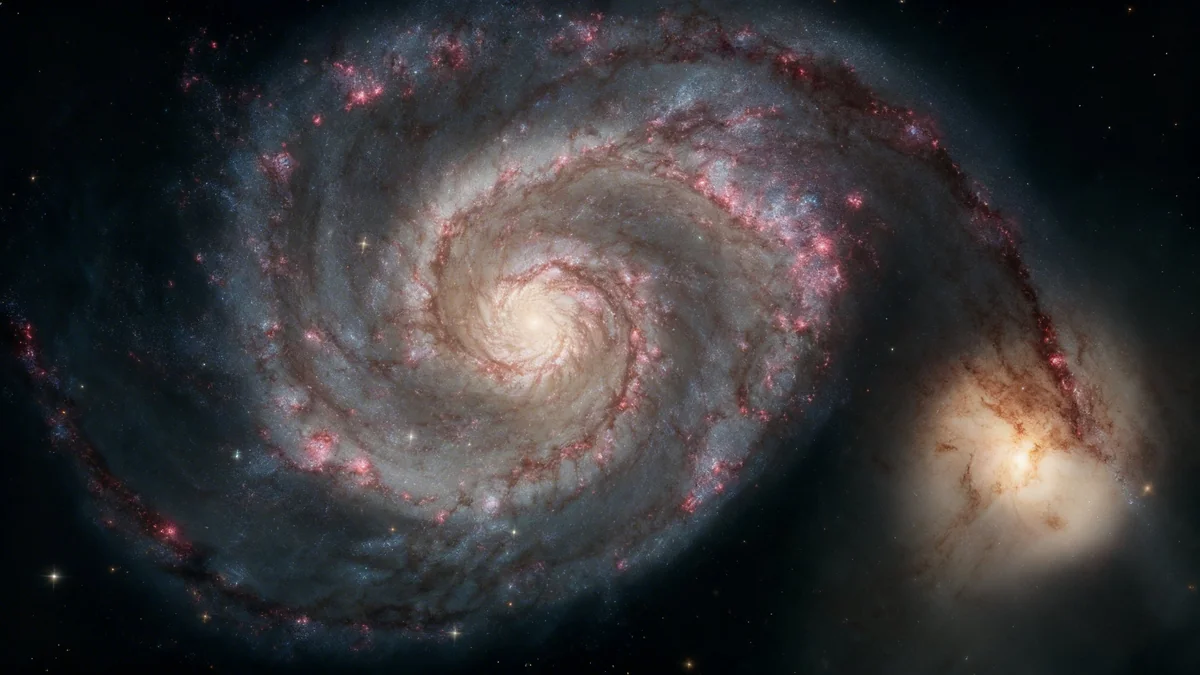
This premature maturity wasn't limited to their chemical composition. Faisst and his colleagues also found that many of the galaxies had developed rotating stellar disks, complex structures similar to the spiral arms of our own Milky Way. Current theories of galaxy formation predicted these features would appear much later in cosmic history.
Furthermore, the supermassive black holes at the centers of these galaxies were found to be actively feeding on surrounding gas and dust. This rapid accretion means the black holes themselves were also growing at an accelerated pace, contributing to the overall swift development of their host galaxies.
Cosmic Growth Spurt
The study revealed a trio of mature characteristics in these early galaxies:
- Chemical Maturity: High levels of heavy elements (metals).
- Structural Maturity: Presence of organized, rotating disks.
- Black Hole Growth: Rapidly accreting supermassive black holes.
An Enriched Galactic Neighborhood
The team's analysis extended beyond the galaxies themselves to the vast, diffuse gas surrounding them, known as the circumgalactic medium. This gas was also found to be surprisingly enriched with heavy elements, indicating that powerful stellar explosions had already ejected these materials far into intergalactic space.
"The galaxies show very flat gradients in their metal abundances, reaching out to more than 30,000 light-years," explained Wuji Wang of Caltech's Infrared Processing & Analysis Center. This suggests the process that distributed these elements was remarkably efficient and widespread even at this early stage.
This finding implies that the first generations of stars were highly effective at polluting their environments with the raw materials needed for future stars and planets.
Rewriting the Story of Galaxy Formation
These observations present a significant puzzle for astrophysicists. The combined chemical and structural maturity of these 18 galaxies suggests that the fundamental processes governing the cosmos may have operated differently or more quickly in the early universe.
The research team now plans to use computer simulations to try and replicate the conditions that could lead to such rapid growth. By comparing their observational data with theoretical models, they hope to gain a deeper understanding of the mechanisms at play.
"The combination of observations and simulations provides a powerful synergy to understand the details of star formation, and dust and metal production mechanisms," Faisst stated. Ultimately, this work helps trace the cosmic lineage that led to galaxies like our own.
The findings, presented at the 247th meeting of the American Astronomical Society, not only change our view of the first billion years but also provide a crucial foundation for understanding how the first stars and planets, and eventually the Milky Way, came into being.