


In a remarkable demonstration of artificial intelligence's power in scientific discovery, researchers have uncovered more than 800 previously unknown cosmic anomalies by applying a new AI tool to 35 years of data from the Hubble Space Telescope. The algorithm sifted through a massive archive of images, identifying celestial phenomena that had gone unnoticed by human eyes for decades.
The project, led by scientists at the European Space Agency (ESA), represents a significant leap forward in how astronomers can process vast datasets. The AI completed a task that would have taken a human team years in just a matter of days, revealing a hidden treasure trove of galactic events and strange structures scattered across the universe.
Key Takeaways
- An AI tool developed by the European Space Agency analyzed the Hubble Space Telescope's archival data.
- The AI identified over 1,300 cosmic anomalies, with 800 being completely new discoveries.
- It processed over 100 million image cutouts in just two and a half days.
- Discoveries include merging galaxies, gravitational lenses, and other unexplained objects.
- This method provides a new model for exploring large astronomical datasets from telescopes like Hubble and JWST.
A Digital Archaeologist for the Cosmos
For over three decades, the Hubble Space Telescope has been humanity's eye on the universe, capturing breathtaking images and generating an immense volume of data. This collection, known as the Hubble Legacy Archive, contains countless observations that hold the potential for new discoveries. However, manually searching this archive is an overwhelming task.
To tackle this challenge, an ESA research team developed a sophisticated artificial intelligence designed to act as a cosmic detective. They trained the AI to recognize unusual or 'anomalous' features within the telescope's images. The system was then unleashed on the full archive, a dataset comprising more than 100 million individual image cutouts.
The results were staggering. In just 2.5 days, the AI completed its scan—a process that would have been practically impossible for human researchers to accomplish with the same speed and accuracy. This efficiency highlights a major shift in astronomical research, where machine learning can now perform the heavy lifting of data analysis, freeing up scientists to focus on interpretation and follow-up studies.
What is the Hubble Legacy Archive?
The Hubble Legacy Archive is a vast digital repository containing all the science data and images collected by the Hubble Space Telescope since its launch in 1990. It serves as a crucial resource for astronomers worldwide, allowing them to study celestial objects and cosmic events observed over a 35-year period without needing to request new telescope time.
A Catalog of Celestial Wonders
The AI's search yielded a fascinating collection of cosmic phenomena. Out of the more than 1,300 anomalies it flagged, approximately 800 were objects and events that had never been documented or cataloged before. These discoveries provide new targets for astronomers to study in greater detail.
The newly identified objects fall into several intriguing categories:
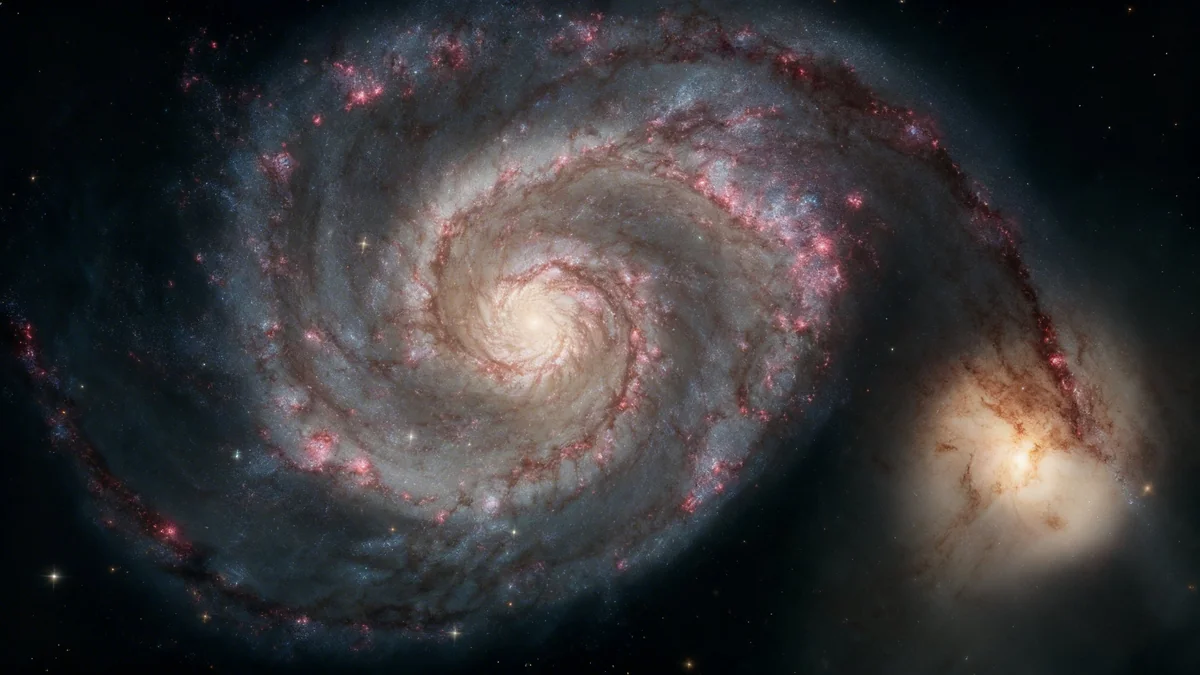
- Galaxy Mergers: Images of massive galaxies in the process of colliding and combining, a fundamental process in cosmic evolution.
- Gravitational Lenses: Instances where the immense gravity of a foreground galaxy bends and magnifies the light from a more distant object, creating distorted or multiple images of the background source. These are crucial for studying dark matter and the early universe.
- Jellyfish Galaxies: These are galaxies moving rapidly through galaxy clusters, which strips gas away from them, creating long, trailing tentacles that resemble a jellyfish.
- Collisional Ring Galaxies: Rare and spectacular objects formed when a smaller galaxy passes directly through the center of a larger spiral galaxy, triggering a wave of star formation that expands outwards in a ring.
Beyond these classifications, the AI also found dozens of other peculiar objects that defy easy explanation. These oddities are particularly exciting for scientists, as they could represent new types of astrophysical phenomena or rare stages of cosmic events that have never been observed before.
By the Numbers: An AI's Cosmic Hunt
- 100 Million+: Image cutouts analyzed from the Hubble archive.
- 2.5 Days: Total time the AI took to scan the entire dataset.
- 1,300+: Total anomalous objects flagged by the system.
- 800: Newly discovered objects never before described by astronomers.
The Future of Astronomical Discovery
This successful application of AI to the Hubble archives is more than just a single discovery; it's a proof of concept for a new era of space exploration. As new telescopes like the James Webb Space Telescope (JWST) generate data at an even faster rate, AI-driven tools will become essential for managing and analyzing the information.
Pablo Gómez, an ESA data scientist and co-author of the study published in the journal Astronomy & Astrophysics, highlighted the broader implications of this work. He noted that this approach could serve as a model for exploring other major scientific archives, not just in astronomy but in other fields as well.
"It [shows] how useful this tool will be for other large datasets," Gómez stated, emphasizing the technology's potential to accelerate discovery across different scientific domains.
The project demonstrates a powerful synergy between human ingenuity and machine intelligence. While the AI can rapidly identify patterns and anomalies on a massive scale, human astronomers are still needed to verify the findings, interpret their significance, and decide which of these 800 new cosmic curiosities warrants a closer look. This collaboration ensures that even after 35 years, the Hubble Space Telescope continues to reveal the universe's deepest secrets.