


As NASA prepares for its historic Artemis II mission, a critical component of the spacecraft destined for the moon originates from Ravenswood, West Virginia. The more than 1,100 employees at the Constellium manufacturing plant have produced specialized aluminum plates that form the structural backbone of the rocket, marking a significant contribution from the state to America's return to deep space exploration.
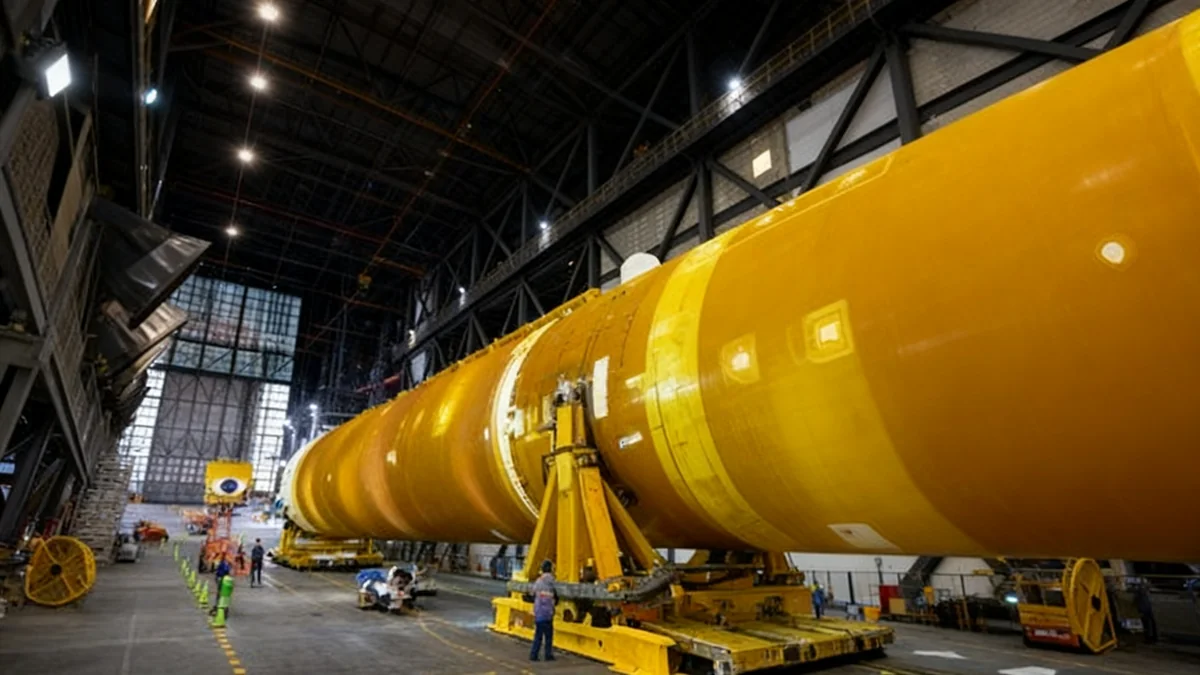
The upcoming launch, scheduled for next month, will carry four astronauts on a journey farther into space than any human has traveled before. The mission relies heavily on the high-strength, lightweight aluminum-lithium alloy developed and manufactured in Ravenswood, which is used throughout the massive Space Launch System (SLS) rocket and the Orion crew capsule.
Key Takeaways
- Over 1,100 employees at the Constellium plant in Ravenswood, WV, produced aluminum for NASA's Artemis II rocket.
- The specialized aluminum-lithium alloy is used from the rocket's tip to its tail, including the Orion space capsule's heat shield.
- Artemis II will send four astronauts on a lunar flyby, traveling deeper into space than previous missions.
- Constellium has been involved since the early stages of the project and aims to supply materials for future missions to the Moon and Mars.
A Local Contribution to a Global Milestone
For the community of Ravenswood and the state of West Virginia, the Artemis II mission represents a profound source of pride. The work conducted at the local Constellium facility is integral to the success of a mission that captures global attention. The aluminum plates are not a minor component; they are fundamental to the vehicle's integrity.
Brian McCallie, Vice President at Constellium, explained the scope of the plant's involvement. "We produced aluminum plates that are used, basically, tip to tail on this Artemis II rocket," he stated. "We’ve got applications in the Orion space capsule that will actually carry the astronauts all the way down to the bottom of the vehicle at the heat shield."
Mission Critical Material
The specialized aluminum produced in Ravenswood is an aluminum-lithium alloy. This material is prized in aerospace for its unique combination of low density and high strength, allowing engineers to build lighter, more efficient spacecraft without compromising safety or structural integrity.
This project elevates the plant's already impressive portfolio. While its materials are used in many advanced applications, participating in human space exploration is a unique achievement.
"The aluminum that we make here in Ravenswood, WV, does some amazing things, but nothing quite like this, and to know that the plates that we make here are going to carry astronauts into deep space is just phenomenal and gives us a real sense of pride in what we do every day."
The Science of Space-Grade Aluminum
The journey from raw material to a component ready for deep space is a testament to advanced manufacturing and material science. The aluminum-lithium alloy is not ordinary aluminum. Its formulation is the result of extensive research and development to meet the extreme demands of spaceflight.
During launch, the SLS rocket will experience immense forces and vibrations. Once in space, the Orion capsule must withstand the vacuum of space and extreme temperature fluctuations. The materials used must perform flawlessly under these conditions. The Ravenswood-produced plates provide the necessary strength to handle the structural loads while being light enough to help the rocket escape Earth's gravity efficiently.
The Artemis Program
NASA's Artemis program is a multi-mission endeavor to establish a long-term human presence on and around the Moon. Artemis I was an uncrewed test flight. Artemis II will be the first crewed mission, performing a lunar flyby. Artemis III, planned for later in the decade, aims to land the first woman and first person of color on the lunar surface, marking the first human landing since 1972.
Constellium's role began in the early phases of the Artemis program. According to McCallie, the company worked closely with NASA engineers to provide a material solution that fit the mission's ambitious requirements.
"It’s bringing Constellium’s unique solutions, like aluminum-lithium alloy plates, to the table and working with the engineers at NASA and various other parties to say, ‘Here’s a material that we have that can do some unique things and is extremely lightweight and is also very strong,’" McCallie explained. This collaborative approach was key to integrating their product into the spacecraft's design.
Beyond Artemis II: A Future Forged in West Virginia
Constellium's involvement with NASA is not expected to end with the launch of Artemis II. The company is already looking ahead to subsequent missions, including the planned lunar landing of Artemis III and the even more ambitious goal of sending humans to Mars.
The infrastructure and expertise developed in Ravenswood for this project position the facility as a key supplier for the future of space exploration. As NASA pushes the boundaries of human travel, the demand for advanced, reliable materials will only grow.
McCallie spoke of this long-term vision and its significance for the state.
"The intention is to not only get to the moon, but the next step in that evolution would be to get to Mars and to know that the state of West Virginia, and absolutely here in Ravenswood, WV as well, really a sense of pride overcomes you."
As the launch window approaches next month, after a slight delay for final preparations, the team in Ravenswood will be watching closely. Their work, forged in the hills of West Virginia, is set to become part of a new chapter in human history, carrying astronauts toward the moon and beyond.