
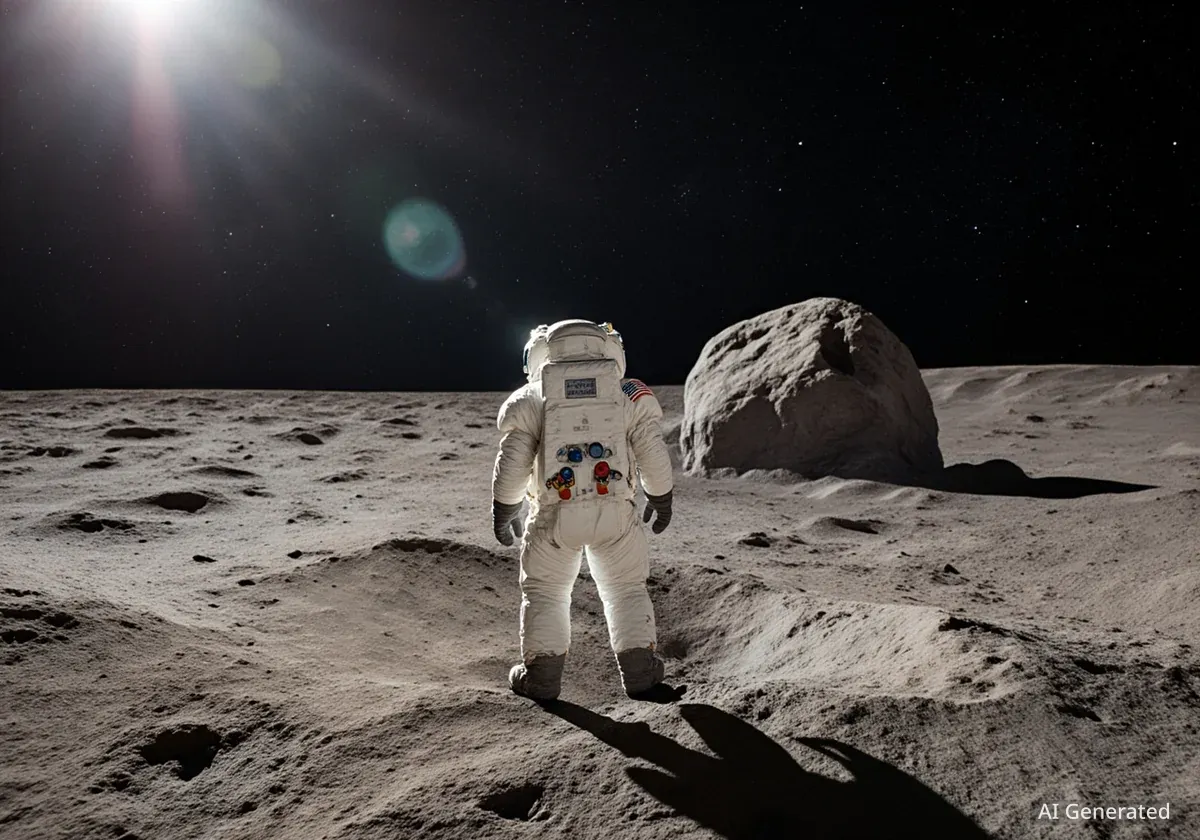


As NASA prepares for its historic return to the lunar surface with the Artemis III mission, astronauts will be equipped with a new generation of spacesuit designed for the extreme environment of the moon's south pole. Developed by Axiom Space, the Axiom Extravehicular Mobility Unit (AxEMU) promises a level of flexibility and movement never before seen in space, though questions about its total weight remain.
This advanced suit is a critical piece of technology for the first crewed lunar landing in over 50 years, engineered to enable complex scientific work on treacherous terrain and serve as a mobile life-support system for a new era of exploration.
Key Takeaways
- Axiom Space has developed the new AxEMU spacesuit for NASA's Artemis III lunar landing mission.
- The suit's primary innovation is its enhanced flexibility, allowing astronauts to kneel, walk, and handle tools with greater ease.
- It is specifically designed for the harsh conditions of the moon's south pole, which features extreme temperatures and rugged terrain.
- While mobility is improved, the suit is heavier than its Apollo-era predecessors, raising some concerns about astronaut fatigue and safety.
A New Generation of Lunar Gear
With the Artemis program, NASA is not just revisiting the moon; it's aiming to establish a sustained human presence. This ambitious goal requires equipment far more advanced than what was used during the Apollo missions of the 1960s and 70s. The spacesuit, essentially a personal spacecraft, is one of the most vital components.
Since 2022, Houston-based Axiom Space has been tasked with developing this next-generation suit. The result, the AxEMU, was officially unveiled in 2024. While its white, bulky exterior appears familiar, its internal engineering represents a significant leap forward in material science and design.
From Apollo to Artemis
The last time humans walked on the moon was in 1972 during the Apollo 17 mission. Those early suits were groundbreaking for their time but were notoriously stiff and restrictive, making simple movements difficult. The Artemis missions are planned for the lunar south pole, a region with far greater scientific potential but also more environmental challenges than the equatorial sites visited by Apollo crews.
The AxEMU must not only protect astronauts from the vacuum of space, cosmic radiation, and extreme temperatures but also allow them to perform as geologists and field scientists. This requires a suit that moves with the human body, not against it.
A Leap Forward in Flexibility
The most significant advancement in the AxEMU is its mobility. Unlike the rigid, inflated feel of previous spacesuits, the new design incorporates advanced flexible joints in the arms, waist, and legs. This gives astronauts a remarkable range of motion, enabling them to kneel to inspect a rock, bend to pick up tools, and walk with a more natural gait.
This enhanced flexibility is crucial for the scientific objectives of Artemis III. Astronauts will need to navigate uneven terrain, collect samples, and set up equipment—tasks that were physically demanding and often awkward for their Apollo predecessors.
"It’s really pushing the limits of material science," said Paul Spana, a curator and director of collections at Space Center Houston. "There’s going to be a lot of new things introduced for the new suit that will be used for moonwalking on Artemis III."
The ability to move freely also improves safety, allowing astronauts to recover more easily from a fall and maneuver within the tight confines of lunar landers and future rovers.
Built for an Unforgiving Environment
The Artemis missions are targeting the moon's south pole, a region of stark contrasts with permanently shadowed craters and areas of near-constant sunlight. This creates temperature swings far more extreme than anything experienced on Earth.
The AxEMU is equipped with a robust temperature regulation system to protect its occupant from these conditions. The outer layers are also designed to be highly durable and scratch-resistant, a necessary defense against the moon's sharp, abrasive dust and jagged rocks.
Challenges of the Lunar South Pole
- Extreme Temperatures: The suit must handle temperatures ranging from scorching heat in sunlight to cryogenic cold in shadow.
- Difficult Terrain: The region is characterized by steep slopes and deep craters, demanding greater mobility.
- Abrasive Dust: Fine lunar regolith can damage materials and clog mechanisms if not properly managed.
Victoria Ugalde, a NASA spokesperson, highlighted the unique demands of the landing site. "This region presents unique challenges including steeper terrain, extreme temperatures and prolonged periods of light and darkness—conditions far harsher than those faced by Apollo astronauts at the lunar equator." The suit's design must accommodate these factors while being compatible with various spacecraft and vehicles.
The Weight of Exploration
Despite its technological advancements, the AxEMU has one notable concern: its weight. Axiom Space has not disclosed the exact mass, but it is confirmed to be heavier than the Apollo suits, which weighed nearly 200 pounds (about 90 kilograms) on Earth.
While an astronaut will only feel one-sixth of that weight on the moon, it is still a significant mass to move around for hours at a time, especially while carrying heavy tools and science equipment. NASA astronaut and physician Mike Barratt has noted that the added weight could increase astronaut fatigue and potentially lead to injuries during long extravehicular activities (EVAs).
NASA officials have acknowledged the challenge. "Weight is always a key consideration in space suit design," Ugalde stated, but she affirmed that the agency maintains "extremely high confidence" that astronauts will be able to perform all necessary mission tasks.
The Artemis III mission will be the ultimate test for the AxEMU. The data and experience gathered from its performance on the lunar surface will be invaluable for refining future suits. According to Ugalde, these lessons will "shape future Artemis missions, expanding operating ranges and enhancing crew capabilities," paving the way for a long-term human presence on the moon and the eventual journey to Mars.