


A new sense of urgency is reshaping the world of space observation, as both NASA and private philanthropists are pushing to build and launch powerful new telescopes at a record pace. This shift aims to move beyond the decades-long development cycles and budget overruns that have characterized past flagship missions, promising a new era of faster, more efficient cosmic discovery.
While NASA celebrates the early success of its Nancy Grace Roman Space Telescope, a privately funded project backed by billionaire Eric Schmidt is aiming to build a telescope larger than Hubble in just three years, a timeline previously considered impossible.
Key Takeaways
- NASA's Nancy Grace Roman Space Telescope is months ahead of schedule, on track for a September launch.
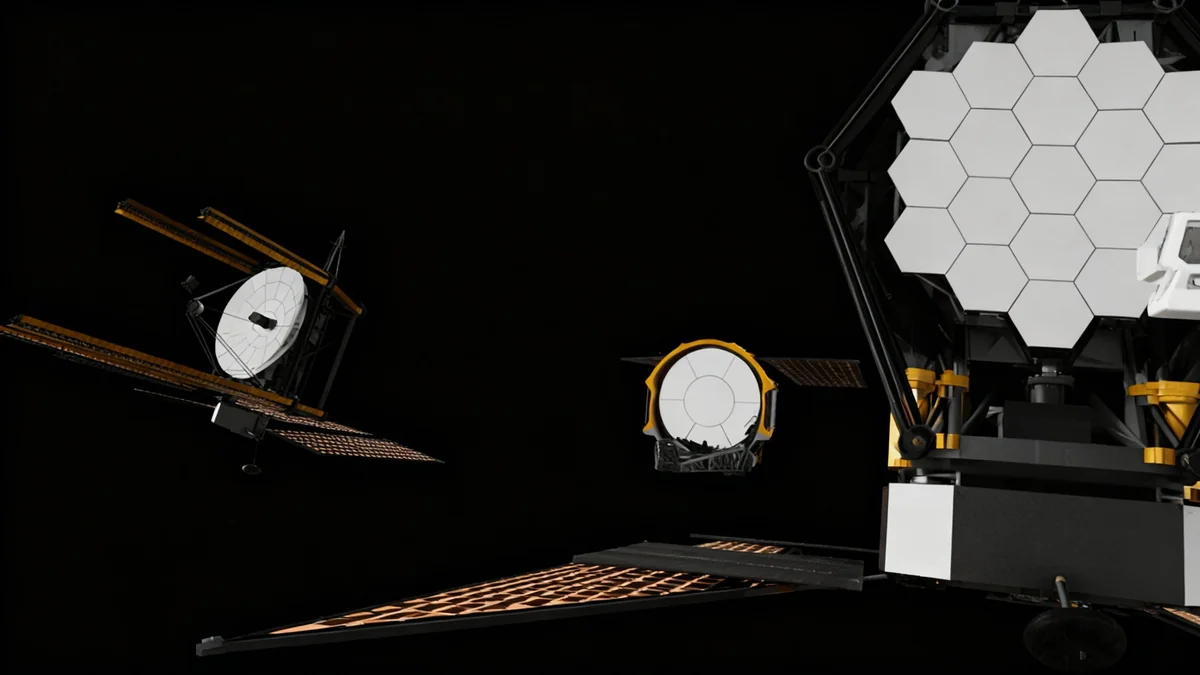
- A private initiative, the Schmidt Observatory System, is developing the Lazuli space telescope, which is larger than Hubble and aims for a mid-2028 launch.
- NASA is adopting faster development models, including a rapid 12-month mission to save the aging Swift telescope.
- Both public and private efforts are focused on learning from past delays, like those of the James Webb Space Telescope, to make space astronomy more agile.
NASA Sets a New Pace
For years, the development of major space observatories has been a slow, methodical process. The James Webb Space Telescope (JWST), for instance, was first conceived in the 1990s but did not launch until 2021 after significant delays. Now, NASA is actively working to prove it can move faster.
The agency's next major mission, the Nancy Grace Roman Space Telescope, is a prime example of this new approach. Project officials recently confirmed the observatory is on track for a launch as soon as September, months ahead of its official May 2027 commitment date. The spacecraft's assembly was completed in November and it is now undergoing final testing.
"I don’t want to hear that we can’t do flagships on time and on schedule. The Roman team has proven we can," said Shawn Domagal-Goldman, director of NASA’s astrophysics division, at a recent American Astronomical Society conference.
The Roman telescope has also stayed within its $4.3 billion budget, a critical achievement for an agency seeking to build support for future large-scale projects.
An Urgent Rescue Mission
NASA's commitment to speed is also evident in its plan to save the Swift gamma-ray telescope. Launched in 2004, Swift's orbit is decaying, and it could reenter Earth's atmosphere by 2026. In response, NASA awarded a $30 million contract to Katalyst Space to develop a mission to dock with Swift and boost its orbit.
The timeline is ambitious: the goal is to go from the initial decision to launch in about 12 months. While officials acknowledge the risk—a mission of this kind has never been attempted—the potential reward of extending Swift's operational life for years is deemed worth it.
Fact: A Race Against Time
If the Swift reboost mission launches on schedule in June, it will have gone from concept to launch pad in just one year, a pace unheard of for missions beyond small CubeSats.
A Billionaire's Bet on Private Astronomy
While NASA rethinks its internal processes, a major private initiative is looking to completely rewrite the rules of space telescope development. Schmidt Sciences, founded by former Google CEO Eric Schmidt and his wife Wendy, has unveiled the Schmidt Observatory System, a network of ground and space-based telescopes funded entirely by their philanthropy.
The centerpiece of this effort is the Lazuli space telescope. With a planned 3-meter primary mirror, it will be larger than both the Hubble (2.4 meters) and Roman space telescopes. More remarkably, the project aims for a development cycle of just three years and a launch by mid-2028.
Pete Klupar, the executive director of the Lazuli project, stated that the telescope is designed to deliver "Hubble-class image quality" for a fraction of the cost of previous flagship missions, estimated to be in the hundreds of millions of dollars.
Context: The Private Space Telescope Challenge
Previous attempts to build large, privately funded space telescopes have struggled. The B612 Foundation's Sentinel project and the BoldlyGo Institute's missions both failed to secure the necessary funding to proceed. The direct financial backing from the Schmidts gives the Lazuli project a significant advantage.
Can Speed and Quality Coexist?
The Lazuli team plans to achieve its aggressive goals by leveraging several key strategies that differ from the traditional government-led approach.
- Commercial Components: An estimated 80% of the spacecraft will be built using commercially available, off-the-shelf hardware that already has a history of successful spaceflight.
- Streamlined Testing: The team is exploring ways to skip certain system-level environmental tests, such as vibration and acoustic checks, based on extensive modeling.
- Lean Management: With a single source of funding, the project can avoid the lengthy review processes and bureaucratic hurdles common in government programs.
"We have one shareholder. This eliminates analysis paralysis and allows us to take credible, calculated risks that others just can’t do," Klupar explained.
Despite the innovative approach, the project has been met with a degree of skepticism within the astronomical community. Many scientists privately doubt that a telescope of this complexity can be built on the budget and schedule of a commercial satellite. Stu Feldman, president of Schmidt Sciences, acknowledged the challenge but remained confident in the project's ultimate goal: "to change the schedule and cost curve of astronomy."
The Future of Cosmic Observation
Looking ahead, NASA is already laying the groundwork for its next great observatory, the Habitable Worlds Observatory (HWO), slated for launch in the early 2040s. Learning the lessons of JWST, the agency is investing heavily in maturing critical technologies years before official development begins, hoping this upfront work will prevent delays later.
Whether through government reform or private disruption, the field of space astronomy is entering a period of rapid change. As both NASA and private ventures push the boundaries of what's possible, the universe may be brought into focus faster than ever before.