


NASA is targeting 2026 for the launch of Artemis II, a mission that will send four astronauts on a journey around the moon. This flight marks the first time humans will travel to the lunar vicinity in more than half a century and serves as a critical test for the agency's next-generation space exploration hardware.
The roughly 10-day mission is a pivotal step in the Artemis program, designed to validate the life-support systems and capabilities of the Orion spacecraft and the powerful Space Launch System (SLS) rocket with a crew on board. While the astronauts will not land on the moon, their voyage is essential for paving the way for future lunar landings and establishing a long-term human presence in deep space.
Key Takeaways
- The Artemis II mission is scheduled for 2026 and will carry four astronauts on a flight around the moon.
- It is the first crewed flight of NASA's Space Launch System (SLS) rocket and Orion spacecraft.
- The mission is a crucial precursor to Artemis III, which aims to land humans near the moon's south pole.
- This flight represents a significant step in the renewed international focus on lunar exploration, with geopolitical and scientific implications.
A New Generation of Lunar Explorers
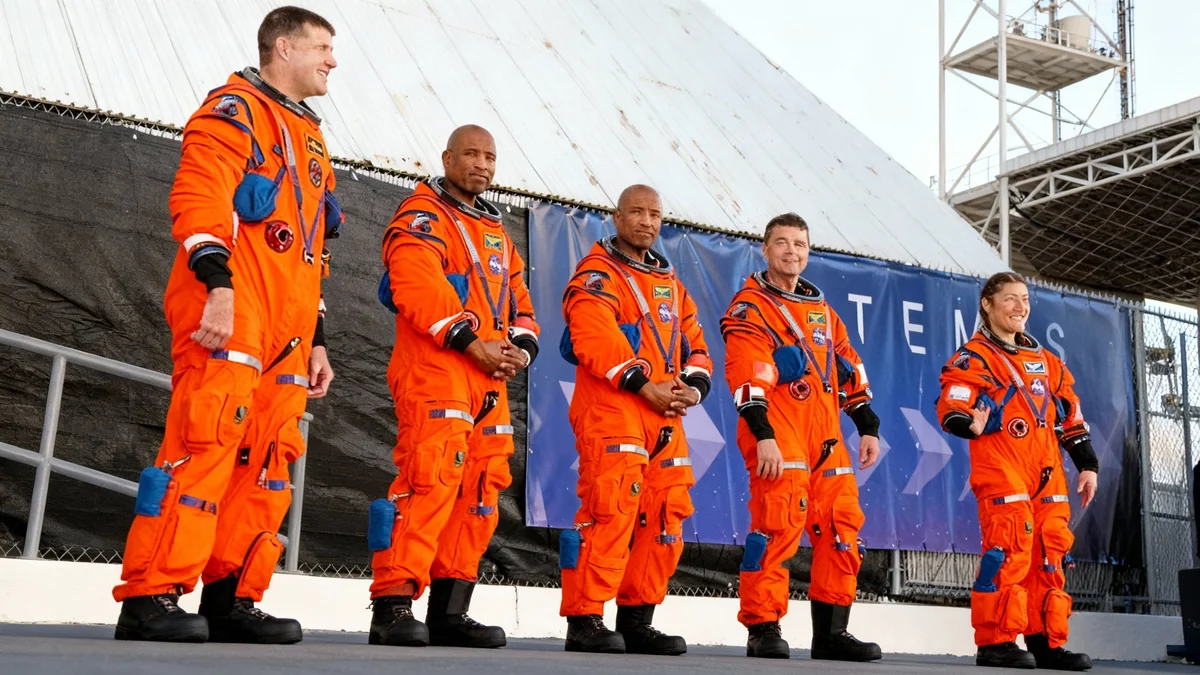
The crew for this historic flight was selected in 2023, comprising a team of experienced astronauts and one spaceflight newcomer. The four-person crew includes NASA astronauts Reid Wiseman, Victor Glover, and Christina Koch, along with Canadian Space Agency astronaut Jeremy Hansen.
For Wiseman, Glover, and Koch, this will be their second journey into space, while Hansen will be making his inaugural flight. The international collaboration highlights the global nature of the Artemis program's ambitions. The crew has been undergoing intensive training, recently completing a full launch-day rehearsal where they donned their flight suits and ran through the countdown sequence inside the Orion capsule.
This mission is the first crewed flight for the Orion and SLS system, which successfully completed an uncrewed test flight, Artemis I, in 2022. That mission lasted over three weeks and provided valuable data on the hardware's performance during its trip around the moon and back to Earth.
High Stakes and High Expectations
The Artemis II mission carries significant weight for NASA and the future of American space exploration. The development of the SLS rocket and Orion spacecraft has spanned more than a decade, facing numerous delays and budget overruns. A successful crewed flight is necessary to prove the viability of this multi-billion dollar investment.
"There’s a lot riding on this, both good and bad," said Casey Dreier, chief of space policy for The Planetary Society. "Everything seems to be coming together, but this is the first time with humans on this rocket, and we’ve never tested this life-support system in space before."
The mission's success is also viewed through a geopolitical lens. With China announcing its own plans to land astronauts on the moon by 2030, a new space race is underway. The Artemis program is seen as a key component of maintaining American leadership in space exploration and technology.
A Legacy of Development
The hardware for the Artemis program has a long history. The Space Launch System rocket has been in development since 2010, following the retirement of the Space Shuttle program. The Orion spacecraft was originally conceived for the Constellation Program under President George W. Bush before being repurposed for Artemis. This mission is the culmination of nearly 15 years of effort.
Paving the Way for a Lunar South Pole Landing
Artemis II is not an end in itself but a critical stepping stone. The data and experience gained from this lunar flyby will directly inform the planning and execution of Artemis III, currently slated for 2027. That mission aims to achieve what hasn't been done since Apollo 17 in 1972: land humans on the moon.
However, Artemis III will target a completely new and scientifically intriguing region—the moon's south pole. Unlike the equatorial landing sites of the Apollo missions, the south polar region is rugged and contains permanently shadowed craters where water ice is believed to be abundant.
Exploring Uncharted Territory
The moon's south pole is a challenging landing site due to its pockmarked terrain and extreme lighting conditions. However, the potential presence of water ice makes it a prime location for establishing a sustainable human outpost, as water can be used for life support and converted into rocket fuel.
This new focus opens up unprecedented opportunities for science. Researchers are eager to analyze samples from these permanently shadowed regions, which are among the coldest places in our solar system and may hold clues about the origin of water on the moon and in the inner solar system.
Unlocking the Moon's Ancient Secrets
For lunar scientists, the return of humans to the moon promises to answer questions that have persisted for decades. The samples returned by the Apollo astronauts revolutionized our understanding of the moon, but they also raised new mysteries about its formation and history.
"As you can imagine, lunar scientists have had a lot of pent up questions for decades," explained Brett Denevi, a planetary scientist at the Johns Hopkins University Applied Physics Laboratory. "Apollo gave us the framework to understand the moon, and now we have the foundation to ask different questions."
Denevi, who leads the geology team for Artemis III, highlighted the unique value of the moon as a historical record. Unlike Earth, where geological processes like plate tectonics and weather have erased the earliest history, the moon's surface preserves a 4.5-billion-year-old record.
Studying this ancient terrain can provide insights into the early solar system and the processes that shaped our own planet. The prospect of obtaining new samples from a previously unexplored region has the scientific community energized for a new era of lunar discovery.