
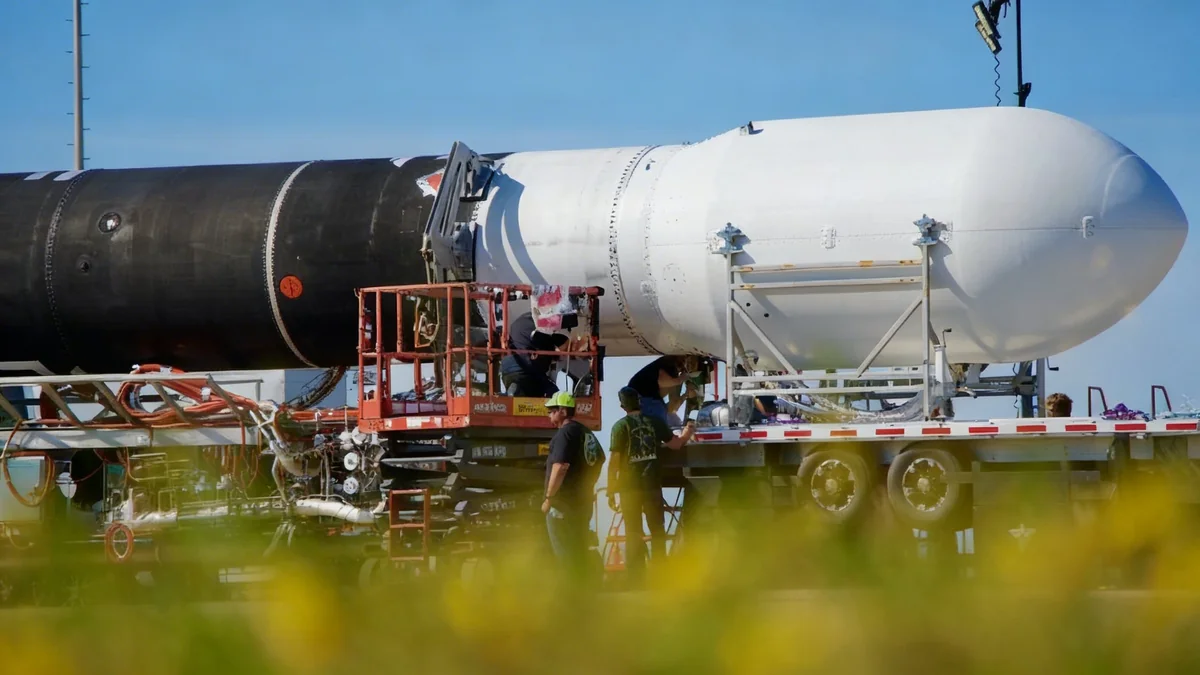


Firefly Aerospace has postponed the return-to-flight mission of its Alpha rocket, citing unfavorable weather conditions at the launch site. The mission, named "Stairway to Seven," was scrubbed on March 1 due to high winds at Vandenberg Space Force Base in California.
The company has not yet announced a new launch date for the vehicle, which has been grounded for 10 months following a previous mission failure. This flight is intended as a critical test before Firefly introduces an upgraded version of the rocket.
Key Takeaways
- Firefly Aerospace's Alpha rocket launch, scheduled for March 1, was scrubbed because of high winds.
- The mission, "Stairway to Seven," marks the rocket's first flight attempt in 10 months.
- This is the final flight for the Alpha Block I configuration, with a larger Block II version planned for subsequent missions.
- The flight is a test mission without any operational payloads, focusing on vehicle performance.
A Cautious Return to the Skies
Firefly Aerospace made the decision to call off the launch of its Alpha rocket from Vandenberg Space Force Base, prioritizing safety amid adverse weather. The two-hour launch window, which opened at 7:50 p.m. EST, was ultimately closed as high winds persisted in the area, making a launch attempt unsafe.
This mission represents a significant step for the Texas-based company. It is the first launch attempt for the Alpha rocket since April 29 of the previous year. That mission, named "Message in a Booster," ended unsuccessfully when the first stage broke apart shortly after separation, leading to the loss of its payload.
Following that incident, the Alpha rocket has undergone a lengthy review and testing process to ensure its readiness for flight. The Federal Aviation Administration (FAA) cleared the vehicle to fly again on August 26, but the path back to the launchpad has faced additional hurdles.
A History of Challenges
The road to this seventh Alpha flight has been marked by significant setbacks. Beyond the April 2023 mission failure, the specific booster intended for "Stairway to Seven" was destroyed during a ground test at Firefly's Texas facility in September. These events have contributed to the extended 10-month gap between launches, highlighting the complex and often difficult nature of rocket development.
The Purpose of 'Stairway to Seven'
Unlike a typical commercial launch, "Stairway to Seven" is not carrying any operational satellites for customers. Instead, Firefly has designated this as a dedicated test flight. The primary objective is to validate the performance of the rocket's first and second stages, ensuring all systems function as designed throughout the launch sequence.
In a mission description, Firefly stated the goal is to "achieve nominal first and second stage performance." This data-gathering approach is crucial for building confidence in the vehicle's reliability before the company commits to flying customer payloads again.
"Flight 7 will test and validate key systems ahead of Firefly’s Block II configuration upgrade on Flight 8 that's designed to enhance reliability and manufacturability across the vehicle," the company explained.
This flight serves as a bridge between the company's current technology and its future ambitions, making a successful outcome more important than deploying a payload.
The End of an Era for Alpha Block I
This seventh flight is also notable as it marks the final mission for the Alpha rocket's initial design, known as Block I. Beginning with its eighth flight, Firefly plans to introduce a significantly upgraded version, the Block II configuration. This new design is intended to improve both the rocket's performance and the efficiency of its manufacturing process.
Alpha Rocket Specifications (Block I)
- Height: 96.7 feet (29.6 meters)
- Stages: Two
- Previous Flights: Six
- Launch Site: Vandenberg Space Force Base, California
The planned upgrades for the Block II configuration are extensive and aim to address key areas of the vehicle's architecture. Key changes include:
- Increased Length: The rocket will be extended by 7 feet.
- Streamlined Avionics: The new version will use consolidated batteries and avionics systems built in-house by Firefly.
- Improved Protection: An enhanced thermal protection system will be integrated.
- Stronger Structures: The rocket will feature stronger carbon composite structures built using automated machinery.
By moving to this new configuration, Firefly aims to create a more robust and reliable launch vehicle capable of competing in the crowded small-satellite launch market. The success of "Stairway to Seven" is a critical prerequisite for this transition, as it will provide the final data set on the Block I design before it is retired.
Looking Ahead for Firefly
While the scrub is a minor delay, the eventual launch of "Stairway to Seven" is a pivotal moment for Firefly Aerospace. A successful test flight would help restore confidence after the previous failure and the ground test explosion, paving the way for the introduction of the more capable Block II vehicle.
The company is also involved in other ambitious space projects. The scrub occurred just a day before the anniversary of its Blue Ghost lunar lander's successful touchdown on the Moon on March 2, 2025. That mission marked the first time a private spacecraft had completed a full surface mission on the Moon, demonstrating Firefly's capabilities beyond just launch services.
As the space industry watches, Firefly will work to reschedule the launch. The company will be looking for a clear weather window to finally send its Alpha rocket on its stairway to space, closing one chapter of its development and opening the next.