
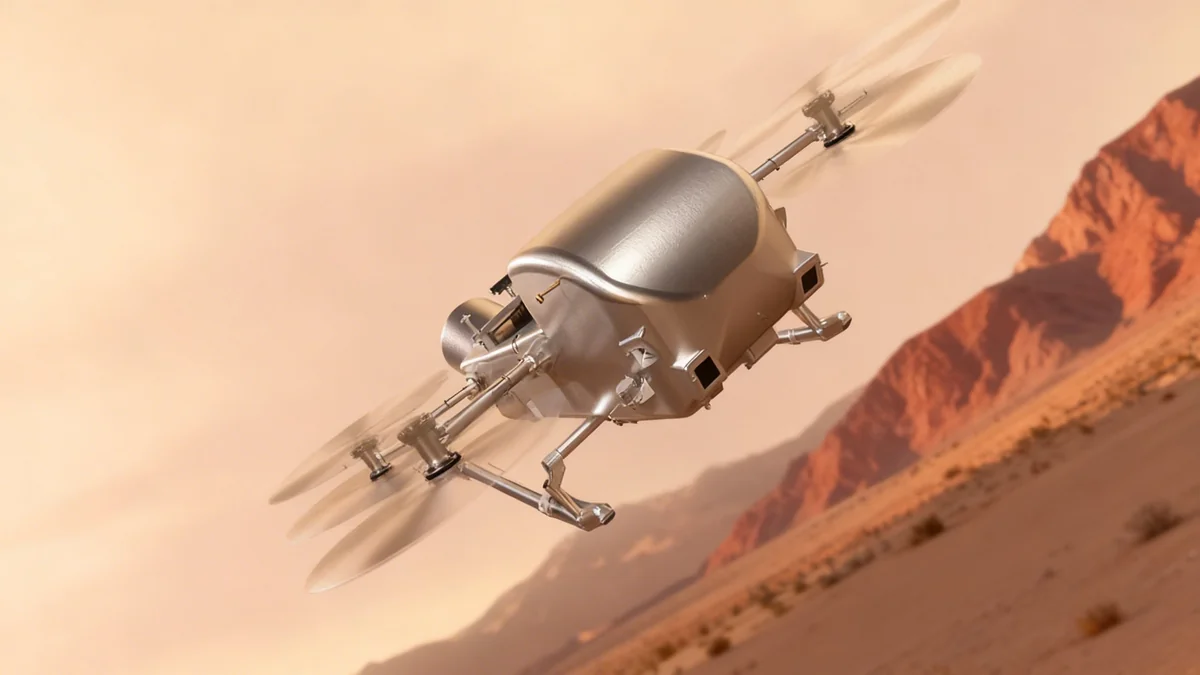


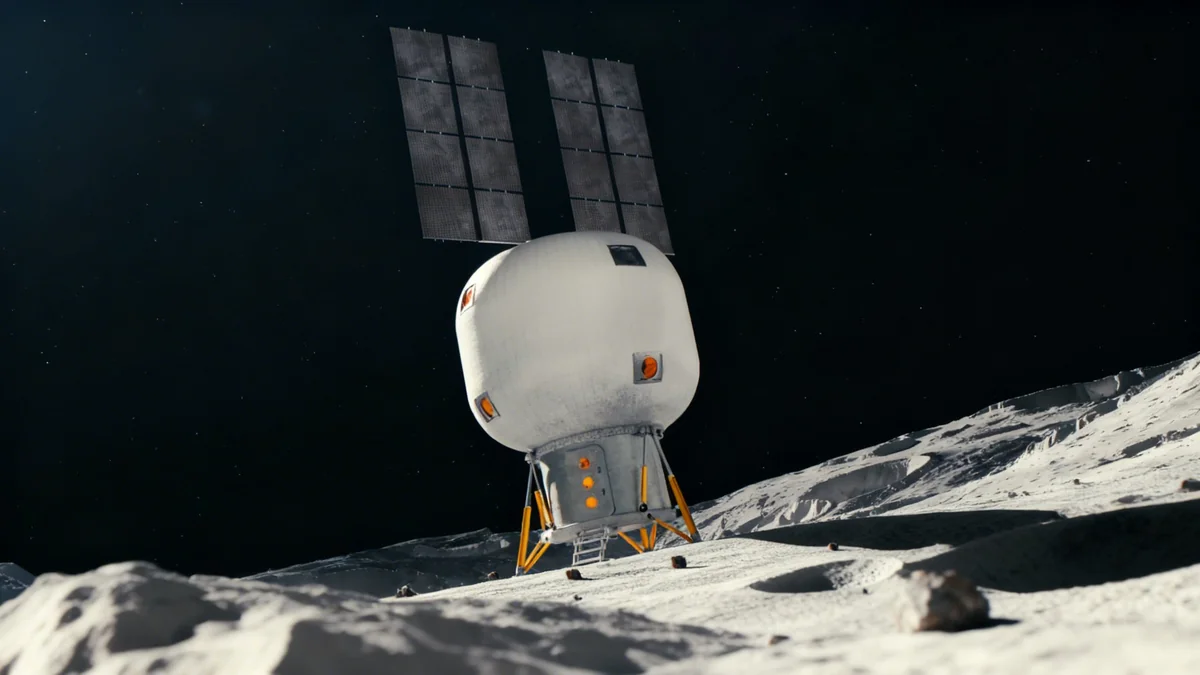
NASA has officially started the construction and testing phase for its Dragonfly rotorcraft, a car-sized, nuclear-powered drone designed to explore Saturn's largest moon, Titan. Technicians at the Johns Hopkins Applied Physics Laboratory (APL) in Maryland are now assembling the groundbreaking vehicle, marking a critical step toward its scheduled launch in 2028.
The mission aims to fly across the diverse landscapes of Titan, studying its complex chemistry and searching for clues about the origins of life. This ambitious project represents a new era of planetary exploration, sending a flying vehicle to an alien world with a thick atmosphere for the first time.
Key Takeaways
- NASA and Johns Hopkins APL have begun building the Dragonfly rotorcraft.
- Dragonfly is a nuclear-powered drone destined for Saturn's moon, Titan.
- The mission is scheduled to launch in July 2028 aboard a SpaceX Falcon Heavy rocket.
- It will study Titan's prebiotic chemistry to understand the origins of life.
- The $3.35 billion mission builds on the success of the Mars helicopter, Ingenuity.
A New Explorer Takes Shape
Inside a cleanroom at the Johns Hopkins APL, the intricate process of bringing Dragonfly to life is underway. The assembly marks a major milestone for the mission, transitioning from years of design and simulation into a tangible flight system.
Elizabeth Turtle, the principal investigator for the Dragonfly mission at APL, described this moment as significant. The team's initial focus is on the core components that will serve as the spacecraft's nervous system.
"This milestone essentially marks the birth of our flight system. Building a first-of-its-kind vehicle to fly across another ocean world in our solar system pushes us to the edge of what's possible, but that's exactly why this stage is so exciting."
- Elizabeth Turtle, Dragonfly Principal Investigator
Engineers are currently integrating and testing the Integrated Electronics Module (IEM), which acts as the "brain" of the rotorcraft. This unit is responsible for guidance, navigation, data handling, and overall command. Alongside the IEM, the Power Switching Units (PSUs) are being assembled to manage the flow of electricity from the nuclear generator to all of Dragonfly's instruments and systems.
From Mars Helicopter to Titan Drone
Dragonfly is not the first rotorcraft NASA has sent to another world, but it represents a massive leap in capability. Its predecessor, the Ingenuity helicopter on Mars, was a small, solar-powered technology demonstrator. Ingenuity, with a fuselage the size of a tissue box, proved that powered flight was possible in another planet's thin atmosphere, completing dozens of flights over nearly three years.
Dragonfly vs. Ingenuity
- Size: Dragonfly is the size of a small car, while Ingenuity was the size of a tissue box.
- Power: Dragonfly will use a Multi-Mission Radioisotope Thermoelectric Generator (MMRTG), a nuclear power source, to operate in Titan's dim light and frigid temperatures. Ingenuity relied on solar panels.
- Mission: Dragonfly is a full-fledged $3.35 billion science mission. Ingenuity was an $85 million technology demonstration.
- Destination: Dragonfly will explore Titan's dense atmosphere, while Ingenuity flew in Mars's thin air.
The lessons learned from Ingenuity were invaluable, but Dragonfly is a far more complex and capable machine. Its nuclear power source is essential for operating on Titan, where sunlight is about 100 times weaker than on Earth and surface temperatures hover around -179 degrees Celsius (-290 degrees Fahrenheit). This power system will allow Dragonfly to operate for years, flying from one location to another to conduct its research.
Why Explore the Mysteries of Titan?
Titan is one of the most compelling destinations in our solar system for scientists searching for the building blocks of life. It is the second-largest moon in the solar system, after Jupiter's Ganymede, and the only moon with a substantial atmosphere.
This dense, nitrogen-rich atmosphere is similar in some ways to Earth's early atmosphere. More importantly, Titan is rich in complex organic molecules—the carbon-based compounds that are fundamental to life as we know it. The moon features rivers, lakes, and seas of liquid methane and ethane, creating a unique environment where prebiotic chemistry could be unfolding.
A Brief Visit in 2005
Our only up-close look at Titan's surface came from the European Space Agency's Huygens probe, which landed on January 14, 2005. After detaching from the Cassini spacecraft, Huygens descended through the hazy atmosphere for over two hours, capturing images and data before surviving for a few more hours on the frozen ground. Dragonfly aims to build on Huygens' brief glimpse with a long-term, mobile exploration mission.
Dragonfly's goal is to explore a variety of sites on Titan. By landing in different locations, it will analyze the chemistry, geology, and atmospheric conditions to understand how far prebiotic chemistry has progressed in this unique environment. The mission could provide unprecedented insights into the chemical processes that may have led to life on Earth.
The Long Road to Launch
The assembly and testing phase at APL is just the beginning of a long and meticulous process. This initial stage is expected to continue into early 2027.
Annette Dolbow, the integration and test lead for the mission, highlighted the excitement of this new phase.
"We've spent years designing and refining this amazing rotorcraft on computer screens and in laboratories, and now we get to bring all those elements together and transform Dragonfly into an actual flight system."
- Annette Dolbow, Dragonfly Integration and Test Lead
Once initial assembly is complete, the spacecraft will travel across the country for further preparations. Here is a look at the planned timeline:
- Early 2027: Dragonfly will be shipped to Lockheed Martin Space in Colorado for comprehensive systems testing.
- Post-2027: The spacecraft will return briefly to APL for environmental testing to ensure it can withstand the harsh conditions of space and Titan.
- Spring 2028: Dragonfly will be transported to NASA's Kennedy Space Center in Florida for its final preparations.
- July 2028: The rotorcraft is scheduled to launch aboard a SpaceX Falcon Heavy rocket.
While the flight system is being built, other key components are also undergoing rigorous testing. The vehicle's protective shell has completed aerodynamic assessments in wind tunnels at NASA's Langley Research Center, and insulating foam is being tested to protect the craft from Titan's extreme cold. Every piece, from the science payload to the flight radio, is carefully coming together for this historic journey to the outer solar system.