
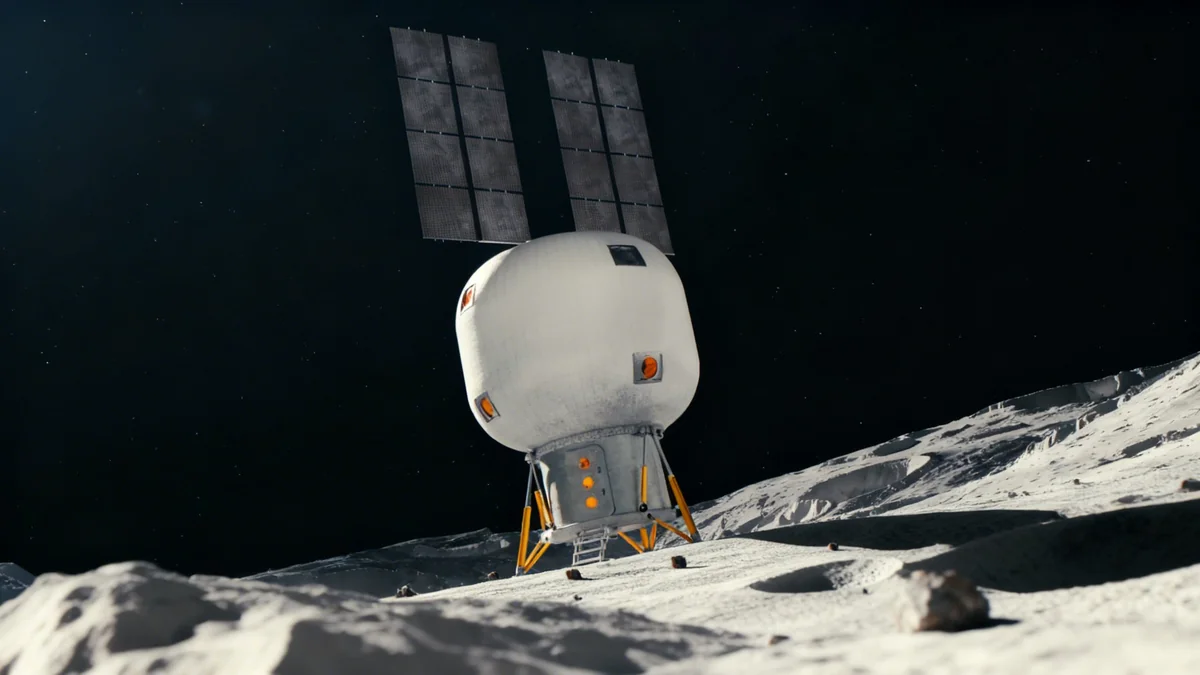



Commercial space infrastructure firm Voyager Technologies has announced a significant multi-million-dollar investment in Max Space, a company specializing in expandable habitat technology. The partnership aims to accelerate the development of modules intended for future long-term human missions on the moon, directly supporting NASA's Artemis program goals.
This collaboration will scale up production and engineering efforts, integrating Voyager's mission systems with Max Space's innovative habitat designs. The goal is to create durable, scalable infrastructure for a permanent human presence beyond low Earth orbit.
Key Takeaways
- Voyager Technologies has made a multi-million-dollar investment in lunar habitat developer Max Space.
- The partnership will focus on creating expandable modules for NASA's Artemis program and future moon bases.
- Max Space technology allows large habitats to be launched in a compact form, reducing costs and maximizing interior volume.
- The initiative builds on previous concepts like NASA's BEAM module, aiming for larger and more permanent structures.
A New Alliance for Lunar Infrastructure
The race to establish a sustainable human presence on the moon has gained a new commercial contender. Voyager Technologies, a Denver-based firm focused on space infrastructure, is investing millions into Max Space to fast-track the creation of expandable living quarters for astronauts.
While the exact financial details of the investment have not been disclosed, the strategic partnership is designed to move expandable habitat technology from the conceptual stage to operational readiness. The collaboration will combine Voyager's expertise in mission services and systems with Max Space's unique habitat architecture.
"Expanding human presence beyond low Earth orbit (LEO) requires infrastructure that is scalable, resilient and purpose-built for permanence,” stated Dylan Taylor, chairman and CEO of Voyager. "By pairing Voyager’s integrated platform with Max Space’s expandable habitat architecture, we are accelerating the transition from demonstration missions to durable lunar capability.”
This move is a direct response to NASA's recently outlined roadmap for its Artemis program, which calls for a permanent base on the lunar surface. Private companies are now stepping in to provide the critical infrastructure needed to support long-duration missions.
The Science of Expandable Habitats
Expandable habitat technology offers a solution to one of the biggest challenges in space exploration: volume. Traditional habitats are rigid structures, meaning their size is limited by the payload fairing of the rocket used to launch them. This creates a trade-off between living space and launch capability.
Max Space's modules are engineered to be different. They are designed to launch in a tightly folded, compact configuration. This allows them to fit within the constraints of existing rockets, such as SpaceX's Falcon 9. Once deployed in space or on the lunar surface, the module expands to its full size, creating a significantly larger interior volume for living and working.
Launch Smart, Live Large
The primary advantage of expandable habitats is the dual benefit of low launch mass and greater usable volume. This efficiency is critical for making long-term missions to the moon and beyond more affordable and sustainable.
Saleem Miyan, co-founder and CEO of Max Space, emphasized the importance of the new partnership. "Voyager’s investment is a powerful validation of our expandable habitat thesis and long heritage in orbit. Together we are building habitats designed not just to reach the moon but to stay there," he said.
Building on Proven Concepts
The idea of inflatable or expandable structures in space is not entirely new. NASA has already explored the concept with a successful on-orbit demonstration.
The Legacy of BEAM
In 2016, the Bigelow Expandable Activity Module (BEAM) was attached to the International Space Station (ISS). Developed by Bigelow Aerospace, this small test habitat was designed to study the performance and durability of expandable structures in the harsh environment of space. BEAM has exceeded its initial mission timeline and remains attached to the ISS, providing valuable data on the technology's viability.
Bigelow Aerospace had ambitious plans for large, free-flying commercial space stations based on this technology but ceased operations in 2020. Max Space now aims to take the foundational concept demonstrated by BEAM and scale it up significantly, creating habitats large enough to support crews for extended periods on the moon.
Supporting NASA's Artemis Ambitions
The partnership between Voyager and Max Space is strategically timed to align with NASA's goals. The Artemis program intends to land astronauts back on the moon, with plans for a landing as soon as 2028, and to establish a long-term base for scientific research and as a stepping stone for future missions to Mars.
To achieve this, NASA will require a wide range of surface infrastructure, including habitats, power systems, and logistics support. The agency has increasingly turned to the commercial space industry to provide these capabilities through fixed-price contracts and public-private partnerships.
The collaboration between Voyager and Max Space aims to provide a comprehensive solution for future lunar operations. Their combined efforts will address several key areas:
- Cislunar Mission Management: Overseeing operations in the space between Earth and the moon.
- Surface Logistics: Managing the transportation and placement of equipment on the lunar surface.
- Propulsion and Power Systems: Developing the necessary systems to power and maneuver lunar assets.
- Future Surface Infrastructure: Planning and building the foundational elements of a permanent lunar base.
The companies share a vision of the moon as an "operational domain, not a temporary destination." This perspective shifts the focus from short-term exploratory missions to building a sustainable and permanent off-world presence, where commercial activity can thrive alongside scientific discovery.