
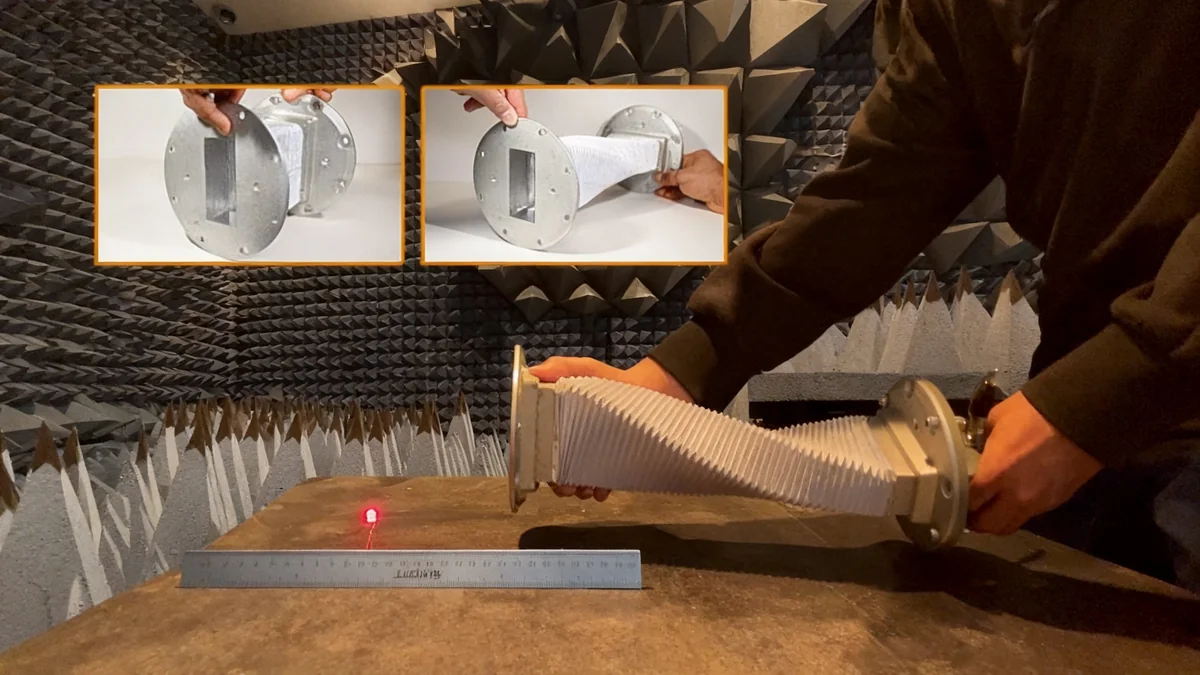



Engineers at the University of Illinois Urbana-Champaign have developed a new type of satellite component inspired by the ancient art of origami. These flexible, lightweight waveguides can be folded for launch and expanded in space, offering a solution to the challenge of heavy, rigid hardware used in high-powered satellites.
Key Takeaways
- Researchers created lightweight, foldable electromagnetic waveguides for satellites using origami principles.
- The new design replaces heavy, inflexible metal tubes, reducing launch weight and saving space.
- Initial inspiration for the structure came from the simple design of a paper shopping bag.
- The technology has a pending patent and potential applications in naval and communication systems on Earth.
The Challenge of Weight in Space
Satellites rely on electromagnetic waveguides to transmit high-powered energy between components, much like pipes carrying water. Traditionally, these parts are made from rigid, heavy metal tubes with bulky flanges at each end. While effective, their weight and inflexibility present significant obstacles for space missions, where every gram and cubic centimeter is meticulously calculated for launch.
Reducing the mass and volume of components is a primary goal for aerospace engineers. Lighter and more compact payloads mean lower launch costs and the ability to include more scientific instruments or fuel on a spacecraft.
Why Waveguides are Critical
Electromagnetic waveguides are essential for high-frequency systems, particularly in communications and radar satellites. They guide microwave energy with minimal loss, ensuring that signals sent from transmitters reach antennas with maximum power and clarity. Their performance is directly tied to their structural integrity and precise shape.
From Paper Bags to Space Tech
The innovative solution came from an unexpected source: origami. Xin Ning, a professor in the Department of Aerospace Engineering, saw the potential of foldable structures for space applications. He collaborated with his former colleague, electromagnetics expert Sven Bilén, to explore if origami could be applied to waveguides.
"Because the most common electromagnetic waveguides are rectangular-shaped, our origami designs needed to maintain a rectangular cross section in the operational state for comparable performance," Ning explained. The team's first model drew inspiration from a surprisingly common object.
The Shopping Bag Prototype
The research team, including graduate students Nikhil Ashok and Sangwoo Suk, noted that the structure of a simple brown paper shopping bag provided a perfect starting point. Its flat-folding design and rectangular base served as a basic model for a foldable tube with connection points.
Using this concept, they developed more sophisticated designs that resembled a bellows. These advanced versions could not only fold compactly but were also engineered to twist and bend during deployment, allowing for more complex connections between satellite components.
From Paper to Prototype
To test their concepts, the team printed folding patterns on large sheets of paper, laminated them with standard kitchen aluminum foil to make them conductive, and then meticulously folded them by hand. This low-cost method allowed for rapid iteration and physical testing of the designs.
Engineering the Perfect Fold
Creating a functional origami waveguide involved more than just folding paper. The team had to ensure their designs performed identically to the rigid metal parts they were meant to replace. They modeled their structures based on existing commercial waveguides to allow for direct, one-to-one performance comparisons.
The process was not without its challenges. While testing a model designed to twist as it deployed, the engineers discovered a mechanical flaw.
"After a few inches of easy deployment, it suddenly got stuck and we really wanted to understand why," said Ning. "We spent a lot of time trying to understand the mechanics and analyzing the angle and distance and deriving the equations."
Their analysis revealed that stretching the model to the point where its creases became completely flat caused a massive spike in force, which could break the structure. To solve this, they carefully calculated the optimal number of folds needed to achieve the required length without over-stretching the material. This ensured a smooth and safe deployment.
Future Applications On and Off Earth
While the initial prototypes were made from paper and foil, the final space-ready versions would use far more robust materials. The researchers suggest the waveguides could be 3D printed from durable polymers and then coated with high-quality materials like Kapton and metal laminates to withstand the harsh environment of space.
The team now has a patent pending for their shape-morphing origami waveguides. Although the primary focus was on spacecraft, the underlying concept has much broader potential. These lightweight, flexible structures could be adapted for use in various terrestrial systems that rely on transferring microwave energy, including:
- Naval communication systems
- Mobile radar equipment
- Advanced electrical engineering applications
By transforming a rigid and heavy component into something lightweight and adaptable, this origami-inspired engineering provides a compelling new tool for designers building the next generation of technology for both space exploration and use here on Earth.