
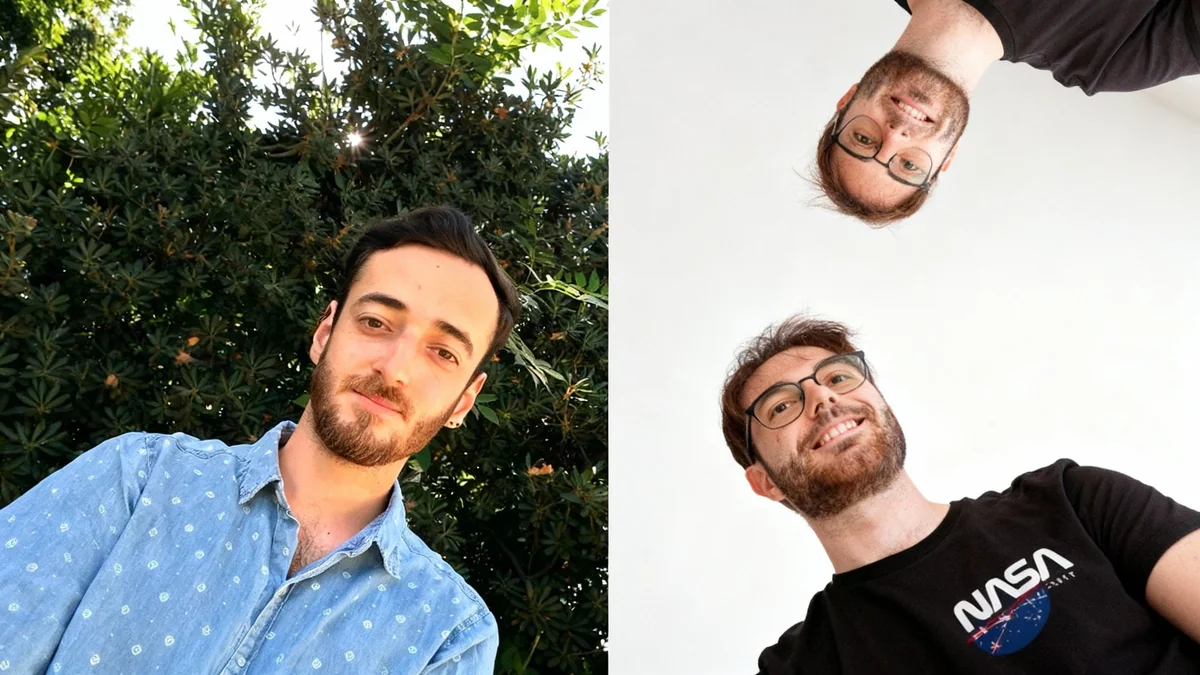


Two PhD students from Australia have developed a groundbreaking software solution that has corrected a persistent blur in images from the James Webb Space Telescope. Their work, conducted entirely from Earth, has restored the telescope's ability to capture ultra-sharp images of distant stars and planets, overcoming a problem that was impossible to fix with a physical repair mission.
Key Takeaways
- University of Sydney PhD students Max Charles and Louis Desdoigts created software to fix a blur in the James Webb Space Telescope's high-resolution imaging mode.
- The problem was caused by subtle electronic distortions in the telescope's infrared detector, which could not be physically repaired.
- Their solution, named AMIGO, uses advanced algorithms and neural networks to 'deblur' the images, restoring the instrument to its full potential.
- The fix has already enabled the telescope to capture its sharpest images yet of faint objects, including an exoplanet and a brown dwarf.
A Remote Repair Mission
Shortly after the James Webb Space Telescope (JWST) began its mission in late 2021, scientists noticed an issue. One of its key instruments, the Aperture Masking Interferometer (AMI), was not performing as expected. The AMI is designed for extremely high-resolution imaging, allowing astronomers to see fine details of distant stars and even planets orbiting them.
However, the images were coming back with a subtle blur, particularly when observing faint objects. The cause was identified as minor electronic distortions within the telescope's sensitive infrared detector. Unlike the Hubble Space Telescope, which was repaired by astronauts in orbit, the Webb is positioned nearly a million miles from Earth, making a crewed service mission impossible.
Why Physical Repairs Are Off the Table
The James Webb Space Telescope orbits the sun at a point known as Lagrange Point 2 (L2), which is about 1.5 million kilometers (nearly 1 million miles) from Earth. This location keeps the telescope cold and shielded from the Sun's light and heat, which is critical for its infrared instruments. However, it is far beyond the reach of any current crewed spacecraft, meaning any repairs must be done remotely through software.
The Software Solution from Down Under
The challenge was taken up by Max Charles and Louis Desdoigts, two PhD students at the University of Sydney. Working under their tutor, Professor Peter Tuthill, who helped design the original AMI hardware, they developed a purely code-based solution.
Their system is called AMIGO, which stands for Aperture Masking Interferometry Generative Observations. Instead of altering the hardware, AMIGO tackles the problem from the data side. It uses sophisticated simulations and neural networks to create a precise model of how the Webb's optics and electronics distort the light they capture.
"Instead of sending astronauts to bolt on new parts, they managed to fix things with code," explained Professor Tuthill, highlighting the ingenuity of the remote fix.
Once this model was built, the students created algorithms that could effectively reverse the distortion. The software processes the raw, blurry data from the telescope and 'deblurs' it, producing the crisp, clear images scientists had originally hoped for.
Restoring Webb's Sharp Vision
The implementation of AMIGO has been a resounding success. The software has unlocked the full power of the AMI instrument, enabling the Webb telescope to achieve its sharpest detections of faint celestial objects to date. The difference is clear in before-and-after images of targets like the galaxy NGC 1068 and the star WR 137.
Immediate Scientific Impact
With the AMIGO software in place, the JWST has successfully captured direct images of a dim exoplanet and a nearby brown dwarf—a type of object that is too large to be a planet but not massive enough to be a star. These observations would have been compromised by the original blur issue.
The project demonstrates a new era of space observatory maintenance, where complex problems can be solved from a lab on Earth. It saves the immense cost and risk associated with physical space missions and extends the scientific lifetime and capabilities of these invaluable instruments.
"It’s incredibly rewarding to see a software solution extend the telescope’s scientific reach," said Louis Desdoigts. He added that it was remarkable "to know it was possible without ever leaving the lab."
A Permanent Mark of Success
To commemorate their unique contribution to the world's most powerful space telescope, Charles and Desdoigts made a more personal gesture. After confirming their software worked, the two students got matching tattoos of the James Webb Space Telescope's iconic 18-segment hexagonal mirror.
Their work ensures that for years to come, astronomers around the world will be able to study the universe in unprecedented detail, thanks to a software patch developed by two dedicated students half a world away from the telescope's mission control.