

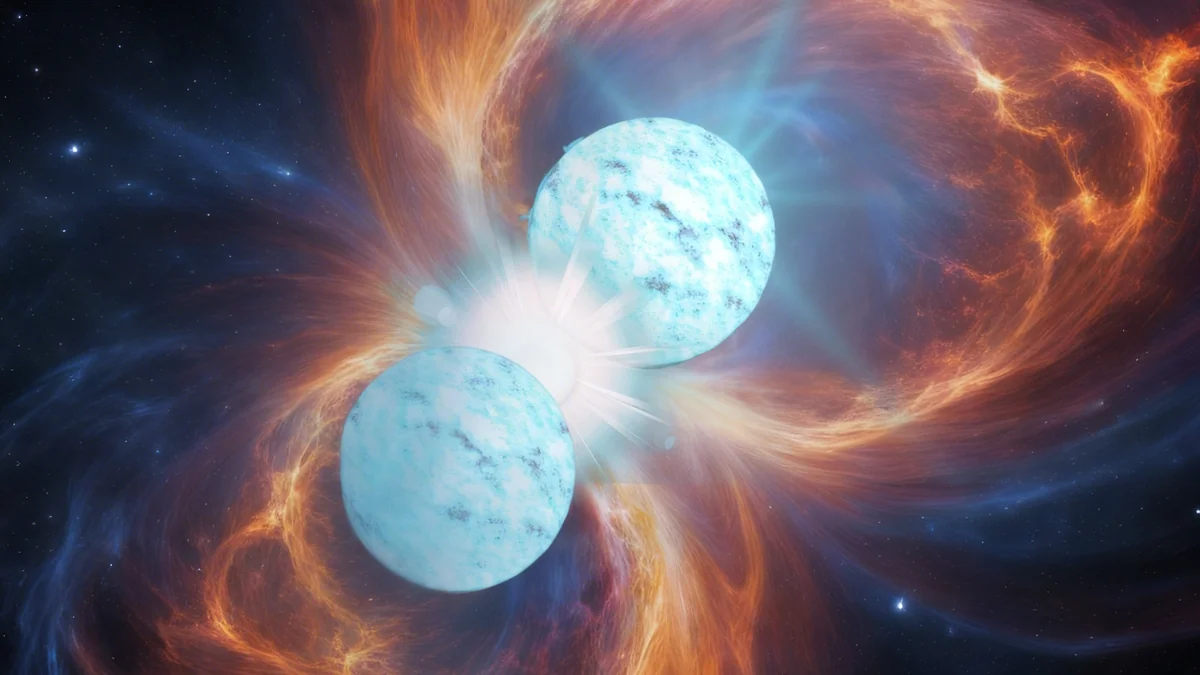
Astronomers using the James Webb Space Telescope have solved a long-standing cosmic mystery, identifying for the first time the type of star that remains after two stars collide and merge. The result, a massive and surprisingly cool object, challenges previous assumptions about stellar evolution and highlights the role these violent events play in creating the chemical building blocks of life.
The powerful infrared vision of the Webb telescope allowed scientists to peer through dense clouds of dust that shrouded the aftermath of these mergers, known as luminous red novae. What they found was not the hot, compact star they anticipated, but a swollen object resembling a red supergiant, offering new insights into the life cycle of stars.
Key Takeaways
- The James Webb Space Telescope (JWST) has observed the remnant of a stellar merger, identifying it as a cool, supermassive star similar to a red supergiant.
- This discovery was unexpected, as scientists predicted the merged object would be hotter and more compact.
- The observations focused on two specific events, AT 2011kp and AT 1997bs, years after their initial explosions.
- The dust ejected during these mergers is rich in carbon compounds, essential ingredients for life, suggesting these events help seed the universe with vital elements.
A Cosmic Question Answered
For years, the final outcome of a luminous red nova, an explosion triggered by the collision of two stars, remained unknown. While astronomers could observe the initial bright flash, the central object created by the merger was hidden behind a thick veil of gas and dust ejected during the event.
These events are crucial for understanding stellar lifecycles. They are brighter than classical novae but less powerful than supernovae, occupying a unique middle ground in cosmic explosions. The stars involved can range from smaller than our sun to giants up to 50 times its mass.
A research team led by Andrea Reguitti of Italy's National Institute for Astrophysics (INAF) utilized the unparalleled capabilities of the James Webb Space Telescope to finally get a clear view. By observing in infrared light, Webb could penetrate the obscuring dust and study the stellar remnant directly.
Peering Through the Dust
The primary challenge in studying these events is the sheer amount of material thrown into space. A single luminous red nova can expel dust equivalent to 300 times the mass of Earth. This dense cloud makes it impossible for optical telescopes to see what lies at the center until years, or even decades, have passed.
"We don't normally witness the evolution of a system over millions of years, but these pairs of stars are experiencing the final moments before their collision, which instead occurs much more rapidly," Reguitti explained in a statement. This allows scientists to study a complete, rapid evolutionary event in near real-time.
What is a Luminous Red Nova?
A luminous red nova (LRN) is a stellar explosion thought to be caused by the merger of two stars. It is a transient astronomical event, meaning it appears suddenly and then fades over weeks or months. Its brightness falls between that of a standard nova (an eruption on a white dwarf) and a supernova (the catastrophic death of a massive star).
Two Case Studies Decades in the Making
The team focused its investigation on two specific luminous red novae. The first, designated AT 2011kp, occurred in a galaxy 25 million light-years away. Webb observed it in 2023, twelve years after the initial merger.
The second object, AT 1997bs, is located in a galaxy 31 million light-years from Earth. Webb's observations took place in 2024, a full 27 years after the event. This long baseline allowed the dust cloud to thin sufficiently for the telescope to see the central object clearly.
"Until now, it was unknown what type of star would remain after the merger."
By combining new data from Webb with archival images from the Hubble and Spitzer space telescopes, the researchers pieced together the full story of these stellar collisions, from the progenitor stars before the merger to the final product long after.
An Unexpected Giant
The results surprised the scientific team. The object left behind by the merger was not the hot, dense star they had theorized. Instead, they found a massive star that was remarkably cool and large, bearing a strong resemblance to a red supergiant.
"We didn't expect to find this type of object as a result of the merger," said team member Andrea Pastorello, also of INAF. The expectation was that combining two stars into one would create a more compact and hotter body.
Cool and Colossal
- Size: The resulting star is hundreds of times larger than our sun. If placed in our solar system, it would extend past the orbit of Mars and approach Jupiter.
- Temperature: Its surface temperature is between 5,840 and 6,740 degrees Fahrenheit (3,200 to 3,700 degrees Celsius).
- Comparison: Our sun's surface temperature is much hotter, at around 10,300 degrees Fahrenheit (5,700 degrees Celsius).
This discovery forces a re-evaluation of models describing how stars evolve after merging. It suggests a different, cooler stabilization phase than previously understood, providing a new piece of the puzzle in the complex lives of stars.
The Building Blocks of Life
Beyond identifying the resulting star, Webb's powerful instruments also allowed the team to analyze the chemical composition of the surrounding dust cloud. They discovered that the dust is rich in carbon-based compounds, such as graphite.
Carbon is a fundamental element for life as we know it. The finding that luminous red novae are significant producers of this element suggests they play a vital role in seeding galaxies with the raw materials necessary for forming planets and, eventually, life.
This connection reinforces a profound concept in astronomy: the cosmic origin of the elements that make up our world and our bodies. "We are made of carbon compounds, the same carbon that this dust is rich in," Reguitti noted. "It's a different way of telling the old story that we are 'stardust.'"
The team's research, set for publication in the journal Astronomy & Astrophysics, not only solves a mystery about the fate of merged stars but also deepens our understanding of our own cosmic origins.