
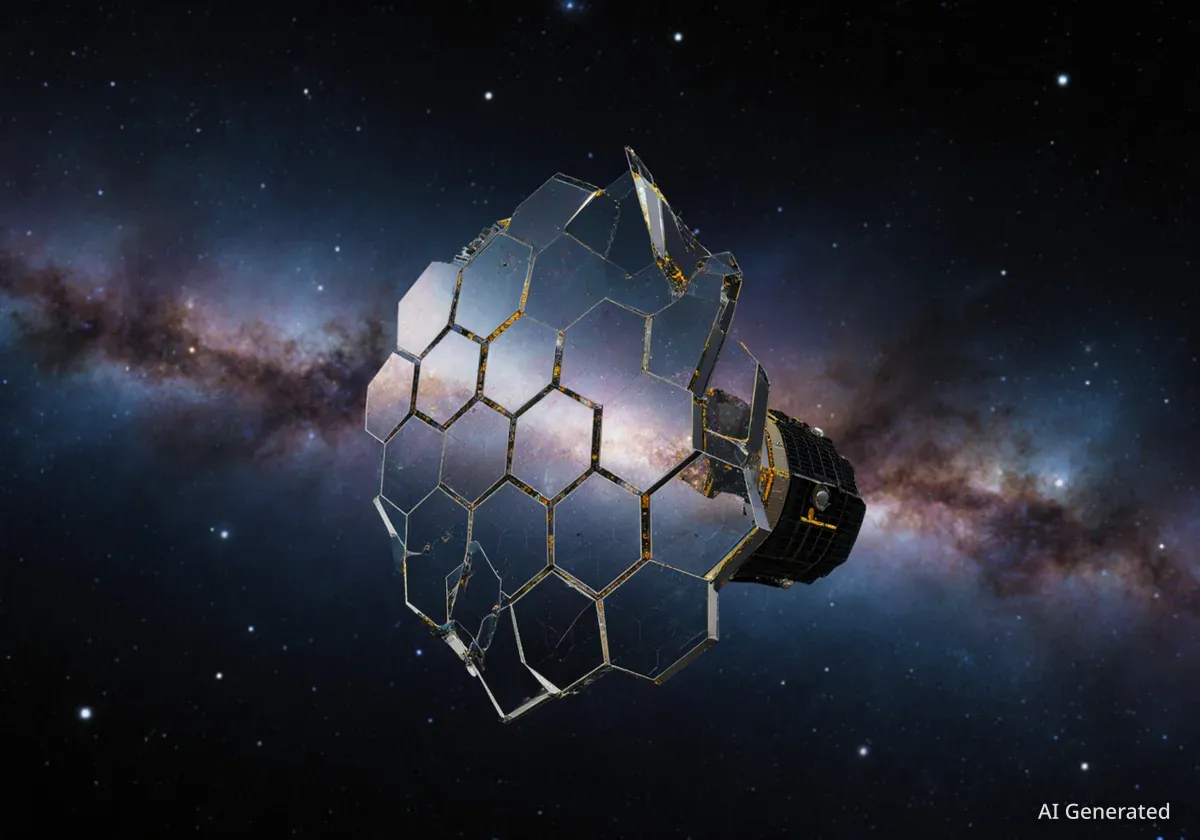

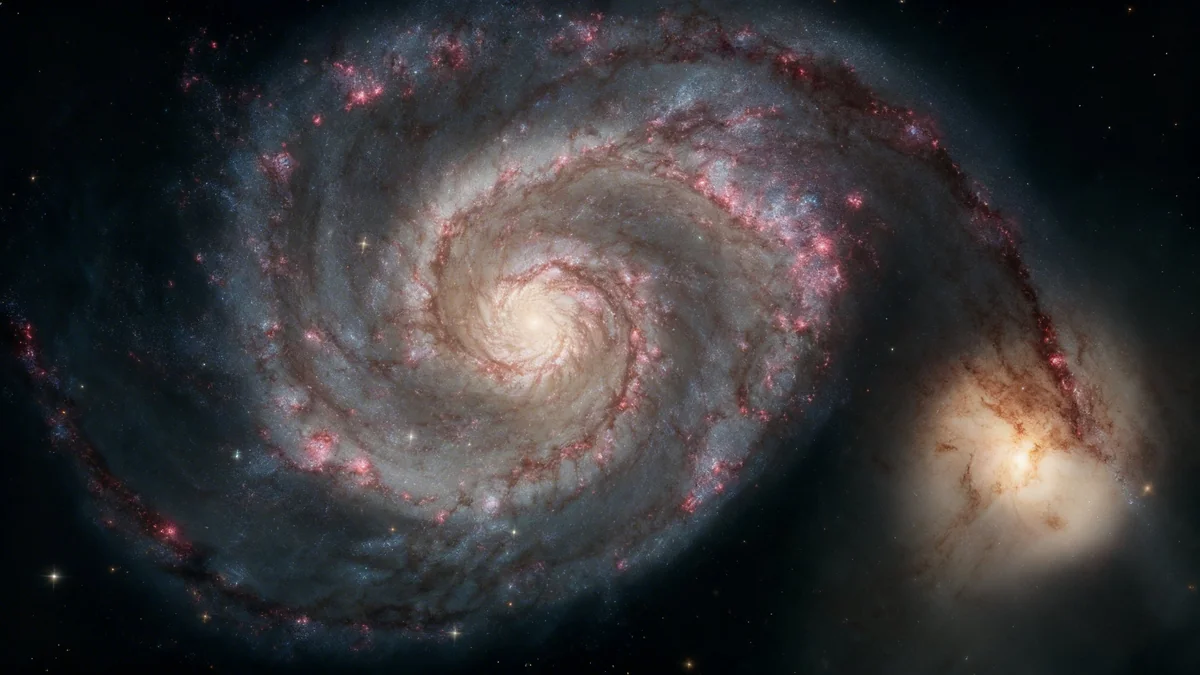
Astronomers using the James Webb Space Telescope have discovered the most distant 'jellyfish' galaxy ever observed, providing a rare look at how galaxies were transformed when the universe was much younger. The galaxy, whose light has traveled for 8.5 billion years to reach us, is being stripped of its gas as it moves through a crowded cluster, leaving behind long, glowing tentacles of newborn stars.
This finding challenges previous ideas about the early universe, suggesting that the environments within galaxy clusters were harsh enough to reshape galaxies much earlier than scientists believed. The observation offers new clues about the processes that may have led to the formation of many of the 'dead' or inactive galaxies seen in clusters today.
Key Takeaways
- The James Webb Space Telescope has identified the most distant jellyfish galaxy to date.
- The galaxy is seen as it was 8.5 billion years ago, offering a glimpse into the early universe.
- Its distinctive tentacles are formed by a process called ram-pressure stripping, where gas is pulled away as the galaxy moves through a cluster.
- The discovery suggests that galaxy clusters were mature and disruptive environments earlier in cosmic history than previously thought.
A Cosmic Jellyfish in Deep Space
Researchers from the University of Waterloo have located a unique galaxy that resembles a jellyfish drifting through the cosmic ocean. Named for the long, trailing streams of gas and stars that look like tentacles, these galaxies are a product of their violent environments. This particular one is the most remote example ever found.
Its light has taken 8.5 billion years to travel to Earth, meaning we are observing it at a time when the universe was only about 5.2 billion years old. The discovery was made while analyzing data from the Cosmic Evolution Survey Deep field, or COSMOS field, a well-studied patch of sky chosen for its clear view into the distant universe.
"We were looking through a large amount of data from this well-studied region in the sky with the hopes of spotting jellyfish galaxies that haven't been studied before," said Dr. Ian Roberts, a postdoctoral fellow at the Waterloo Centre for Astrophysics.
"Early on in our search of the JWST data, we spotted a distant, undocumented jellyfish galaxy that sparked immediate interest."
What is a Jellyfish Galaxy?
Jellyfish galaxies get their name from their appearance. They are typically found moving at high speeds through the center of a dense galaxy cluster. These clusters are filled with a superheated, thin gas. As the galaxy plows through this gas, the intense pressure acts like a powerful headwind, stripping the galaxy's own gas and dust away from its main disk and pulling it into long, trailing tentacles.
The Power of Ram-Pressure Stripping
The process responsible for creating the galaxy's tentacles is known as ram-pressure stripping. It is a powerful force that can dramatically alter a galaxy's evolution. As the galaxy's gas is stripped away, it loses the raw material needed to form new stars within its main body.
However, the new Webb observations show something remarkable happening within the stripped gas itself. Along the galaxy's trailing tentacles, astronomers identified bright blue clumps. These are massive clusters of extremely young stars that have formed within the gas that was pushed out of the galaxy.
This star formation outside the main galactic disk is a key signature of ram-pressure stripping. It confirms that the gas is being compressed as it's pulled away, triggering a burst of star birth in these unusual, trailing structures.
An Ancient Observation
The newly discovered galaxy is located at a redshift of z = 1.156. In astronomy, redshift is a measure of how much an object's light has been stretched by the expansion of the universe. A higher redshift means the object is farther away and its light is older. This redshift corresponds to a look-back time of 8.5 billion years.
Rewriting Early Cosmic History
The discovery of such a well-defined jellyfish galaxy so early in the universe's history has significant implications for our understanding of galaxy evolution. Many astronomers believed that 8.5 billion years ago, galaxy clusters were still in the process of forming and were not yet dense or hot enough to cause such dramatic ram-pressure stripping.
This finding suggests the opposite. The environment in this ancient cluster was already mature and harsh enough to violently transform a galaxy passing through it.
"The first is that cluster environments were already harsh enough to strip galaxies, and the second is that galaxy clusters may strongly alter galaxy properties earlier than expected," Dr. Roberts explained. This early activity could be a key factor in explaining why so many galaxies found in modern clusters are considered 'dead'—that is, they no longer form stars.
- Early Harsh Environments: Galaxy clusters were disruptive forces sooner than previously understood.
- Rapid Transformation: Galaxies could have their star-forming gas stripped away quickly, halting their growth.
- Origin of 'Dead' Galaxies: This process might be a primary reason for the large populations of inactive galaxies in the universe today.
Future Observations with Webb
This initial discovery, published in The Astrophysical Journal, has opened a new window into the past. It provides a rare, direct observation of a key galactic transformation process happening in the early universe.
To learn more, Dr. Roberts and his team have already applied for more dedicated observation time with the James Webb Space Telescope. They hope to conduct a more detailed study of this specific jellyfish galaxy to analyze the composition of its gas and the properties of the stars forming in its tentacles.
Further research on this and other distant jellyfish galaxies could reshape theories on how the dense, clustered environments of the cosmos have shaped the galaxies we see around us today.