

The world's first commercial space telescope has successfully captured its initial measurements, signaling a new era where private companies join government agencies in the scientific exploration of the cosmos. The satellite, named Mauve, is designed to study nearby stars to help scientists identify which ones might host planets capable of supporting life.
Launched in November last year, the suitcase-sized observatory is now entering its operational phase. Its first target was a well-known star in the Ursa Major constellation, providing crucial data that confirms the telescope's systems are functioning as expected.
Key Takeaways
- The first commercial space telescope, Mauve, has captured its first stellar light.
- Its primary mission is to study ultraviolet light from nearby stars to assess the habitability of their exoplanets.
- The project, led by Blue Skies Space, demonstrates a faster, more agile approach to space science compared to traditional agency-led missions.
- Mauve aims to fill a data gap in ultraviolet astronomy left since the last dedicated mission ended in 1996.
A Milestone for Commercial Space Science
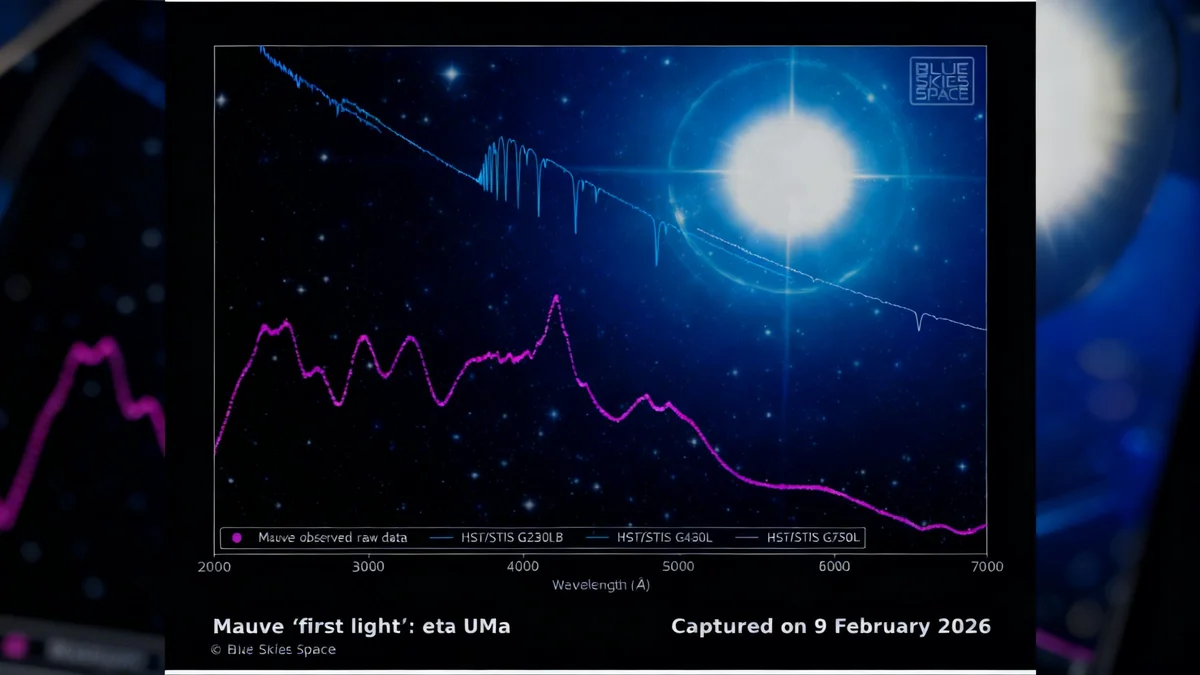
On February 9, after several months of in-orbit checks and calibration, the Mauve telescope pointed its instruments toward eta Ursa Majoris. This star, located approximately 104 light-years from Earth, is one of the brightest objects in the Great Bear constellation and serves as an ideal first target.
The observation, which lasted just five seconds, collected data in both the visible and ultraviolet portions of the light spectrum. According to Marcell Tessenyi, CEO of Blue Skies Space, the company behind the mission, eta Ursa Majoris was chosen for its stability and the existence of previous high-quality data from other instruments, allowing for a clear comparison.
"We wanted to look at a stable star, which behaves in a constant way over time and for which there has already been high-quality spectra collected," Tessenyi explained. This initial success validates the telescope's design and paves the way for its scientific operations to begin.
Focusing on Ultraviolet Clues
Mauve's specialization is observing ultraviolet (UV) light, a part of the spectrum that is difficult to study from Earth due to atmospheric interference. This capability is critical for understanding stellar activity, particularly stellar flares.
These powerful bursts of radiation can significantly impact the environment around a star. While our Sun is relatively calm, many other stars experience frequent and intense flares. Such events could strip away the atmospheres of nearby planets, rendering them uninhabitable. By monitoring the UV emissions of stars, Mauve will provide astronomers with essential data to determine which star systems are more likely to harbor life-friendly exoplanets.
Filling a Decades-Long Gap
The field of ultraviolet astronomy has been underserved for years. The last dedicated mission to observe stellar UV light was the International Ultraviolet Explorer, which ceased operations in 1996. While the Hubble Space Telescope can measure UV light, its time is in extremely high demand across all fields of astronomy. Mauve offers a dedicated and accessible platform to resume this important work.
The mission will help scientists better understand the relationship between a star's magnetic activity and the potential for life to exist on its orbiting planets. For instance, while Earth is protected by a strong magnetic field, a planet like Mars, which lacks a global magnetic shield, has had its atmosphere steadily eroded by solar radiation over billions of years.
A New Model for Astronomical Research
The success of Mauve represents a significant shift in how space science is conducted. Historically, astronomy has been the domain of large, government-funded space agencies like NASA and ESA. These missions, while groundbreaking, often take decades to develop and cost billions of dollars.
Blue Skies Space, a spin-out from University College London, is pioneering a different approach. By utilizing advances in satellite technology and the availability of commercial launch providers like SpaceX, the company developed and built Mauve in just three years. This agile, customer-driven model allows for faster responses to specific scientific needs.
"It's a fascinating opportunity that we have here because, obviously, the space sector has evolved a lot over the last decade... There are plenty of opportunities for many satellites to do space science."
Research institutions from the United States, Japan, and several European countries have already subscribed to use Mauve's observation time. The data collection for these scientific partners is expected to begin within the next two weeks as the final instrument calibrations are completed.
Mission Quick Facts
- Satellite Name: Mauve
- Size: Comparable to a small suitcase
- Launch Date: November 2023
- Launch Vehicle: SpaceX Falcon 9
- Primary Focus: Ultraviolet (UV) stellar observations
- Expected Mission Duration: At least three years
Future Ambitions for Private Astronomy
Mauve is just the first step in a larger plan for Blue Skies Space. The revenue generated from its operations will fund the development of the company's next, more ambitious mission, named Twinkle. This 100-kilogram satellite will be designed to directly observe exoplanets and analyze the chemical compositions of their atmospheres, searching for biosignatures.
Tessenyi emphasized that commercial missions are not meant to replace large-scale agency projects like the James Webb Space Telescope. Instead, they complement them by focusing on specific data gaps and reusing existing, proven technologies in innovative ways.
"The space agencies are doing an incredible job with pushing the technology," he stated. "We, on the other hand, are operating more in the domain of reusing existing components... to try to increment the provision of data."
As Mauve begins its scientific journey, it stands as a testament to a new, more democratized era of space exploration, where nimble commercial endeavors can make significant contributions to our understanding of the universe.