
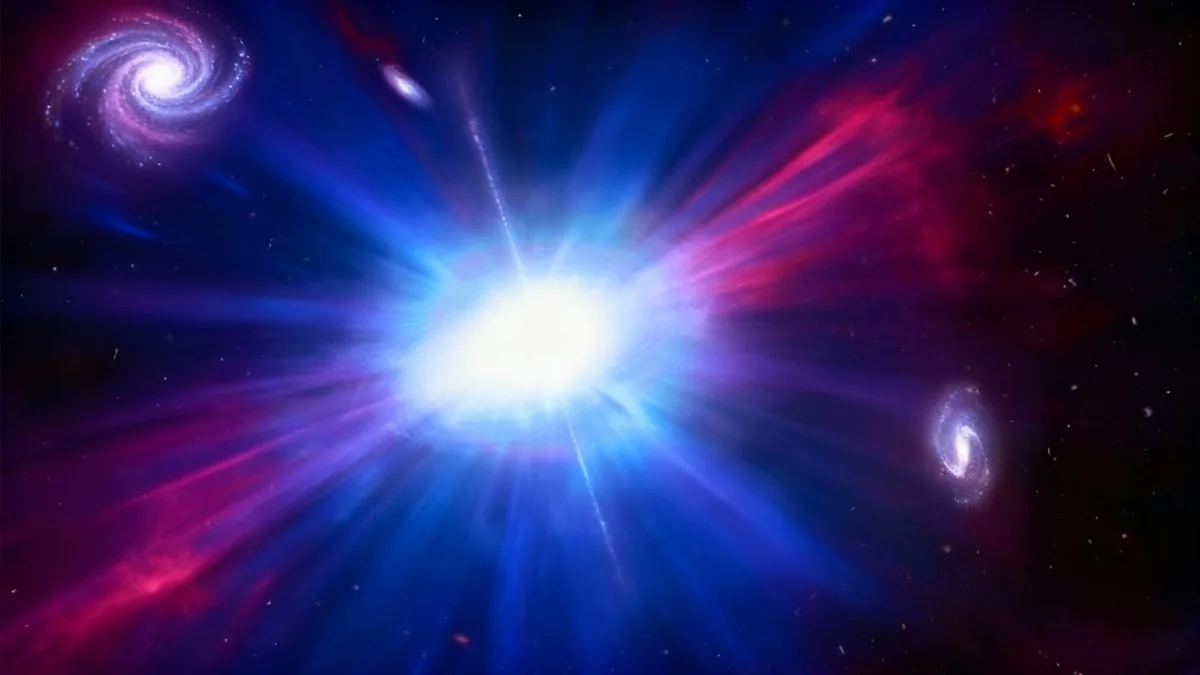

An international team of astronomers using the James Webb Space Telescope has identified one of the most distant supernovas ever recorded, witnessing the explosive death of a massive star that occurred when the universe was just 730 million years old. The discovery offers a rare glimpse into the life and death of the first generations of stars.
The event, designated SN in GRB 250314A, was first detected as a powerful gamma-ray burst on March 14, 2025. Subsequent observations with the Webb telescope confirmed its immense distance and provided detailed information that is challenging long-held assumptions about the early cosmos.
Key Takeaways
- Astronomers detected a supernova that exploded when the universe was only about 730 million years old, deep within the era of reionization.
- The discovery was made possible by combining initial alerts from the SVOM satellite with follow-up observations from the Very Large Telescope and the James Webb Space Telescope (JWST).
- Surprisingly, the ancient supernova's brightness and characteristics closely resemble those of modern supernovas, such as the well-studied SN 1998bw.
- This finding suggests that the first massive stars might have died in ways very similar to stars in our local universe, despite forming in a much different, less metallic environment.
- Researchers plan further JWST observations in the next two years to study the supernova's faint host galaxy after the explosion's light has faded.
A Cosmic Detective Story
The journey to identifying this ancient explosion began on March 14, 2025, when the space-based SVOM (Space-based multi-band astronomical Variable Objects Monitor) detected a brilliant flash of high-energy radiation. This event was classified as a long-duration Gamma-Ray Burst (GRB), a type of cosmic blast often associated with the collapse of a massive star into a black hole.
This initial alert triggered a rapid response from observatories on the ground. Astronomers using the European Southern Observatory's Very Large Telescope (ESO/VLT) in Chile quickly pointed their instruments at the source of the burst. Their observations confirmed the event's extreme distance, placing it at a redshift of approximately 7.3, which corresponds to a time when the universe was in its infancy.
With the distance confirmed, the team secured observation time with the powerful James Webb Space Telescope. Approximately 110 days after the initial gamma-ray burst, Webb’s Near-Infrared Camera (NIRCAM) was able to isolate the fading light of the explosion from its dim host galaxy, providing the crucial data needed to confirm it as a supernova.
What is the Era of Reionization?
The era of reionization is a critical period in cosmic history that occurred from about 150 million to one billion years after the Big Bang. During this time, the universe, which was filled with neutral hydrogen gas, was transformed as the first stars and galaxies formed. Their intense radiation ionized the surrounding gas, making the cosmos transparent to light for the first time. Studying events from this era provides direct insight into how the first cosmic structures were built.
An Unexpected Similarity
One of the most significant findings from the Webb observations is how remarkably similar this ancient supernova is to those seen in the nearby, modern universe. Scientists compared its properties to SN 1998bw, a well-documented supernova associated with a gamma-ray burst that occurred much closer to Earth.
Dr. Antonio Martin-Carrillo, an astrophysicist at UCD School of Physics and co-author of the study, highlighted the importance of this connection.
"The key observation, or smoking gun, that connects the death of massive stars with gamma-ray bursts is the discovery of a supernova emerging at the same sky location," he explained. "Almost every supernova ever studied has been relatively nearby to us, with just a handful of exceptions to date."
The research team had developed models based on local supernovas to predict what Webb might see. To their surprise, the data from the distant supernova matched their predictions almost perfectly. This challenges the prevailing theory that stars in the early universe, which formed from gas with very few heavy elements (low metallicity), would produce explosions that were vastly different—perhaps much brighter or bluer—than those seen today.
A Universe of Different Ingredients
The early universe was composed almost entirely of hydrogen and helium. Heavier elements, which astronomers refer to as "metals," were forged inside the first stars and scattered throughout space when they exploded. The fact that this ancient, low-metallicity star produced a "normal" supernova suggests that the fundamental physics of stellar collapse may be more universal than previously thought.
Peering into a Primordial Galaxy
Beyond studying the supernova itself, the Webb telescope's observations provided a glimpse into the galaxy that hosted the dying star. Separating the supernova's light from its host galaxy is a technical challenge, especially at such vast distances where the galaxy appears as little more than a faint smudge.
"We were also able to get a glimpse of the galaxy that hosted this dying star," Dr. Martin-Carrillo added. The initial data suggest it is a faint, young galaxy, typical of the structures that were just beginning to populate the universe at that time.
The ability to observe both a stellar explosion and its home environment from this early cosmic epoch is a major step forward. It allows scientists to directly test theories of how the first stars influenced their surroundings and contributed to the process of reionization.
Future Observations Planned
While this discovery provides a powerful new data point, it also raises new questions about the uniformity of stellar explosions across cosmic time. Was this supernova an anomaly, or is it representative of how massive stars died in the early universe?
To find answers, the research team has already planned further observations. They intend to use the James Webb Space Telescope again in one to two years to revisit the location of GRB 250314A.
By then, the light from the supernova is expected to have faded by a factor of more than six, becoming significantly dimmer. This will allow astronomers to subtract the supernova's remaining glow and obtain a clean, unobstructed view of its host galaxy. These future observations will enable a complete characterization of the galaxy's properties, such as its mass, rate of star formation, and chemical composition, providing essential context for the star that produced the spectacular explosion.
The findings, published in the journal Astronomy & Astrophysics, mark a new chapter in our ability to probe the dawn of time and understand the cosmic engines that shaped the universe we see today.