
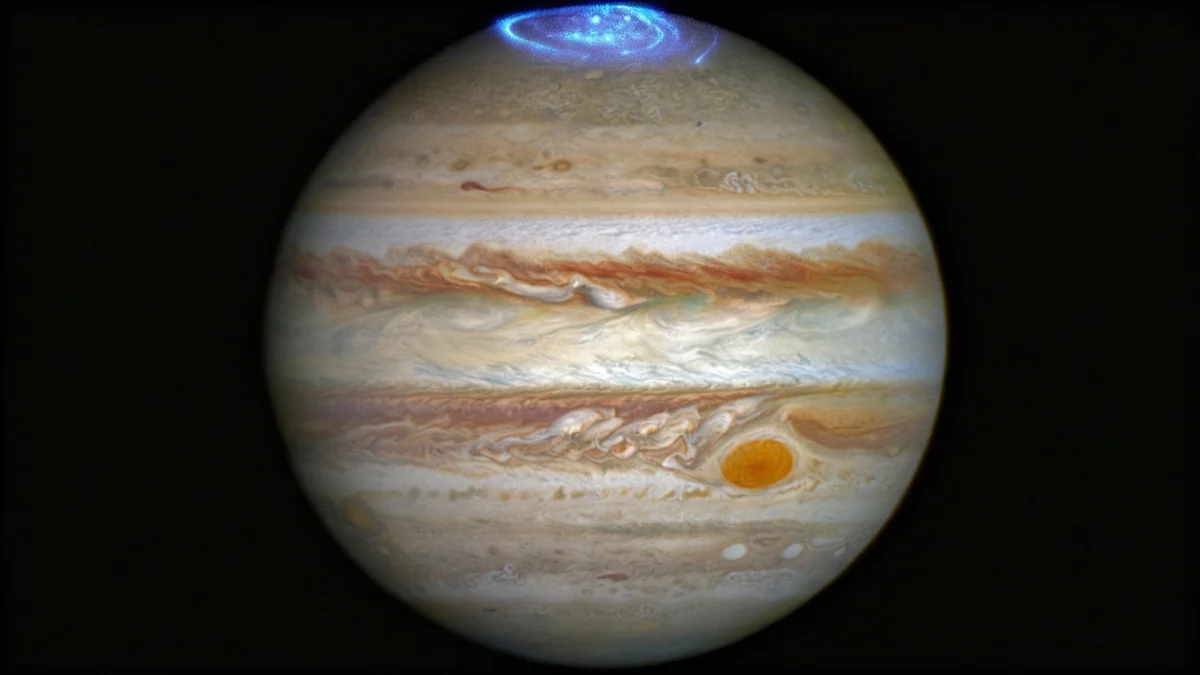
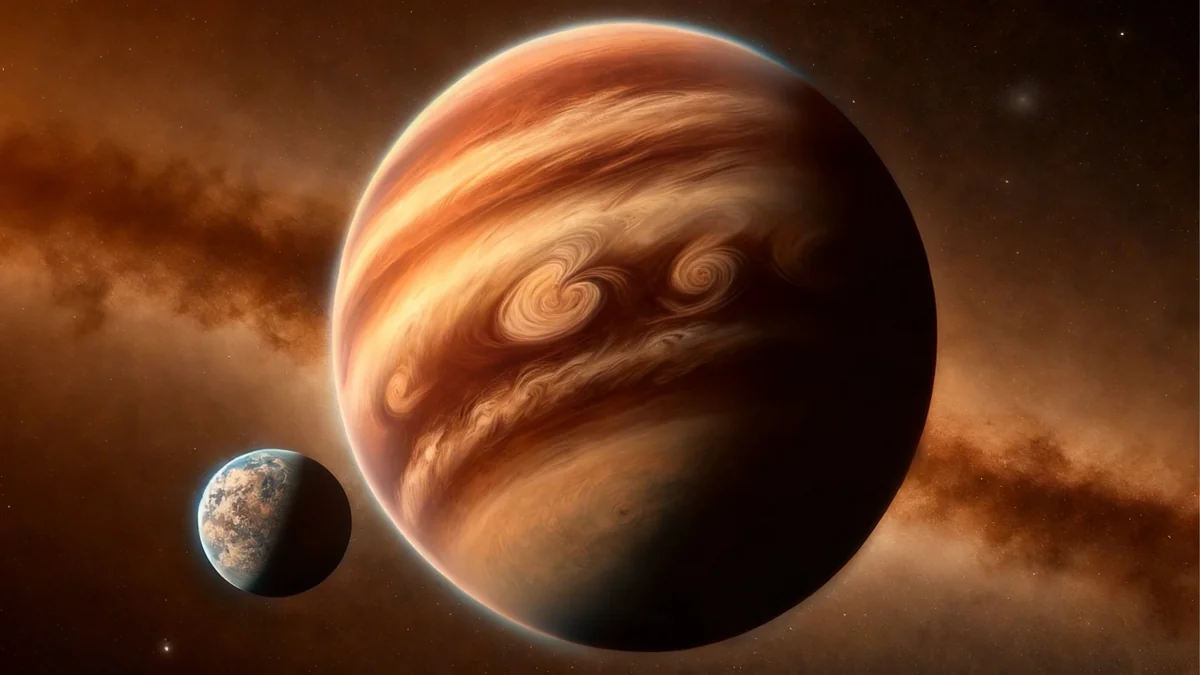

New research reveals that Jupiter's immense gravity played a critical role in the architecture of our solar system, effectively saving the building blocks of Earth, Mars, and Venus from being pulled into the sun. A recent study suggests the gas giant created cosmic barriers in the early solar system, allowing rocky planets to form in a stable environment.
By carving out gaps in the protoplanetary disk of gas and dust that surrounded the young sun, Jupiter prevented a catastrophic inward spiral of material. This action not only secured the raw materials for the inner planets but also dictated the timing and composition of their formation, according to computer simulations modeling the solar system's first few million years.
Key Takeaways
- Jupiter's rapid growth created rings and gaps in the early solar system's disk of gas and dust.
- These gaps acted as barriers, preventing material that formed Earth and other inner planets from falling into the sun.
- This process explains the distinct chemical compositions found in meteorites from the inner and outer solar system.
- The gas giant's influence also accounts for why some ancient meteorites formed millions of years later than others.
The Solar System's Architect
Long before Earth was a solid planet, Jupiter was already defining its future. Scientists now believe the gas giant's early and rapid expansion was the single most important factor in establishing the structure of the inner solar system. Its gravitational pull was so powerful that it sculpted the swirling disk of primordial material around our sun.
This new understanding comes from sophisticated computer models developed by a team at Rice University. The simulations show that as Jupiter grew, it created powerful ripples in the gas and dust disk, forming distinct rings and vast empty gaps.
"Jupiter didn't just become the biggest planet — it set the architecture for the whole inner solar system," stated Andre Izidoro, a co-lead of the study and assistant professor at Rice University. "Without it, we might not have Earth as we know it."
These gaps were not merely empty space; they functioned as cosmic dams. They effectively halted the natural inward flow of dust and pebbles, which would have otherwise been consumed by the sun. This trapped material became the reservoir from which the rocky planets were built.
A Tale of Two Meteorites
One of the long-standing puzzles in planetary science is the clear chemical divide found in meteorites. For years, scientists have noted two distinct "isotopic" signatures—one group of meteorites originating from the inner solar system and another from the outer regions. It was unclear what physical barrier could have kept these materials separate for millions of years.
Cosmic Divide
The gap created by Jupiter was so effective it separated the solar system into two distinct zones. This division prevented material from mixing, preserving the unique chemical fingerprints now found in different classes of meteorites that fall to Earth.
The new models provide a compelling answer. Jupiter's formation created a wide, persistent gap in the protoplanetary disk that acted as an impenetrable wall. This barrier prevented the free exchange of materials between the inner and outer solar system, preserving their unique chemical compositions.
"Our model ties together two things that didn't seem to fit before — the isotopic fingerprints in meteorites, which come in two flavors, and the dynamics of planet formation," explained Baibhav Srivastava, a graduate student at Rice University who co-led the research.
The Mystery of Delayed Formation
The study also sheds light on another cosmic mystery: why certain ancient meteorites, known as chondrites, formed significantly later than other solid bodies. Some of these pristine objects, which contain a chemical record of the solar system's birth, are 2 to 3 million years younger than the first solids.
Researchers propose that Jupiter's influence is the direct cause. By halting the flow of dust inward, the planet's gravity created conditions where a second generation of planetesimals—the small bodies that coalesce to form planets—could be born. This later formation event produced the chondritic meteorites we study today.
"The mystery has always been: Why did some of these meteorites form so late?" said Izidoro. "Our results show that Jupiter itself created the conditions for their delayed birth."
Echoes in Distant Star Systems
The theoretical models presented in the study are not just speculation. They are strongly supported by direct observations of distant, young star systems. Telescopes like the Atacama Large Millimeter/submillimeter Array (ALMA) in Chile have captured stunning images of protoplanetary disks around other stars, and they look remarkably similar to the simulations.
Observing Planetary Birth
The ALMA observatory can detect the faint millimeter-wavelength light emitted by dust grains in distant star systems. Its images have revealed disks with clear rings and gaps, which astronomers widely believe are being carved out by newly forming giant planets, just as Jupiter did in our own system.
These observations provide powerful evidence that the formation of giant planets is a key driver in shaping the architecture of planetary systems across the galaxy. The same physical processes that allowed Earth to form are likely playing out in countless other star systems.
The research, published in the journal Science Advances, reinforces the idea that our solar system's history is written in the smallest of objects that fall to Earth. "Jupiter's early growth left a signature we can still read today, locked inside meteorites that fall to Earth," Izidoro concluded. This work provides a more complete picture of our cosmic origins, highlighting the profound and perhaps essential role of our solar system's largest planet in making life on Earth possible.