


Astronomers using the James Webb Space Telescope and the ALMA observatory have pieced together the story of a young galaxy's demise, finding it was not a sudden cataclysm but a slow, prolonged starvation caused by its own supermassive black hole. The galaxy, located 11 billion light-years away, was gradually stripped of its star-forming fuel in a process described as a "death by a thousand cuts."
This discovery provides a compelling explanation for the growing number of seemingly old, inactive galaxies observed in the early universe. Rather than a single, violent event shutting down star formation, the new evidence points to a recurring cycle of gas expulsion that prevents galaxies from refueling, causing them to "live fast and die young."
Key Takeaways
- A massive galaxy in the early universe, GS-10578, prematurely stopped forming stars.
- Its central supermassive black hole is ejecting gas in repeated, ongoing cycles, not a single massive blast.
- This slow starvation process prevents the galaxy from accumulating new fuel for star birth.
- The findings, combining data from the JWST and ALMA telescopes, could explain why many ancient galaxies appear unexpectedly mature and inactive.
A Cosmic Crime Scene in the Early Universe
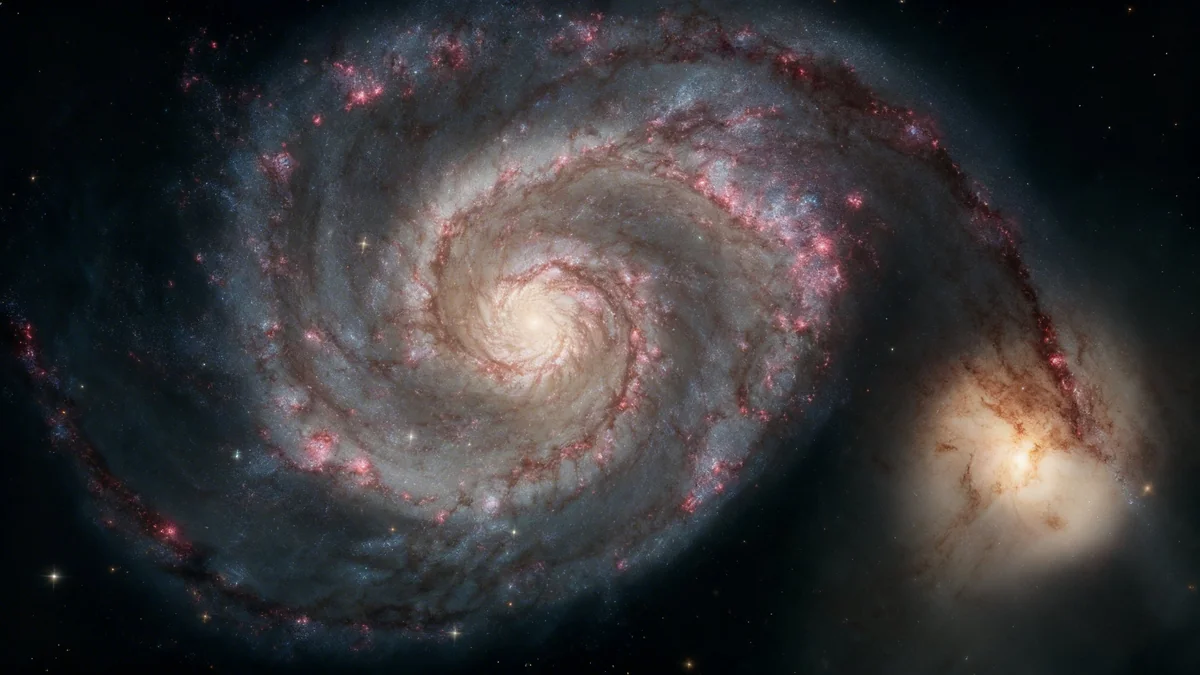
Astronomers are investigating a massive galaxy from the dawn of the cosmos that appears to have died prematurely. Known officially as GS-10578, and nicknamed "Pablo's Galaxy," this celestial object is seen as it was just 3 billion years after the Big Bang. For a galaxy of its era, it is exceptionally large, containing the mass of approximately 200 billion suns.
Despite its youth, Pablo's Galaxy had already ceased creating new stars, a state astronomers refer to as quiescence, or galactic "death." Most of its stars formed in a burst between 11.5 and 12.5 billion years ago. Then, about 400 million years ago, the stellar nurseries went quiet. This presented a puzzle: what could halt star formation so completely in such a massive and young galaxy without evidence of a catastrophic collision?
What Does It Mean for a Galaxy to 'Die'?
In astronomical terms, a galaxy's life is defined by its ability to form new stars. This process requires vast reservoirs of cold hydrogen gas. When a galaxy exhausts this gas or loses the ability to accumulate more, star formation ceases. It becomes a "quiescent" or "red and dead" galaxy, populated only by older, redder stars. This transition marks the end of its active life.
Combining Telescopes to Find the Culprit
To solve the mystery, researchers used a powerful combination of observatories. The James Webb Space Telescope (JWST) first observed powerful outflows of gas being driven from the galaxy's center by its supermassive black hole. This material was being ejected at incredible speeds of up to 2.2 million miles per hour (3.5 million km/h), fast enough to escape the galaxy's gravitational pull entirely.
However, this observation alone didn't explain the complete shutdown. The team then turned to the Atacama Large Millimeter/submillimeter Array (ALMA) in Chile, a network of 66 radio telescopes. They conducted a deep, seven-hour observation searching for carbon monoxide, a tracer molecule used to detect the cold hydrogen gas that fuels star birth.
The search came up empty.
"What surprised us was how much you can learn by not seeing something," stated Jan Scholtz of Cambridge University, a member of the research team. "Even with one of ALMA's deepest observations of this kind of galaxy, there was essentially no cold gas left. It points to a slow starvation rather than a single dramatic death blow."
The Mechanism of a Slow Starvation
The combined data from JWST and ALMA painted a clear picture of a gradual death. The supermassive black hole at the heart of Pablo's Galaxy was not responsible for a single, galaxy-clearing event. Instead, it appears to be caught in a repeating cycle of activity.
Further JWST observations lasting 6.5 hours revealed the galaxy is currently losing gas equivalent to the mass of 60 suns every year. At this rate, its remaining fuel reserves could have been depleted in as little as 16 million to 220 million years—a remarkably short period compared to the billion-year timescale typically expected for a galaxy to run out of gas.
A Calm but Dying Galaxy
Analysis of the galaxy's structure showed it to be a calm, rotating disc. According to Francesco D'Eugenio of the Kavli Institute for Cosmology, this is crucial evidence. "That tells us it didn't suffer a major, disruptive merger with another galaxy," he explained. The lack of disturbance points to an internal process, implicating the black hole as the primary cause of death.
The team's reconstruction of the galaxy's history suggests the black hole's periodic outbursts act like a persistent shield. These repeated episodes of gas expulsion prevent any fresh gas from the cosmic web from falling back into the galaxy and replenishing its star-forming reservoirs.
"So the current black hole activity and the outburst of gas we observed didn't cause the shutdown; instead, repeated episodes likely kept the fuel from coming back," D'Eugenio added.
Implications for the Early Universe
The discovery of this slow starvation mechanism could be a pivotal moment in understanding cosmic evolution. Since its launch, the JWST has been identifying a surprising number of massive, quiescent galaxies in the very early universe, a finding that has challenged existing models of galaxy formation.
The case of Pablo's Galaxy suggests a viable explanation for these observations. It shows that a galaxy doesn't need a violent merger or a single, cataclysmic event to stop forming stars.
- Continuous Fuel Removal: A central black hole can consistently remove or block incoming fuel.
- Rapid Aging: This process can cause a galaxy to age and become inactive much faster than previously thought.
- A Common Phenomenon: This starvation effect may be a common reason why so many early galaxies appear to have lived fast and died young.
"You don't need a single cataclysm to stop a galaxy forming stars, just keep the fresh fuel from coming in," Scholtz concluded. "Before Webb, these were unheard of. Now we know they're more common than we thought—and this starvation effect may be why they live fast and die young."
With the successful partnership of JWST and ALMA now established, astronomers hope to study Pablo's Galaxy further to refine their understanding of how supermassive black holes regulate the life and death of their host galaxies. The findings were published in the journal Nature Astronomy.