
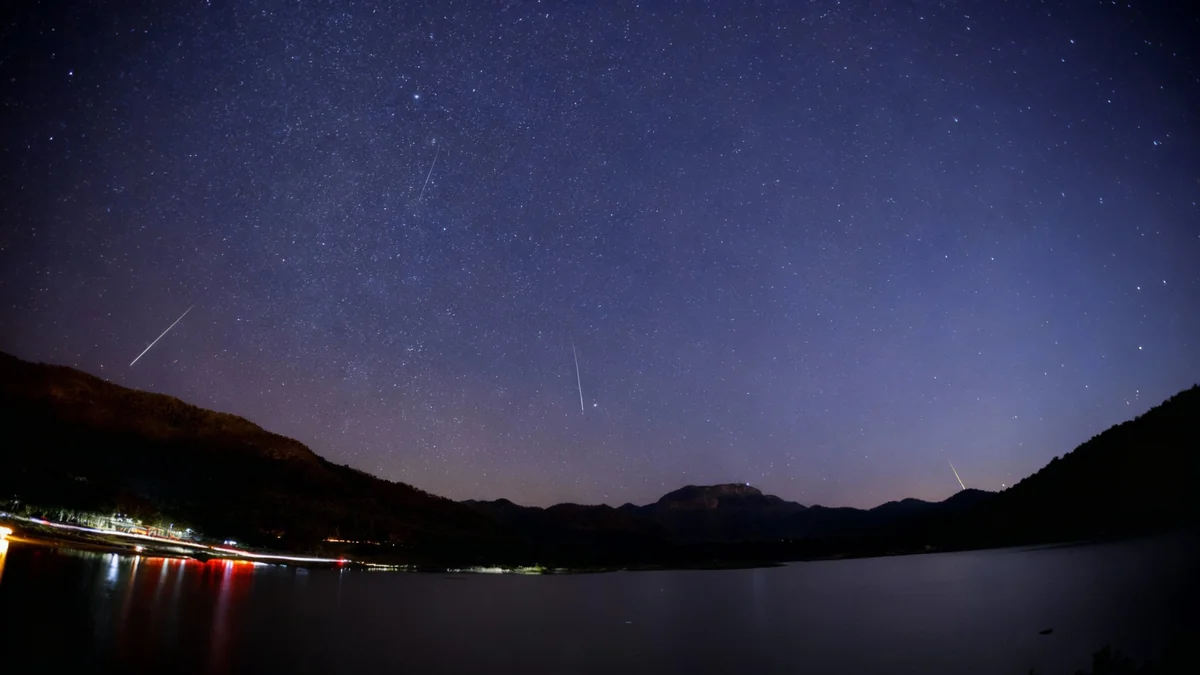

Stargazers looking forward to the Quadrantid meteor shower in January 2026 are facing disappointment due to a combination of poor timing and celestial interference. The annual event, typically one of the most intense meteor displays of the year, will be largely obscured by a daylight peak and the brilliant light of a full moon.
The peak of the shower is predicted to occur during daytime hours for observers in North America. Compounding the issue, a full moon will rise on the same night, flooding the sky with light and washing out all but the brightest meteors, making the 2026 event a challenging one for even the most dedicated skywatchers.
Key Takeaways
- The 2026 Quadrantid meteor shower peak on January 3 is timed poorly for North American observers, occurring in daylight.
- A full moon on the same night will create bright sky conditions, significantly reducing meteor visibility.
- The Quadrantids can normally produce up to 120 meteors per hour in ideal conditions but will be severely hampered in 2026.
- Astronomers are already looking ahead to 2028, which promises a much better viewing opportunity for this shower.
A Celestial Double Whammy in 2026
The prospects for viewing the Quadrantid meteor shower in 2026 are diminished by two significant astronomical events happening in tandem. This unfortunate alignment will turn a potentially spectacular show into a difficult observation.
Daylight Peak Limits Opportunity
The first major obstacle is the timing of the shower's peak. According to predictions from the Royal Astronomical Society of Canada, maximum activity is expected around 5 p.m. Eastern Standard Time on January 3, 2026. For most of North America, this means the most intense part of the shower will happen while the sun is still up, rendering the meteors invisible.
Unlike other showers that have a broader peak lasting a day or more, the Quadrantids are known for a very sharp, intense maximum that lasts only a few hours. Observers must be watching during this brief window to see the highest rates, and in 2026, that window falls during the day.
The Full Moon Problem
Even if the peak were to occur at night, a second, more formidable challenge awaits. January 3, 2026, also marks the date of a full moon. The moon will be positioned in the constellation Gemini, not far from the planet Jupiter, and will remain above the horizon for the entire night.
"The bright moonlight will squelch all but the very brightest of meteors," an astronomical report noted, highlighting the severity of the issue for potential viewers.
The light from a full moon is powerful enough to illuminate the night sky, creating conditions similar to light pollution in a city. This drastically reduces the number of visible meteors, as only the most brilliant fireballs can compete with the lunar glare.
Understanding the Quadrantids
The Quadrantid meteor shower is an annual event that occurs in early January and is considered one of the year's most reliable and intense displays. Under perfect, dark-sky conditions, it can produce between 60 and 120 meteors per hour.
A Constellation That No Longer Exists
The shower is named after an obsolete constellation called Quadrans Muralis, or the "Mural Quadrant," which was charted in the late 18th century. Though the constellation is no longer officially recognized by astronomers, the name "Quadrantids" has persisted. The meteors now appear to radiate from a point in the modern constellation Boötes, the Herdsman.
The Source of the Shower
Meteor showers are created when Earth passes through a trail of debris left behind by a comet or, in some cases, an asteroid. The Quadrantids are linked to a specific near-Earth object discovered in 2003.
- Parent Body: Asteroid 2003 EH1.
- Theory: Astronomers, including Peter Jenniskens of NASA, believe this asteroid is the rocky core or a large fragment of an extinct comet.
- Historical Connection: This parent comet may be the same one recorded by observers in China, Korea, and Japan during 1490 and 1491, which later broke apart.
The debris stream from 2003 EH1 is relatively narrow, which explains why the shower's peak is so brief and intense. Earth passes through this dense trail of particles very quickly, creating the short-lived but powerful display.
How to Approach Viewing in 2026
Despite the poor conditions, some determined observers may still attempt to catch a glimpse of a Quadrantid meteor. The best time to try is typically in the hours just before dawn, around 6 a.m. local time, when the radiant point in the northeastern sky is at its highest.
Tips for a Challenging Year
- Manage Expectations: With the bright moon, expect to see far fewer meteors than the potential 60-120 per hour.
- Find a Dark Spot: Get as far away from city lights as possible to minimize light pollution.
- Block the Moon: Position yourself so that a building, tree, or hill blocks the direct light of the moon from your field of vision.
- Dress Warmly: January nights are cold. Wear multiple layers, a hat, and gloves. A warm beverage can also help.
- Be Patient: Allow your eyes at least 20-30 minutes to adapt to the darkness for the best chance of spotting faint meteors.
While the odds are stacked against a great show, the possibility of seeing a few bright, blue-tinged Quadrantid meteors remains. These are known for being fast and leaving persistent trails across the sky.
Hope on the Horizon for 2028
For those disappointed by the 2026 forecast, there is excellent news on the horizon. The Quadrantid meteor shower in 2028 is shaping up to be a spectacular event, especially for observers in eastern North America.
The peak in 2028 is predicted for 5 a.m. EST on January 4, an ideal pre-dawn time for viewing. More importantly, the moon will be in a much more favorable phase—a waxing crescent that will have set long before the shower's prime viewing hours.
Without any moonlight to interfere, the sky will be dark, allowing for optimal conditions. Given clear weather, the 2028 Quadrantids could be one of the best meteor displays of that year. Stargazers are encouraged to mark their calendars for what promises to be a far more rewarding experience.