

Astronomers have captured an unprecedented view of a newborn star system, revealing a stunning series of more than 400 concentric rings expanding into space. This discovery provides the first direct visual evidence of how young stars undergo violent growth spurts, effectively solving a decades-old puzzle in star formation.
The images, focused on the binary star system SVS 13 located 1,000 light-years away, show nested, bow-shaped structures being ejected from one of the young stars. These rings act like cosmic tree rings, offering a detailed timeline of the star's turbulent history and confirming long-held theories about stellar development.
Key Takeaways
- Astronomers discovered over 400 nested rings in a jet from the young star system SVS 13.
- The finding is the first direct observational proof of a theory explaining how young stars grow through energetic outbursts.
- Each ring corresponds to a past eruption, creating a historical record of the star's formation.
- The data was captured using the Atacama Large Millimeter/submillimeter Array (ALMA) in Chile.
A Glimpse into a Stellar Nursery
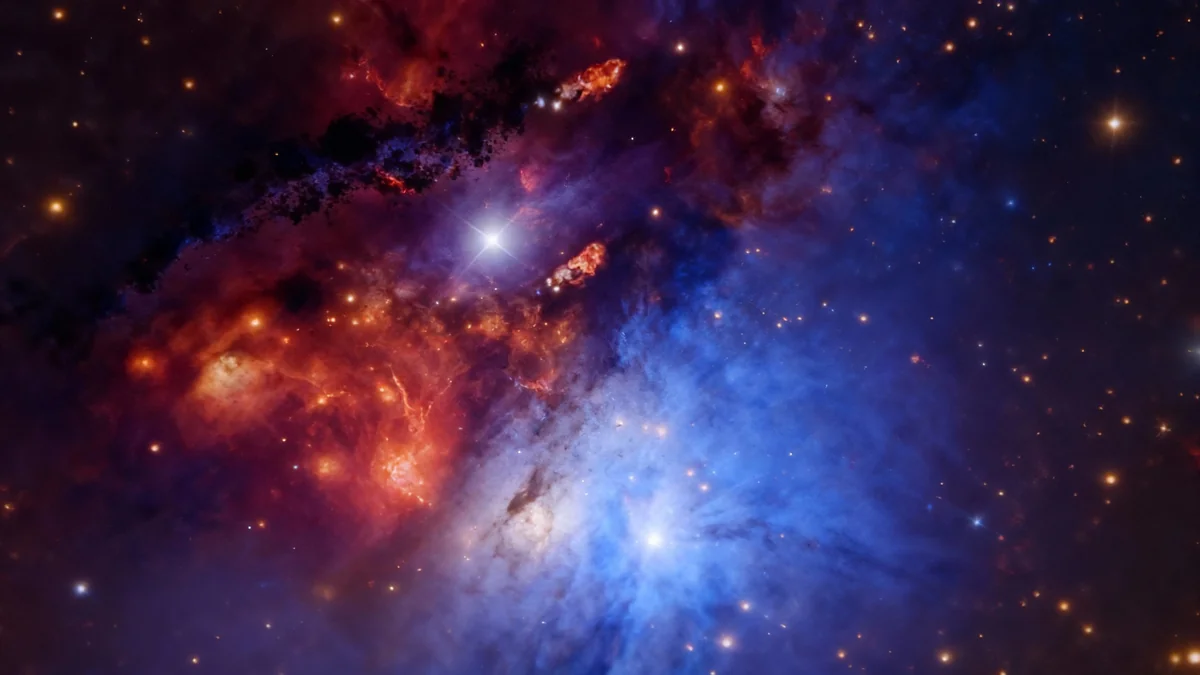
The discovery was made within NGC 1333, a vibrant star-forming region often called the Embryo Nebula. This cloud of gas and dust, located in the constellation Perseus, is one of the closest stellar nurseries to our solar system, making it a prime location for studying the birth of stars.
SVS 13, the subject of the study, is a binary system containing two infant stars, known as protostars. These stars are still in the process of accumulating mass from the surrounding molecular cloud. For years, scientists have theorized that this process is not smooth but punctuated by intense, energetic outbursts.
What is a Reflection Nebula?
A reflection nebula, like NGC 1333, is a cloud of interstellar dust that does not produce its own light. Instead, it shines by reflecting the light from nearby stars. The blue color often associated with these nebulae is due to blue light scattering more efficiently off the dust particles than red light, a similar process to what makes Earth's sky appear blue.
Using the powerful ALMA radio telescope array in Chile, researchers were able to create a high-resolution, three-dimensional view of a jet of material being propelled from one of the SVS 13 protostars. Within this jet, they identified the remarkable series of ultra-thin, bow-shaped rings.
Solving a 30-Year-Old Mystery
The prevailing theory of star formation suggests that as a young star pulls in large amounts of gas and dust, it can become unstable. To regulate its growth, the star violently ejects some of this material back into space through powerful jets.
These outbursts, or eruptions, were thought to happen periodically, but direct evidence linking them to changes in the star's jets was missing until now. The more than 400 distinct rings observed around SVS 13 provide that missing link. Each ring represents the aftermath of a specific energetic eruption from the star's past.
By the Numbers
- Distance: 1,000 light-years from Earth
- Object: Star system SVS 13 in nebula NGC 1333
- Rings Discovered: Over 400
- Telescope Used: Atacama Large Millimeter/submillimeter Array (ALMA)
Remarkably, researchers were able to connect the youngest, outermost ring to a known bright outburst from the SVS 13 system that was observed in the early 1990s. This direct correlation allows astronomers to precisely link a specific event in a star's activity with a physical structure in its outflowing jet, confirming the theoretical model with stunning accuracy.
A New Way to Read a Star's History
This discovery provides astronomers with a powerful new tool for understanding the early lives of stars. The collection of rings serves as a detailed historical archive, chronicling the star's growth and activity over decades.
"These images give us a completely new way of reading a young star's history," said Gary Fuller, a professor at the University of Manchester and co-author of the study published in Nature Astronomy. "Each group of rings is effectively a time-stamp of a past eruption."
By studying the spacing and characteristics of the rings, scientists can reconstruct the frequency and intensity of the star's past outbursts. This information is crucial for understanding not only how stars grow but also how their surrounding environments are shaped.
Fuller added that the findings offer "an important new insight into how young stars grow and how their developing planetary systems are shaped." The violent outflows can clear out gas and dust from the protoplanetary disk, influencing the formation and final arrangement of planets around the star. This new method of charting a star's history could therefore have profound implications for our understanding of how planetary systems, including our own, come into being.