
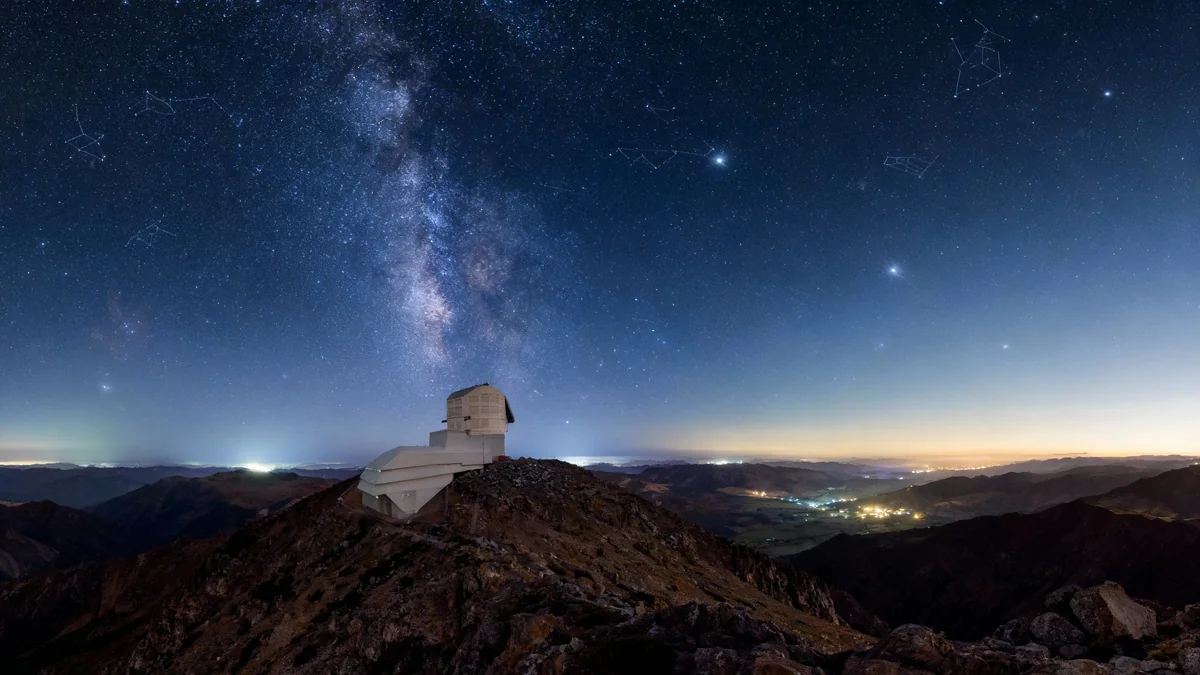


Perched atop Cerro Pachón in the Chilean Andes, the Vera C. Rubin Observatory has begun its ambitious 10-year mission to map the southern sky in unprecedented detail. The facility, now fully operational, will capture the cosmos using the world's largest digital camera, aiming to document billions of celestial objects and phenomena.
This comprehensive undertaking, known as the Legacy Survey of Space and Time (LSST), is expected to generate a vast public archive of astronomical data, revolutionizing our understanding of everything from mysterious dark matter to the trajectories of near-Earth asteroids.
Key Takeaways
- The Vera C. Rubin Observatory in Chile is now operational and has started its 10-year Legacy Survey of Space and Time (LSST).
- It will survey the entire southern sky every three nights, creating the most detailed celestial map ever assembled.
- Equipped with a 3.2-gigapixel camera, the observatory can detect up to 10 million transient events, like supernovas, each night.
- The project is named after Vera C. Rubin, an astronomer whose work provided key evidence for the existence of dark matter.
A New Eye on the Southern Sky
The observatory's primary mission is to conduct the LSST, a systematic survey designed to create a dynamic map of the universe. Over the next decade, its powerful 8.4-meter Simonyi Survey Telescope will repeatedly scan the sky, capturing changes in the position and brightness of celestial bodies.
This rapid, wide-field approach sets the Rubin Observatory apart from other major telescopes, which typically focus on narrow sections of the sky for longer periods. By revisiting the same areas every few nights, astronomers will be able to create a time-lapse movie of the universe, revealing events that were previously impossible to track on such a massive scale.
The location in the Chilean Andes was chosen for its high altitude, dry climate, and minimal light pollution, providing some of the clearest viewing conditions on Earth. This pristine environment is crucial for capturing the faint light from distant galaxies and stars.
Unprecedented Data Collection
The LSST is projected to catalog approximately 37 billion stars and galaxies during its 10-year run. The total data collected is estimated to reach around 60 petabytes, an amount so large that it requires specialized data management systems, including an automated "data butler," to process and distribute the images to the global scientific community.
The Power of the LSST Camera
At the heart of the Rubin Observatory is the LSST Camera, a technological marvel weighing over three tons and roughly the size of a small car. With a resolution of 3.2 gigapixels, it is the largest digital camera ever constructed for astronomy. Its massive focal plane allows it to capture an area of the sky 40 times the size of the full moon in a single exposure.
This immense field of view is what enables the observatory to survey the entire visible southern sky in just three nights. The camera is so sensitive that it could detect a golf ball from 15 miles away. This capability will be used to spot faint and fast-moving objects, including potentially hazardous asteroids that could pose a threat to Earth.
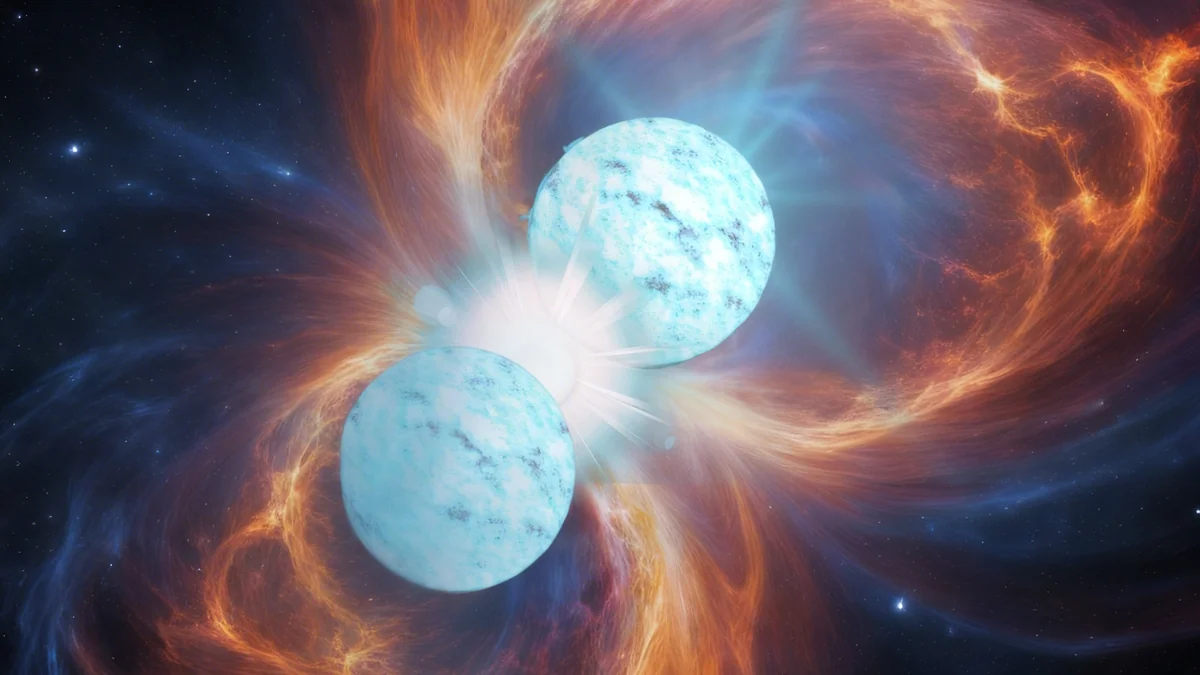
Each night of observation is expected to identify up to 10 million transient events—celestial objects that change in brightness or position. These include:
- Supernovas: The explosive deaths of massive stars.
- Asteroids: Small rocky bodies orbiting the Sun, primarily in our solar system.
- Variable Stars: Stars that fluctuate in brightness.
- Gravitational Lensing Events: The bending of light from distant objects by the gravity of closer ones.
By building a massive database of these events, scientists hope to answer fundamental questions about the structure and evolution of the universe.
Honoring a Pioneer in Astronomy
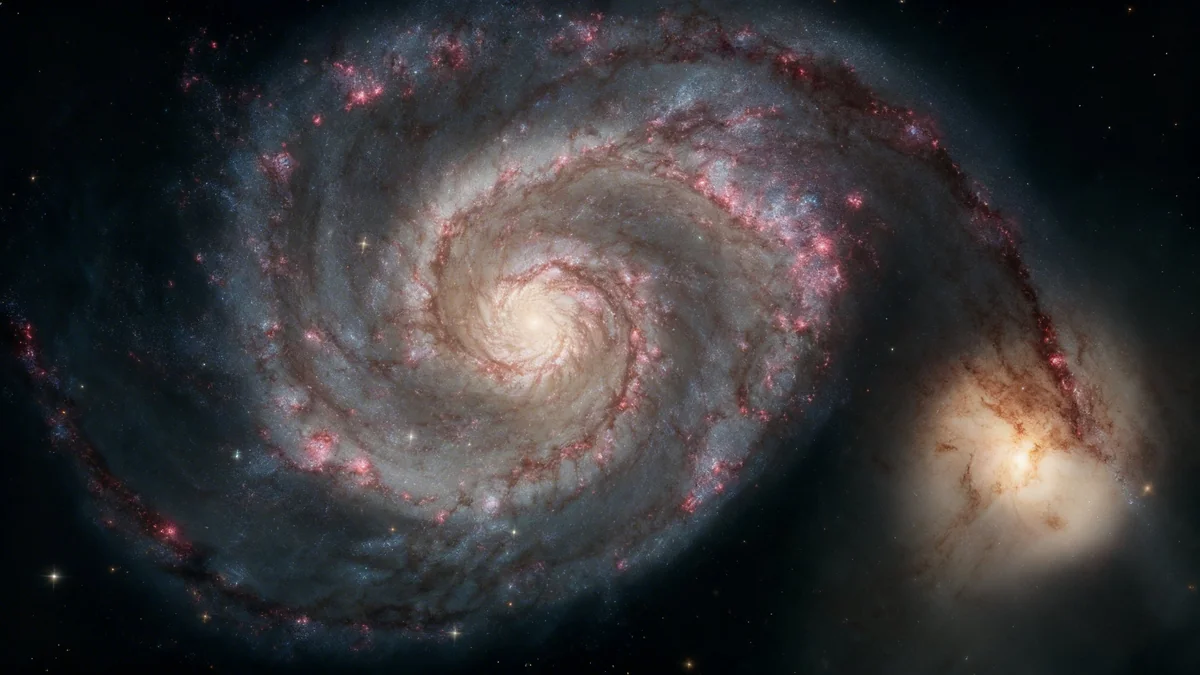
The observatory is named in honor of Vera C. Rubin (1928-2016), an American astronomer whose groundbreaking work in the 1970s provided some of the most compelling evidence for the existence of dark matter. By observing the rotation speeds of galaxies, she found that stars on the outer edges were moving far too fast to be held by the gravity of visible matter alone.
Her findings suggested that an unseen, massive substance—dark matter—must be providing the extra gravitational pull. Naming this next-generation facility after her recognizes her pivotal contribution to modern cosmology and the search for the universe's unseen components, a key research area for the observatory.
Transforming Modern Astronomy
The data from the LSST will be made available to scientists and the public, heralding a new era of data-driven discovery. Researchers from various fields will be able to mine this vast dataset to explore a wide range of topics. The project's goals are far-reaching, from creating a detailed inventory of our solar system to probing the nature of dark energy, the mysterious force believed to be accelerating the expansion of the universe.
The sheer volume and frequency of data from Rubin will allow us to see the sky as a dynamic, ever-changing environment. It's a fundamental shift from the static view we've traditionally had.
One of the survey's primary objectives is to produce a comprehensive map of the Milky Way galaxy. This will allow astronomers to study its structure, formation, and the distribution of its stars with unparalleled precision. Furthermore, by tracking the movements of millions of asteroids, the LSST will significantly improve our ability to identify and assess potential impact threats to our planet.
As the Rubin Observatory embarks on its decade-long journey, the global scientific community watches with anticipation. The images and data it collects promise not only to fill in the gaps in our current knowledge but also to reveal entirely new and unexpected cosmic phenomena, continuing the legacy of exploration embodied by its namesake.