

Astronomers have detected a supermassive black hole generating winds at an astonishing 130 million miles per hour, approximately 20% of the speed of light. The discovery, centered on a distant galaxy, provides new insights into the powerful forces that shape galactic evolution and reveals a surprising connection between black holes and our own sun.
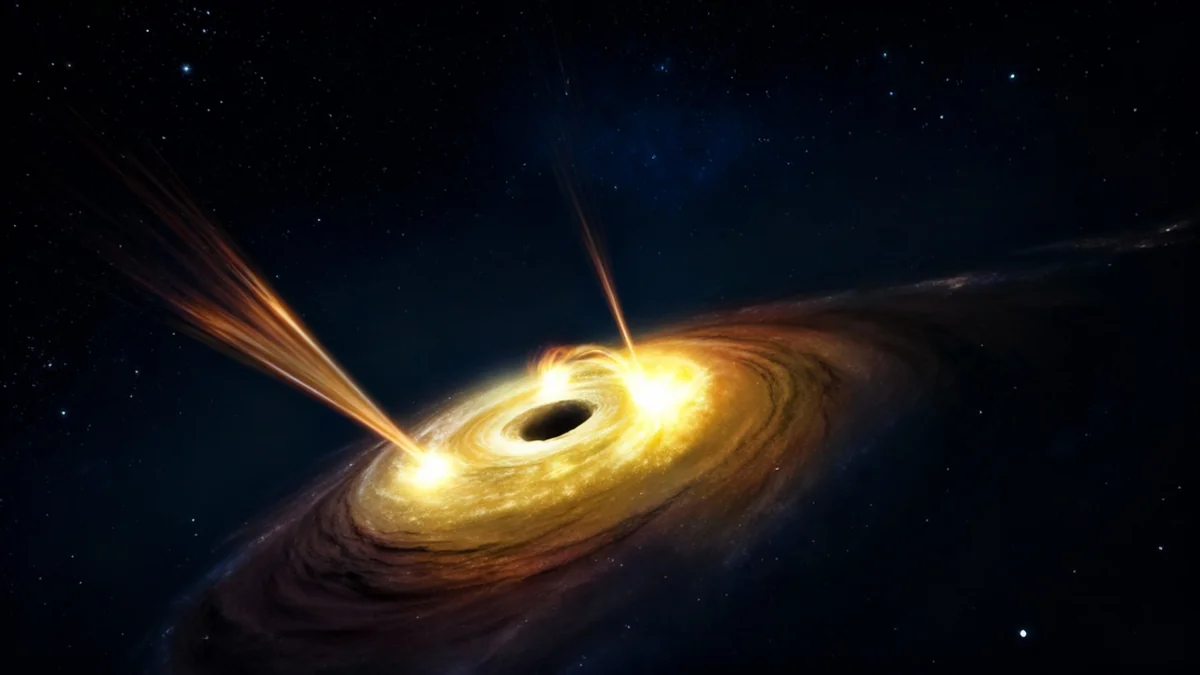
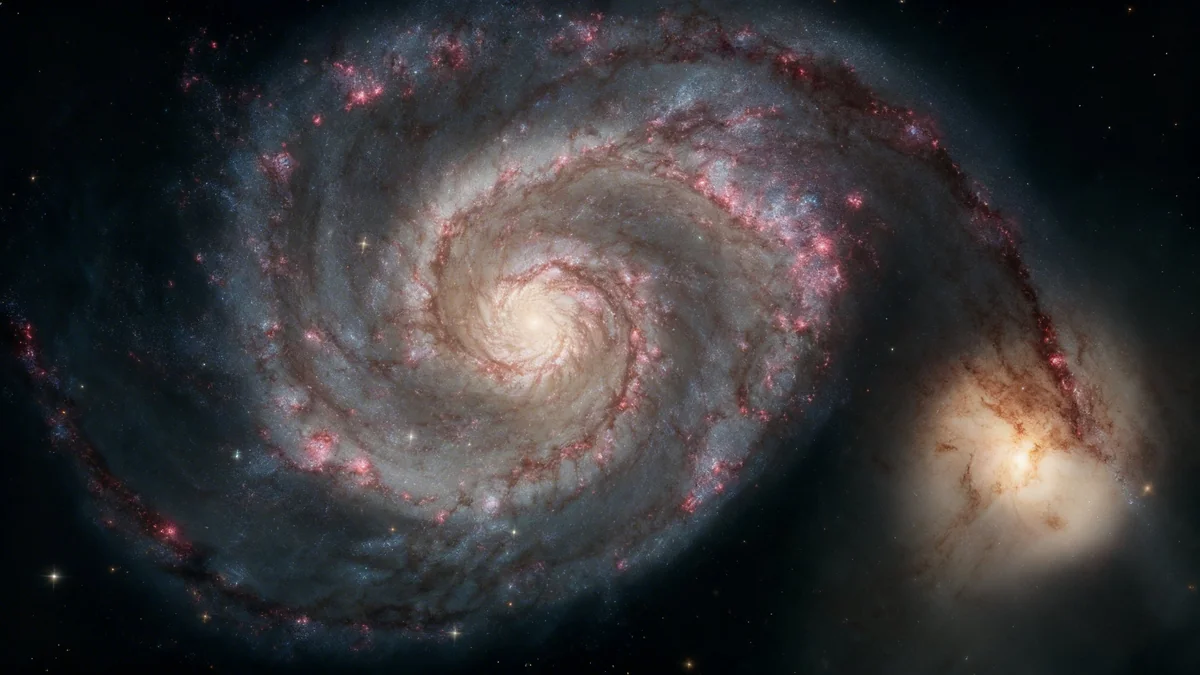
The phenomenon was observed in the spiral galaxy NGC 3783, where a black hole with the mass of 30 million suns is actively consuming surrounding matter. This process fuels an extremely bright region at the galaxy's core, known as an active galactic nucleus, which is now understood to be the source of these record-breaking cosmic winds.
Key Takeaways
- A black hole in galaxy NGC 3783 is producing winds traveling at 130 million mph (60,000 km/s).
- This speed is roughly 20% the speed of light, a new record for observed black hole winds.
- The winds were triggered by a sudden burst of X-rays and formed in just one day.
- The mechanism is similar to solar flares, suggesting a common physical process across the universe.
Record-Breaking Speeds Observed
The European Space Agency (ESA) confirmed the unprecedented speeds, marking a significant moment in the study of black holes. An international research team measured the outflow from the active galactic nucleus (AGN) at the heart of NGC 3783, a galaxy located millions of light-years from Earth.
The black hole, a behemoth 30 million times more massive than our sun, is in a constant state of feeding. As it pulls in gas, dust, and other cosmic material, the matter heats up and releases immense energy, creating the brilliant AGN. This energy is now known to be capable of ejecting material at incredible velocities.
"We've not watched a black hole create winds this speedily before," stated Liyi Gu of the Space Research Organisation Netherlands (SRON), who led the research. "For the first time, we've seen how a rapid burst of X-ray light from a black hole immediately triggers ultra-fast winds, with these winds forming in just a single day."
A Swift and Powerful Formation
The speed of the wind's formation is as remarkable as its velocity. The observation that such a powerful outflow could materialize in approximately 24 hours provides a direct link between the black hole's feeding activity and its impact on its surroundings. This rapid response helps scientists model how these events unfold in real-time.
By the Numbers
- Black Hole Mass: 30 million times the mass of the Sun.
- Wind Speed: 130 million mph (60,000 km/s).
- Relative Speed: 20% of the speed of light.
- Formation Time: Approximately one day.
A Surprising Solar Connection
One of the most compelling aspects of the discovery is the mechanism behind the winds. Researchers believe the event was caused by the sudden untwisting of the powerful magnetic field surrounding the black hole's nucleus. This process mirrors the phenomenon responsible for coronal mass ejections on our own sun, where tangled magnetic field lines snap and release enormous bursts of energy and plasma.
According to ESA researcher Matteo Guainazzi, the event is comparable to solar ejections "but on a scale almost too big to imagine." This similarity suggests that the fundamental laws of physics governing magnetic fields and plasma operate in similar ways, whether around a star or a supermassive black hole.
This connection demystifies some of the most extreme objects in the cosmos. "The similarity between black holes and the sun makes these mysterious objects seem a little less alien," the ESA noted in its announcement.
What is an Active Galactic Nucleus (AGN)?
An Active Galactic Nucleus is an extremely bright and compact region at the center of a galaxy. Its luminosity is not produced by stars but by matter accreting onto a supermassive black hole. As gas and dust spiral into the black hole, friction and gravitational forces heat the material to millions of degrees, causing it to emit intense radiation across the electromagnetic spectrum, including X-rays and visible light. This process can also launch powerful jets and winds that extend far beyond the galaxy itself.
Implications for Galactic Evolution
The discovery is more than just a cosmic speed record; it carries profound implications for our understanding of how galaxies are formed and how they evolve over billions of years. The powerful winds generated by AGNs are believed to play a crucial role in this process, acting as a form of galactic feedback.
These outflows can push gas out of a galaxy, effectively halting or regulating star formation. By clearing out the raw material needed to create new stars, a black hole can dictate the growth and ultimate fate of its host galaxy. Understanding the power and frequency of these winds is therefore essential for building accurate models of the universe's history.
"Because they're so influential, knowing more about the magnetism of AGNs, and how they whip up winds such as these, is key to understanding the history of galaxies throughout the Universe," explained Camille Diez, an ESA research fellow.
Project scientist Erik Kuulkers added that the finding "suggests that solar and high-energy physics may work in surprisingly familiar ways throughout the universe." This convergence of different fields of physics could open new avenues for research, allowing solar physicists and astrophysicists to share models and insights to solve some of the cosmos's biggest mysteries.