
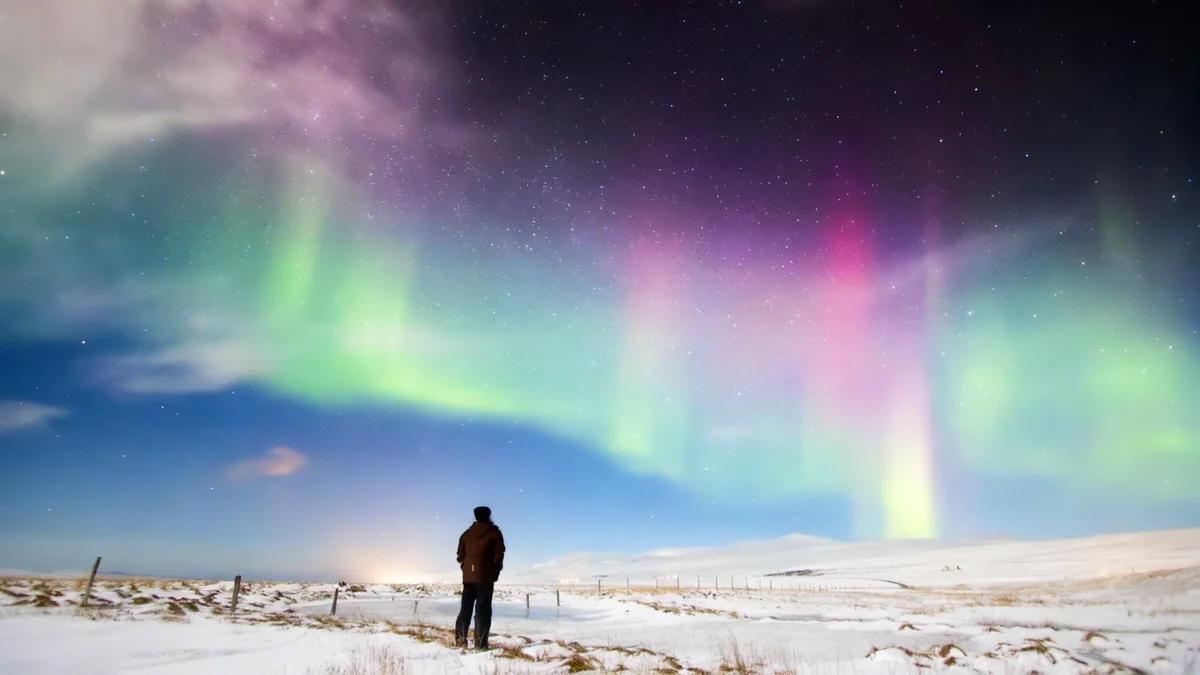

Skywatchers are preparing for what could be an active season for the northern lights. Recent solar activity, including coronal mass ejections and high-speed solar wind streams, has already produced notable displays at high latitudes, and forecasters are monitoring conditions for potential widespread sightings in the months ahead.
Understanding the science behind these celestial displays can significantly increase your chances of witnessing them. The key drivers are events on the sun that send charged particles toward Earth, interacting with our planet's magnetic field to create the aurora.
Key Takeaways
- Solar activity, such as Coronal Mass Ejections (CMEs) and solar wind from coronal holes, is the primary driver of the northern lights.
- Geomagnetic storms are rated on a G-scale (G1 to G5). Stronger storms (G3 or higher) can push auroras to lower latitudes.
- Key indicators to watch in forecasts include the Kp index, which measures geomagnetic activity, and the Bz value of the solar wind.
- The best viewing opportunities occur during dark, clear nights away from city light pollution, primarily in high-latitude regions.
Understanding the Solar Drivers of Auroras
The appearance of the northern lights, or aurora borealis, is directly tied to activity on the sun, located approximately 93 million miles away. Two primary phenomena are responsible for sending the necessary ingredients for an aurora toward Earth: coronal holes and coronal mass ejections (CMEs).
What Are Coronal Holes?
Coronal holes are areas in the sun's outer atmosphere, the corona, where the magnetic field opens up into space. This allows a continuous stream of charged particles, known as solar wind, to escape at high speeds. When a coronal hole faces Earth, this high-speed stream can buffet our planet's magnetic field for several days, leading to sustained periods of geomagnetic activity and reliable aurora displays, especially at high latitudes.
Forecasters regularly monitor the sun for these features. When a large coronal hole rotates into an Earth-facing position, predictions for auroral activity often increase for the following two to three days, which is the time it takes for the solar wind to travel from the sun to Earth.
The Role of Coronal Mass Ejections
Coronal Mass Ejections are far more explosive. These are massive eruptions of plasma and magnetic fields from the sun's corona. CMEs are often associated with solar flares but can occur on their own. When a CME is directed at Earth, it can deliver a powerful and concentrated blow to our magnetic field.
An arriving CME can trigger significant geomagnetic storms. The intensity of these storms determines how far south the aurora might be visible. While many CMEs miss Earth or only deliver a glancing blow, a direct hit can produce spectacular and widespread light shows.
Solar Wind Speed: A typical solar wind travels at about 400 km/s (nearly 900,000 mph). However, high-speed streams from coronal holes can reach speeds of 700-800 km/s (over 1.7 million mph).
How to Read an Aurora Forecast
To successfully chase the aurora, it helps to understand the terminology and data used by space weather forecasters. Several key metrics can tell you if conditions are favorable for a light show in your area.
The Kp Index
The Kp index is a global measure of geomagnetic activity, rated on a scale from 0 to 9. It provides a simple way to gauge the potential for auroras.
- Kp 0-2: Quiet conditions. Auroras are likely confined to the far north, such as Alaska, northern Canada, and Scandinavia.
- Kp 3-4: Unsettled to active. Auroras may become more dynamic and visible at slightly lower latitudes.
- Kp 5: G1 (Minor) storm. This is the threshold for a geomagnetic storm. Auroras may be visible in the northern tier of the United States.
- Kp 6-7: G2 (Moderate) to G3 (Strong) storm. At these levels, auroras can push much farther south, potentially reaching states like Idaho, Illinois, and New York.
- Kp 8-9: G4 (Severe) to G5 (Extreme) storm. These are rare events that can cause widespread auroras, sometimes seen in places as far south as Alabama and northern California.
The Importance of Bz
Perhaps the most critical short-term indicator is the Bz component of the Interplanetary Magnetic Field (IMF). This value describes the north-south orientation of the solar wind's magnetic field.
For a strong aurora, you want to see a sustained, strong southward Bz. When the Bz is negative (southward), it effectively opens a door in Earth's northward-pointing magnetic field, allowing energy from the solar wind to pour into our atmosphere. A northward Bz (positive value) largely closes this door, limiting auroral activity even if the solar wind is fast.
Many real-time aurora apps and websites display the Bz value. A sharp, sustained drop into negative numbers is often a sign that an aurora display is about to intensify.
Recent Activity and What to Expect
The current solar cycle is approaching its maximum, a period of heightened solar activity that occurs roughly every 11 years. This has led to more frequent and intense solar events, increasing the chances for geomagnetic storms.
In recent months, forecasters have tracked numerous Earth-directed CMEs and persistent coronal holes. One notable event in January involved a severe G4 storm triggered by a powerful CME, which brought the aurora to dozens of states not accustomed to seeing the lights. Such events highlight the potential of the current solar maximum.
Planning Your Aurora Hunt
Success in aurora viewing depends on more than just solar activity. You also need the right conditions on the ground.
- Location: The farther north you are, the better your chances. Prime locations include Alaska, Canada, Iceland, Norway, Sweden, and Finland.
- Darkness: Get away from city lights. Light pollution will wash out all but the most intense auroras. A new moon phase is also ideal.
- Clear Skies: Clouds are the biggest obstacle for skywatchers. Check your local weather forecast before heading out.
- Patience: Auroras are unpredictable. Activity can ebb and flow throughout the night. Be prepared to wait, and dress warmly.
As the season progresses, forecasters will continue to monitor the sun for Earth-facing active regions and coronal holes. With solar activity expected to remain high, the potential for memorable aurora displays remains strong for both seasoned chasers and first-time viewers.