
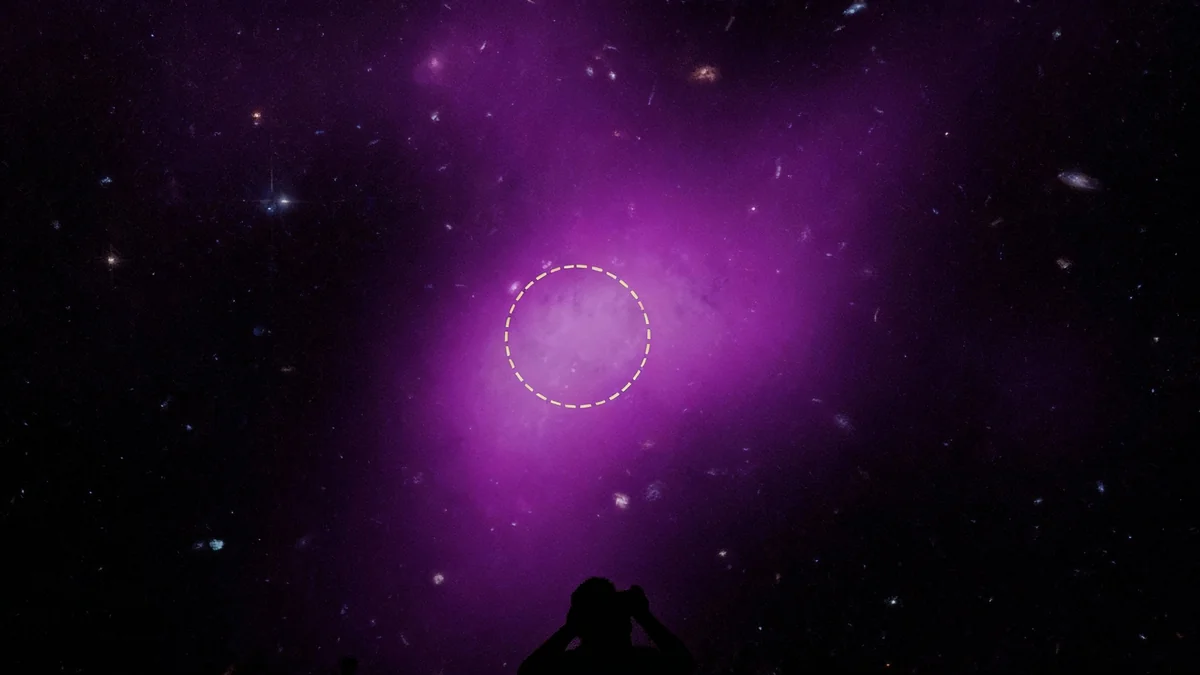

An international team of astronomers has confirmed the existence of a massive, starless cloud of gas located approximately 2,000 light-years from Earth. Nicknamed 'Cloud-9,' this object is the first confirmed example of a long-theorized cosmic structure, offering a rare glimpse into the universe's most mysterious component: dark matter.
The discovery, detailed in a recent study in The Astrophysical Journal Letters, confirms that Cloud-9 is a primordial building block of a galaxy that never formed. Its existence provides physical evidence for theories about how galaxies are born and why some fail to ignite.
Key Takeaways
- Astronomers have discovered 'Cloud-9,' a massive cloud of gas and dark matter without any stars, located 2,000 light-years away.
- It is the first confirmed 'Reionization-Limited H I Cloud' (RELHIC), a type of failed galaxy long predicted by theorists.
- The cloud is estimated to contain around 5 billion solar masses of dark matter, making it a unique laboratory for studying this elusive material.
- The Hubble Space Telescope was crucial in confirming the absence of stars, which could not be achieved with ground-based instruments.
A Glimpse into the Dark Universe
For decades, scientists have theorized that the vast majority of the universe's mass is composed of dark matter, an invisible substance that does not emit, reflect, or absorb light. Its presence can only be inferred through its gravitational effects on visible matter. Cloud-9 provides a direct window into this unseen realm.
"This cloud is a window into the dark Universe," said Andrew Fox, a study co-author and team member at the Space Telescope Science Institute (STScI). Because dark matter is so difficult to detect, finding an object dominated by it is a significant breakthrough.
"Cloud-9 gives us a rare look at a dark-matter-dominated cloud."
- Andrew Fox, Space Telescope Science Institute
Initial analysis shows that the gas pressure within Cloud-9 is in equilibrium with the gravitational pull of its dark matter halo. This balance suggests a much higher concentration of dark matter than is typical for its size. Current estimates place its dark matter content at a staggering 5 billion times the mass of our sun.
Cloud-9 by the Numbers
- Distance from Earth: 2,000 light-years
- Dark Matter Mass: Approx. 5 billion solar masses
- Neutral Hydrogen Mass: Approx. 1 million solar masses
- Hydrogen Core Width: 4,900 light-years
Unlike the sprawling, irregular hydrogen clouds often found near the Milky Way, Cloud-9 is notably smaller, more symmetrical, and compact. These characteristics are consistent with theoretical models of primordial gas clouds that have not yet undergone star formation.
The Tale of a Failed Galaxy
The formal name for this type of object is a Reionization-Limited H I Cloud, or RELHIC. The 'H I' refers to neutral hydrogen, the most basic element in the universe. This is the raw gas from the cosmos's earliest epochs that serves as the fuel for star birth. The core of Cloud-9 is a dense reservoir of this neutral hydrogen, spanning about 4,900 light-years and containing the mass of a million suns.
According to Alejandro Benitez-Llambay, a lead investigator on the project from Italy’s Milano-Bicocca University, Cloud-9 represents a "tale of a failed galaxy." It is essentially a galactic seed that never sprouted.
"In science, we usually learn more from the failures than from the successes," Benitez-Llambay explained. "In this case, seeing no stars is what proves the theory right. It tells us that we have found in the local Universe a primordial building block of a galaxy that hasn’t formed.”
Confirming the Absence of Stars
Finding a suspected RELHIC is one challenge; proving it is another. Initial clues about Cloud-9's nature emerged in 2023 from radio data collected by the ground-based Very Large Array (VLA). However, ground-based telescopes lacked the sensitivity to definitively rule out the presence of a faint dwarf galaxy hidden within the gas.
This is where the Hubble Space Telescope's powerful Advanced Camera for Surveys became essential. By pointing Hubble at the cloud's densest region, the team could search for the faint light of individual stars.
Why Hubble Was Necessary
Ground-based telescopes are limited by Earth's atmosphere, which can obscure the faint light from distant, small stars. The Hubble Space Telescope, operating above the atmosphere, can achieve much deeper and clearer observations, making it the only instrument capable of confirming that Cloud-9 was truly starless.
"Before we used Hubble, you could argue that this is a faint dwarf galaxy that we could not see with ground-based telescopes," stated Gagandeep Anand, an astronomer at STScI and study co-author. "But with Hubble…we’re able to nail down that there’s nothing there.”
What the Future Holds for Cloud-9
The discovery of Cloud-9 opens up new avenues for research into galaxy formation and the nature of dark matter. While it is currently a failed galaxy, its story may not be over. Astronomers are now considering two potential futures for this unique object.
One possibility is that Cloud-9 will continue to accrete gas as it travels through space. If it gathers enough material, its internal gravity could eventually overcome its gas pressure, leading to a collapse that would ignite the first generation of stars in a brand new galaxy.
Alternatively, the powerful cosmic forces it encounters on its journey could have the opposite effect. Interactions with other galaxies or intergalactic gas could strip away its hydrogen, ensuring it remains a dark, starless relic for eternity.
Regardless of its ultimate fate, the confirmation of one RELHIC suggests there are likely more to be found. Researchers believe these objects could be common, though difficult to detect. Rachael Beaton, a co-author and STScI astronomer, suggested that these cosmic failures might be hiding in plain sight.
“Among our galactic neighbors, there might be a few abandoned houses out there,” she noted. The search is now on for more of these dark, quiet corners of the universe, each holding clues to the grand story of cosmic creation.