
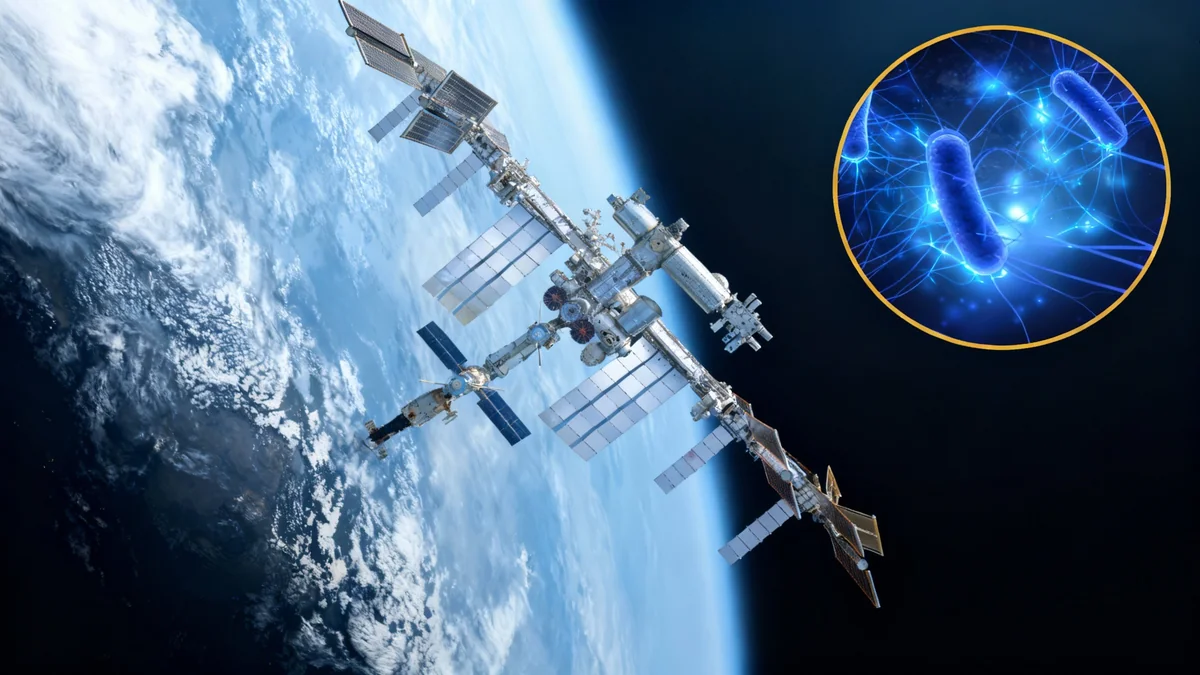


A groundbreaking experiment conducted aboard the International Space Station (ISS) has revealed that viruses evolved in microgravity can become more effective at killing drug-resistant bacteria back on Earth. This unexpected discovery could open new avenues in the fight against antibiotic resistance, a growing global health crisis.
Researchers sent common bacteria and the viruses that infect them, known as bacteriophages or phages, into orbit to study their evolutionary battle in a near-weightless environment. The results showed that the unique conditions of space forced the viruses to adapt in ways that made them surprisingly potent against terrestrial pathogens upon their return.
Key Takeaways
- Viruses (phages) and bacteria (E. coli) were sent to the ISS to study their evolution in microgravity.
- In space, the infection process slowed down, forcing the phages to become more efficient at targeting bacteria.
- The space-evolved phages developed unique genetic mutations not seen in control groups on Earth.
- When tested back on Earth, these mutated phages were more effective at killing strains of E. coli that cause urinary tract infections and are typically resistant to standard phages.
- The findings could help develop new phage therapies to combat antibiotic-resistant superbugs.
An Evolutionary Arms Race in Orbit
On Earth, bacteria and phages are locked in a constant evolutionary struggle. As bacteria develop defenses to survive viral attacks, phages evolve new ways to overcome those defenses. Scientists have long been interested in harnessing this natural predatory relationship to create therapies against harmful bacteria.
To understand how this dynamic changes in an alien environment, a research team sent cultures of E. coli bacteria and a specific virus that infects it, phage T7, to the International Space Station. Identical control samples were kept on Earth for comparison.
The primary goal was to observe how the near-weightless conditions of microgravity would alter this microscopic conflict. The findings, published in the journal PLOS Biology, confirmed that space fundamentally changes the rules of engagement.
What Are Phages?
Bacteriophages, or phages, are viruses that specifically infect and replicate within bacteria. They are the most abundant biological entities on Earth. Phage therapy is an emerging field that uses these natural predators to treat bacterial infections, offering a potential alternative to antibiotics.
Microgravity Slows the Chase
One of the first observations was that the infection cycle took longer in space. On Earth, gravity plays a subtle but crucial role in mixing fluids. Heavier particles settle, and temperature differences create currents, constantly stirring microbes and viruses together and increasing their chances of an encounter.
In the microgravity of the ISS, this constant stirring is absent. Bacteria and phages simply float, making contact far less frequent. This physical limitation dramatically slowed down the pace of infection.
"This new study validates our hypothesis and expectation," said Srivatsan Raman, lead study author and an associate professor at the University of Wisconsin-Madison, confirming that the lack of fluid mixing was a key factor.
This slower pace forced the T7 phages to adapt. To survive, they had to become much more efficient at latching onto any bacteria they happened to drift past. This environmental pressure drove a unique evolutionary path not observed in the Earth-based samples.
Unexpected Mutations and a Serendipitous Discovery
Upon the samples' return to Earth, scientists conducted a whole-genome sequencing analysis on both the bacteria and the viruses. They discovered that both organisms had accumulated distinctive genetic mutations.
The space-faring phages developed mutations that specifically enhanced their ability to bind to bacterial receptors—the molecular doorways they use to inject their genetic material. At the same time, the E. coli bacteria evolved their own set of mutations, altering their receptors to fend off the phages and improving their overall survival in the harsh space environment.
A Surprising Benefit
The most significant finding came when the space-evolved phages were tested against different strains of bacteria on Earth. Researchers found that the mutations acquired in orbit made the phages highly effective at killing strains of E. coli that commonly cause urinary tract infections. These particular strains are often resistant to the standard T7 phages used in the experiment.
"It was a serendipitous finding," Raman noted. "We were not expecting that the [mutant] phages that we identified on the ISS would kill pathogens on Earth."
This outcome suggests that the unique evolutionary pressures of space can produce biological tools with valuable medical applications back on our planet.
Implications for Future Medicine
The discovery holds significant promise for the development of phage therapies, a field gaining urgency as antibiotic resistance grows. By understanding the genetic changes that made the space-phages more potent, scientists may be able to engineer similarly effective viruses in labs on Earth.
Nicol Caplin, a former astrobiologist at the European Space Agency, highlighted the potential. "If we can work out what phages are doing on the genetic level in order to adapt to the microgravity environment, we can apply that knowledge to experiments with resistant bacteria," she explained. "This can be a positive step in the race to optimise antibiotics on Earth."
While the prospect is exciting, there are practical challenges. Sending experiments into space is expensive and complex. However, Charlie Mo, an assistant professor at the University of Wisconsin-Madison, suggested that it might be possible to simulate microgravity conditions on Earth to achieve similar results, though the costs would still need to be considered.
Protecting Astronauts on Long Missions
Beyond its applications on Earth, this research also has important implications for the health of astronauts. During long-duration missions, such as journeys to the Moon or Mars, astronauts' immune systems can be compromised, making them more susceptible to infections.
Developing effective phage therapies tailored for microgravity could become a critical part of the medical toolkit for future space explorers. Understanding how microbes and viruses behave and evolve in space is the first step toward creating treatments that work reliably far from home.
This study not only expands our understanding of evolution but also demonstrates how space exploration can yield unexpected solutions to some of the most pressing health challenges on Earth.