



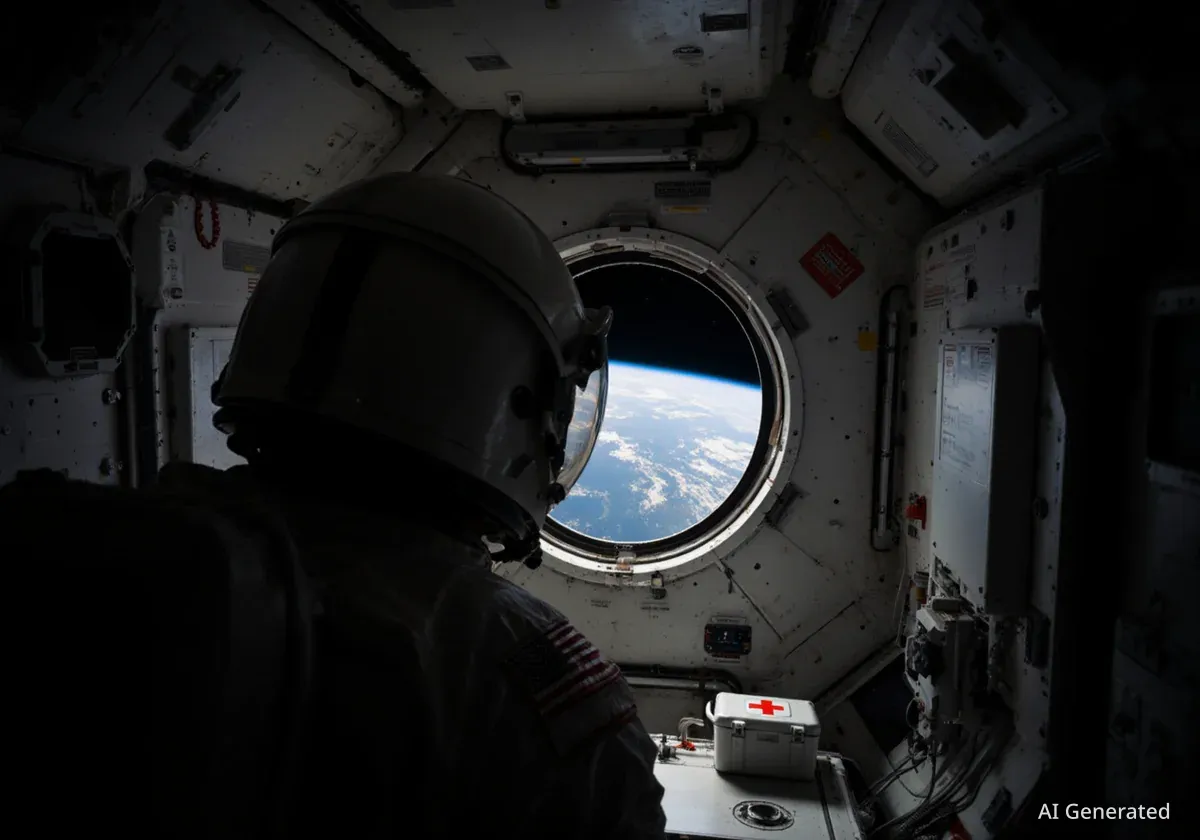

As humanity's presence in space expands from short-term missions to long-duration stays and commercial travel, a new report from an international group of experts warns that the question of reproductive health is no longer theoretical. The study, published in Reproductive BioMedicine Online, calls for urgent action to address the scientific, ethical, and policy gaps surrounding human reproduction beyond Earth.
The authors argue that without established guidelines, space travelers face foreseeable risks from cosmic radiation and microgravity, with critical knowledge gaps remaining about the long-term effects on both male and female fertility. They stress that the time to create a framework is now, before irreversible harm occurs.
Key Takeaways
- A new report highlights the urgent need to address reproductive health for astronauts and commercial space travelers.
- Space presents a hostile environment for human biology, with cosmic radiation and microgravity posing significant risks to fertility.
- There are currently no widely accepted international standards or ethical guidelines for managing reproductive health in space.
- Experts suggest that advanced Assisted Reproductive Technologies (ART), like IVF, could be adapted for space but require ethical oversight.
A New Frontier for Human Biology
For more than half a century, space exploration and assisted reproduction have evolved on parallel tracks. The first moon landing and the first successful in-vitro fertilization (IVF) were landmark achievements that redefined biological and physical possibilities. Now, experts say these two fields are colliding as space becomes a routine workplace and potential destination for private citizens.
"More than 50 years ago, two scientific breakthroughs reshaped what was thought biologically and physically possible—the first moon landing and the first proof of human fertilization in vitro," explained Giles Palmer, a clinical embryologist with the International IVF Initiative Inc. and one of the study's authors. He noted that these once-separate revolutions now represent an "underexplored reality."
The report, compiled by experts in reproductive health, aerospace medicine, and bioethics, does not advocate for conception in space. Instead, its primary goal is to identify and mitigate the foreseeable reproductive risks for anyone traveling beyond Earth's atmosphere.
The Rise of Commercial Spaceflight
The landscape of space travel is rapidly changing. Once the exclusive domain of national space agencies, the sector now includes a growing number of private companies offering flights for tourism, research, and commerce. This expansion means more people, with diverse health profiles, will spend extended periods in space, making reproductive health a practical and immediate concern.
The Hostile Environment of Space
Space is fundamentally inhospitable to human biology. The report details several factors known to be detrimental to healthy reproductive processes, creating a challenging environment for long-term human presence.
Key Biological Stressors
- Cosmic Radiation: Constant exposure to high-energy particles from beyond our solar system can damage DNA and disrupt cellular processes. Studies on animal models show that even short-term radiation exposure can adversely affect female menstrual cycles and increase cancer risks.
- Altered Gravity: Microgravity affects nearly every system in the human body, from bone density to fluid distribution. Its long-term impact on gametes (sperm and eggs) and embryonic development remains largely unknown.
- Circadian Disruption: The lack of a natural 24-hour light-dark cycle can disrupt hormonal balances that are critical for reproductive health.
While data from early female astronauts on shorter Shuttle missions showed subsequent pregnancy rates were comparable to their peers on Earth, very little is known about the effects of longer missions. The report identifies the impact of cumulative radiation on male fertility as a "critical knowledge gap."
Did You Know?
While pregnancy is currently a contraindication for spaceflight, many female astronauts use hormonal methods to avoid menstruation during missions. This highlights that reproductive management is already a part of space travel, though comprehensive policies are lacking.
Can Technology Provide a Solution?
Even as scientists identify the risks, they are also exploring potential solutions. Modern Assisted Reproductive Technologies (ART) have become highly advanced, portable, and increasingly automated, making them potentially suitable for use in space.
Technologies like gamete cryopreservation (freezing sperm and eggs), embryo culture, and genetic screening are mature fields. Palmer suggests these technologies are highly transferable because they are designed for situations where reproduction is biologically possible but constrained by environment or health—conditions that mirror the challenges of space.
"IVF technologies in space are no longer purely speculative. It is a foreseeable extension of technologies that already exist," Palmer stated. "As human activity shifts from short missions to a sustained presence beyond Earth, reproduction moves from abstract possibility to practical concern."
The use of these technologies could allow for research into reproductive biology in space without risking a human pregnancy in an uncontrolled environment. However, this path also opens a new set of complex ethical questions.
The Urgent Need for Ethical Guidelines
The prospect of human reproduction in space, whether for research or settlement, demands immediate ethical consideration. The report warns that waiting until a problem arises is a dangerous approach, as reproductive technologies often enter practice incrementally and are justified after the fact.
Key ethical and policy questions that need answers include:
- What are the protocols for disclosing an inadvertent pregnancy during a mission?
- Who bears responsibility for any negative health outcomes for a parent or child conceived after space travel?
- What are the ethical boundaries for genetic screening of astronauts or any embryos created for space-based research?
- How can international guidelines be established that apply to both government astronauts and private space travelers?
The authors argue that urgency means taking responsibility in advance. "Treating these concerns as speculative misunderstands how reproductive technologies enter practice," the report states, emphasizing that "governance delayed is governance denied."
Dr. Fathi Karouia, the study's senior author and a research scientist at NASA, stressed the need for a unified approach.
"As human presence in space expands, reproductive health can no longer remain a policy blind spot. International collaboration is urgently needed to close critical knowledge gaps and establish ethical guidelines that protect both professional and private astronauts—and ultimately safeguard humanity as we move toward a sustained presence beyond Earth."
The report concludes with a call for a collaborative framework to guide the next generation of reproductive research and policy for space. This proactive stance aims to ensure that as humanity reaches for the stars, it does so responsibly, with safeguards in place for the health and future of all spacefarers.