



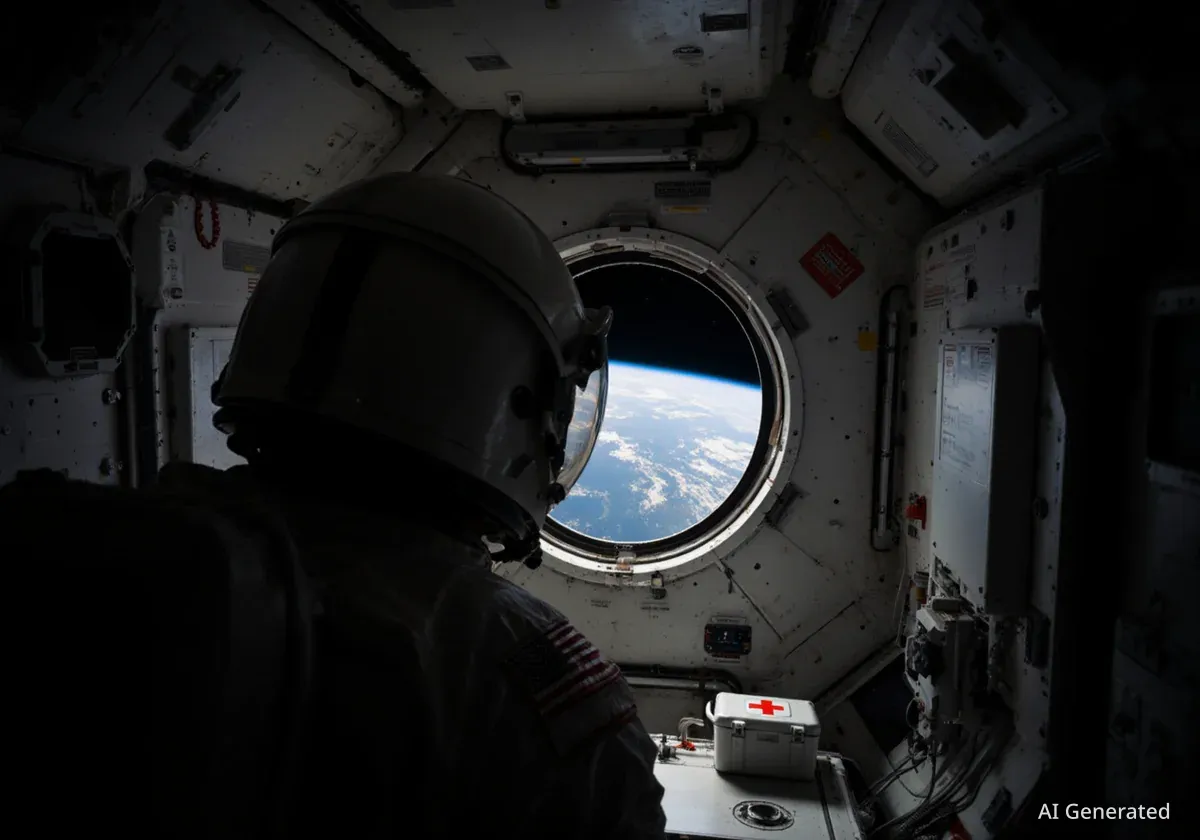

The three-person crew of Expedition 74 aboard the International Space Station is conducting a series of critical experiments focused on human cardiovascular health and advanced space physics. These investigations are taking place as the orbiting laboratory circles Earth at its highest altitude to date, following a recent orbital reboost.
Key Takeaways
- Astronauts are conducting detailed ultrasound scans to monitor for blood clots, a known risk of long-duration spaceflight.
- A new physics experiment is testing methods to store cryogenic fuels more efficiently for future deep-space missions.
- The International Space Station recently achieved a new record altitude of 269 by 255 statute miles after an orbital boost.
A Focus on Cardiovascular Health in Microgravity
The primary focus for the crew this week has been understanding how the human body adapts to the weightless environment. Living in space causes significant fluid shifts, moving bodily fluids toward the upper body and head, which can impact the cardiovascular system over time.
NASA Flight Engineer Chris Williams and Roscosmos cosmonauts Sergey Kud-Sverchkov and Sergei Mikaev dedicated time to multiple health checks. These studies are essential for developing countermeasures to protect astronauts on current missions and future long-duration journeys to the Moon and Mars.
The Risk of Blood Clots in Space
One of the most serious health risks monitored is venous thromboembolism, or blood clots. The entire crew participated in detailed vein scans inside the Columbus laboratory module using an Ultrasound 2 device.
With real-time guidance from doctors on the ground, the astronauts took turns scanning each other’s neck, shoulder, and leg veins. This regular monitoring allows flight surgeons to detect any potential issues early and ensure the crew remains healthy during their months-long stay in orbit.
Why Microgravity Affects Blood Flow
On Earth, gravity pulls blood and other fluids toward the feet. In space, this pull is gone. The resulting upward fluid shift can increase pressure in the head and upper body, alter heart function, and increase the risk of blood clots forming in the large veins.
Understanding Blood Vessel Behavior
Beyond simply looking for clots, researchers are also investigating the root causes of cardiovascular changes. Cosmonauts Kud-Sverchkov and Mikaev conducted experiments to understand how the cells lining blood vessels, known as endothelial cells, function in microgravity.
The pair used a series of cuffs and electrodes to measure blood pressure at various points, including the arm, wrist, and thumb. These cells are vital for regulating blood pressure, blood flow, and preventing inflammation, and understanding their response to spaceflight is key to keeping future explorers safe.
Paving the Way for Future Missions
While human health is a top priority, the crew is also working on technologies that will enable more ambitious exploration of the solar system. A significant experiment this week involves the management of cryogenic fluids.
Cryogenic propellants, such as liquid hydrogen and liquid oxygen, are extremely cold liquids that must be kept at low temperatures to prevent them from boiling off into gas. Managing this "boil-off" is a major challenge for long-term space missions.
The Zero Boil-Off Tank Experiment
Inside the Destiny laboratory, NASA astronaut Chris Williams configured the Zero Boil-Off Tank investigation. He injected gas into the experimental hardware to test new methods for controlling tank pressure as the surrounding heat causes the cryogenic propellants to evaporate.
The results from this experiment could lead to lighter and more efficient cryogenic storage tanks. Such technology is critical not only for spacecraft but also has potential applications for various industries on Earth that rely on storing super-cooled liquids.
A New Orbital Record for the Space Station
All this research is happening from a higher vantage point than ever before. On January 23, a docked SpaceX Dragon spacecraft fired its Draco engines in a scheduled maneuver to raise the station’s orbit.
The reboost pushed the International Space Station into a new orbit with an apogee of 269 statute miles and a perigee of 255 statute miles. This marks the highest altitude at which the station has operated in its more than two decades of continuous human presence.
The adjustment ensures the station maintains the proper altitude to counteract atmospheric drag, which slowly pulls it back toward Earth. It also positions the ISS correctly for future visiting vehicle arrivals and departures.