

At any given moment, about ten people are living in space, split between the International Space Station and China's Tiangong station. This small number stands in stark contrast to the ambitious visions of industry leaders, who imagine future populations reaching one million or more in orbit and on other planets.
While powerful rockets capture public attention, the greatest challenge to this future is not propulsion, but biology. The complex, unglamorous work of managing life support, food, and waste is emerging as the critical barrier to humanity's long-term expansion beyond Earth.
Key Takeaways
- Long-term space habitation depends more on sustainable biological systems than on advanced rocketry.
- Current space missions rely heavily on costly and unsustainable resupply missions from Earth for essentials like water, food, and air.
- Developing closed-loop life support systems that recycle waste, water, and air is the primary engineering challenge for deep space travel.
- The biological challenges of radiation, microgravity, and psychological stress must be solved for humans to survive long-duration missions to Mars and beyond.
The Limits of a Long Supply Chain
The International Space Station (ISS) serves as a remarkable feat of engineering, but it operates on a logistical model that is impossible for deep space exploration. Astronauts depend on regular cargo shipments from Earth to deliver everything from food and water to spare parts and scientific equipment.
This constant resupply is a lifeline. Without it, the station's life support systems would fail, and its inhabitants would run out of provisions in a matter of weeks. While feasible for a station in low-Earth orbit, just 400 kilometers away, this approach is completely impractical for a mission to Mars, which would involve a journey of many months each way.
What is a Closed-Loop System?
In the context of space travel, a closed-loop life support system is a self-sustaining environment that recycles nearly 100% of its resources. It purifies wastewater back into drinking water, scrubs carbon dioxide from the air to produce oxygen, and processes solid waste to recover nutrients, mimicking Earth's natural ecosystems. Achieving a fully closed loop is considered the holy grail for long-term space habitation.
The reliance on Earth creates a fundamental constraint. Every kilogram of supplies launched into space costs thousands of dollars. For a multi-year Mars mission, the sheer mass of food, water, and oxygen required would be astronomical, making the mission prohibitively expensive and complex.
The Unseen World of Life Support
The true challenge of long-term space habitation lies in creating a self-sufficient ecosystem in a metal container. This means mastering the mundane but essential tasks that Earth's biosphere performs for us automatically.
Recycling Every Drop and Breath
On the ISS, significant progress has been made. The station's Environmental Control and Life Support System (ECLSS) can reclaim about 98% of the water from astronauts' breath, sweat, and urine, purifying it into drinkable water. This technology is crucial, but it is complex and requires constant maintenance.
Air revitalization is another critical function. Systems must continuously remove the carbon dioxide exhaled by the crew and generate fresh oxygen. While current systems are effective, they are not fully regenerative. The goal is to create a system that can use captured CO2, perhaps with algae or chemical processes, to produce a constant supply of breathable air without needing new materials from Earth.
The Problem of Waste
Waste management is one of the most difficult problems to solve. On Earth, organic waste decomposes and returns nutrients to the soil. In space, it accumulates. Long-duration missions cannot afford to simply store or jettison waste; it represents a valuable resource of water and organic compounds that must be recovered.
Engineers are developing advanced systems that can process human waste and leftover food through biological or chemical means. The objective is to break it down into its constituent parts: recovering water, extracting minerals for plant growth, and even converting the rest into safe, compact material or fuel.
Farming in the Final Frontier
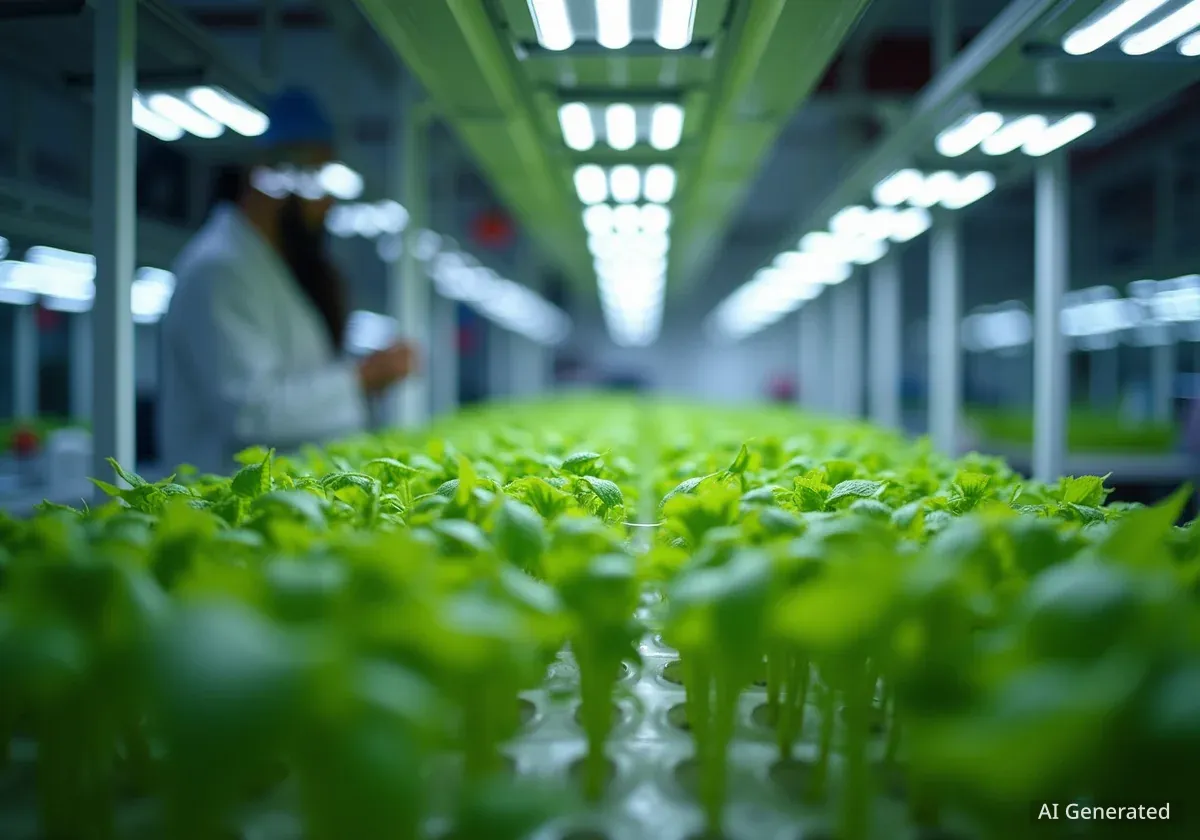
A sustainable off-world settlement cannot rely on packaged meals. Growing fresh food is essential not only for nutrition but also for the psychological well-being of the crew. Space agriculture, however, presents a unique set of challenges.
Key issues that scientists are working to solve include:
- Growing Medium: Soil is heavy and impractical to transport. Hydroponic and aeroponic systems, which use nutrient-rich water or mists, are the leading alternatives.
- Lighting: Plants need specific wavelengths of light to grow efficiently. Advanced LED systems are being developed to provide optimal light while minimizing energy consumption.
- Pollination: On Earth, wind and insects handle pollination. In a closed environment, this must be done manually or with specialized robots.
- Water Usage: Every drop of water is precious. Drip irrigation and other highly efficient watering systems are necessary to minimize waste.
Experiments like the Veggie program on the ISS have successfully grown lettuce, radishes, and chili peppers. These are important first steps, but scaling up to produce enough calories to sustain a full crew remains a distant goal.
The Human Factor
Ultimately, the most complex biological system in space is the human body itself. Even with perfect life support, astronauts face significant health risks from the space environment.
Radiation exposure outside of Earth's protective magnetosphere is a major concern, increasing the risk of cancer and other long-term health issues. Shielding a spacecraft or habitat sufficiently without adding prohibitive weight is a major engineering problem.
Furthermore, the long-term effects of microgravity include bone density loss, muscle atrophy, and changes to cardiovascular function. While exercise countermeasures help, the full impact of spending years in reduced gravity is not yet fully understood.
"Rockets are great, but sewage treatment is what you need for the long haul."
As humanity looks toward establishing a permanent presence on the Moon and Mars, the focus is shifting. The era of pioneering rocketry is giving way to an era of pioneering biology. The future of space exploration will not be defined by how fast we can travel, but by how effectively we can replicate the life-sustaining systems of our home planet, millions of kilometers away in the void.