
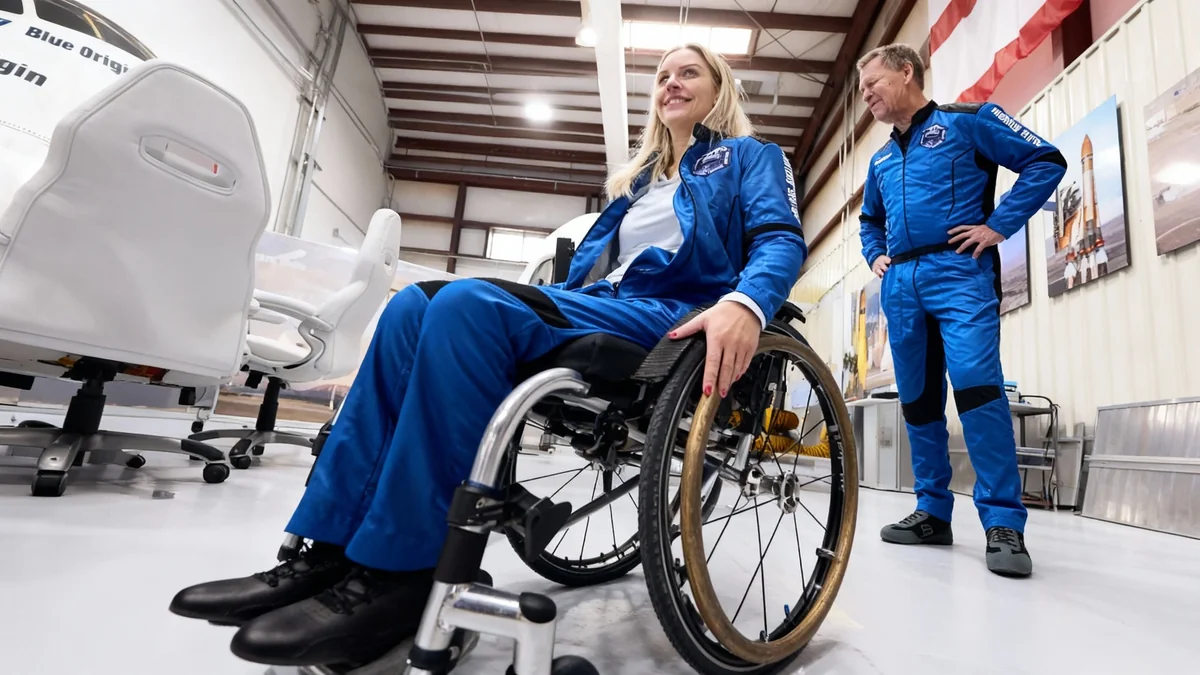

European Space Agency engineer Michaela Benthaus is preparing to make history as the first wheelchair user to travel to space. She will fly aboard a Blue Origin New Shepard rocket, a mission made possible through an unexpected collaboration with a former top executive from SpaceX.
The suborbital flight, which will carry a crew of six, aims to cross the Kármán line, the internationally recognized boundary of space 100 kilometers above Earth. The mission marks a significant step toward making space travel more accessible for individuals with physical disabilities.
Key Takeaways
- Michaela Benthaus, an ESA engineer, will be the first wheelchair user to fly to space.
- The flight is on Blue Origin's New Shepard rocket, mission NS-37.
- Former SpaceX executive Hans Koenigsmann helped arrange the flight and will fly as her companion.
- The mission highlights the growing conversation around disability inclusion in the commercial space industry.
An Unlikely Partnership Forges a Path to Space
The journey for this groundbreaking flight began not in a mission control room, but during a casual conversation at an event in Munich. Michaela Benthaus, an aerospace engineer who sustained a spinal cord injury in 2018, shared her dream of spaceflight with Hans Koenigsmann, one of SpaceX's earliest and most respected employees.
Koenigsmann, who had recently departed his role at SpaceX, took her aspiration seriously. Recognizing that a brief, suborbital trip was the most feasible first step, he reached out to his former company's main competitor, Blue Origin.
"She said she was only thinking about a suborbital flight," Koenigsmann noted, explaining his decision to contact the company founded by Jeff Bezos. "They responded really, really well to us."
For Benthaus, the news was almost unbelievable. "When Hans told me, ‘Blue is excited about this,’ I was like, ‘Are you sure? Are you sure you understood them correctly?’" she recalled. "I always wanted to go to space, but I never really considered it something which I could actually do."
From Rivalry to Collaboration
Koenigsmann's involvement is particularly noteworthy. A legendary figure at SpaceX for nearly two decades, he was instrumental in developing the company's first rockets. His decision to fly with Blue Origin underscores a mission that he sees as transcending corporate competition.
A Shift in the Space Industry
Hans Koenigsmann left SpaceX in 2021 after a reported disagreement with CEO Elon Musk over an internal report. His participation in a Blue Origin flight is a symbolic moment, suggesting that personal and scientific goals can sometimes bridge the intense rivalry between the two commercial space giants.
"I think the competition is good in general," Koenigsmann stated. "It shouldn’t always be as personal as it sometimes is." He views this flight as a collaborative effort focused on a shared human goal.
Adapting Procedures for a New Kind of Astronaut
Preparing for the flight required careful planning and collaboration. Benthaus and Koenigsmann made two trips to Blue Origin's launch facility in Texas to work with the engineering and operations teams on specific procedures and accommodations.
The goal was to ensure Benthaus could operate as autonomously as possible while guaranteeing safety. She will be able to enter and exit the New Shepard capsule on her own using a small bench. During the three to four minutes of weightlessness at the peak of the flight, she plans to use a strap to keep her legs from floating apart.
Mission Profile: NS-37
- Vehicle: Blue Origin New Shepard
- Flight Duration: Approximately 10 minutes
- Altitude: Over 100 kilometers (62 miles)
- Zero-Gravity Time: 3-4 minutes
- Passengers: Six, including Benthaus and Koenigsmann
Koenigsmann will serve as her companion, ready to provide assistance if needed, particularly during re-entry or in an emergency scenario. "Blue Origin is super well prepared," Benthaus said, expressing confidence in the customized procedures they developed.
Paving the Way for Future Missions
While this flight is a personal dream realized, Benthaus emphasizes its broader significance for the future of human space exploration. She argues that accommodating disabilities is not just about inclusivity, but also about practicality for long-duration missions.
"Some of us want to go to the Mars in the future. That’s a very long journey," she explained. "People can get a disability on the way. People can have a stroke or break their leg or get a spinal cord injury."
Understanding how a person with a mobility impairment navigates a space environment provides crucial data for these future scenarios. An injured astronaut on a mission to Mars cannot simply return to Earth, making these early suborbital flights invaluable learning opportunities.
Benthaus also believes that people with disabilities bring unique strengths to a crew. "People that have had an accident — that’s a lot one has to go through," she said. "You develop a very special resilience."
A Growing Movement
This mission is part of a larger trend toward making space accessible. In 2021, cancer survivor Hayley Arceneaux, who has a prosthetic in her leg, spent three days in orbit. The European Space Agency has also medically cleared Paralympian John McFall for a future flight to the International Space Station.
Benthaus had previously wondered if her specific condition was "way too disabled" for space. Her upcoming flight is set to challenge those perceptions, opening the door for others who may have felt their dreams were out of reach. As part of her mission, she is also raising funds for Wings for Life, a nonprofit dedicated to spinal cord injury research.