


SpaceX has announced a new space traffic management system called Stargaze, designed to prevent in-orbit collisions. The company will offer access to the system free of charge to all satellite operators, leveraging its vast Starlink constellation to monitor orbital objects with unprecedented speed and accuracy.
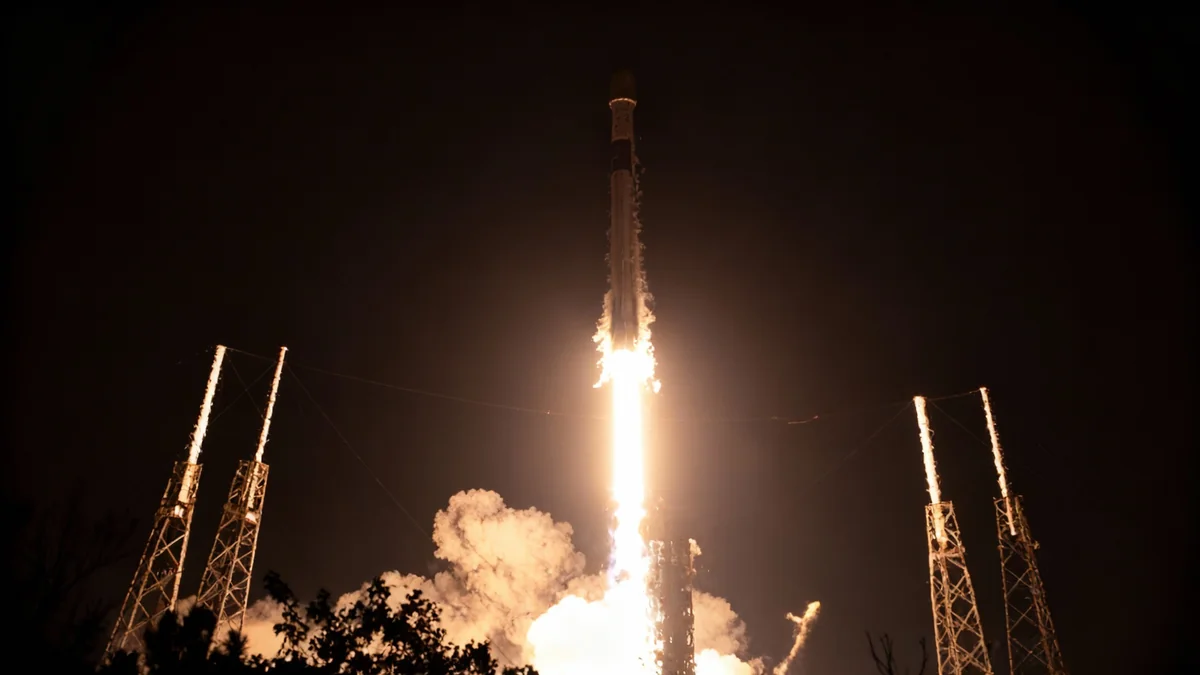
The announcement came shortly after the company successfully completed its 13th launch of the month, sending another 29 Starlink satellites into orbit from Cape Canaveral Space Force Station early on January 30, 2026.
Key Takeaways
- SpaceX has developed a new Space Situational Awareness (SSA) system named Stargaze.
- The system uses data from nearly 30,000 star trackers on its 9,500+ Starlink satellites to detect potential collisions.
- Stargaze will be made available for free to all satellite operators in the coming weeks.
- The system aims to reduce collision assessment times from hours to minutes, addressing the growing danger of space debris.
A Crowded Sky Prompts New Solutions
Low Earth orbit is becoming increasingly congested. The risk of collisions between active satellites, defunct spacecraft, and discarded rocket bodies is a growing concern for all space-faring entities. SpaceX directly addressed this challenge, citing practices that have heightened the risk of orbital incidents.
These practices include leaving rocket stages in orbit, satellite operators performing maneuvers without coordinating with others, and anti-satellite weapons tests that create vast fields of debris. Conventional ground-based tracking systems often observe objects only a few times per day, leading to significant uncertainty in predicting their paths.
The Problem of Space Debris
Low Earth orbit (LEO) is home to thousands of active satellites and an even greater number of inactive objects, from old satellites to fragments from past collisions. Traveling at speeds over 17,000 miles per hour, even a small piece of debris can cause catastrophic damage to an operational satellite, potentially creating even more debris in a chain reaction known as the Kessler syndrome.
SpaceX's Stargaze system is designed to provide a more dynamic and responsive solution to this problem. By using its own satellite network as a sensor grid, the company aims to create a safer operational environment for everyone.
How Stargaze Works: A Network of Eyes in Orbit
The Stargaze system is built upon the existing infrastructure of the Starlink megaconstellation. Each of the more than 9,500 Starlink satellites is equipped with sophisticated star trackers, which are sensors that allow the satellite to determine its precise orientation and position by observing the stars.
SpaceX has repurposed these sensors to also act as a massive, distributed observatory. The nearly 30,000 star trackers across the fleet continuously observe nearby objects, detecting what the company says are approximately 30 million transits daily.
A Leap in Detection Capability
SpaceX claims Stargaze offers a "several-order-of-magnitude increase in detection capability" when compared to traditional ground-based radar and optical tracking systems. This constant, real-time data stream dramatically reduces the uncertainty in orbital predictions.
This wealth of data allows the system to assess potential conjunctions, or close approaches, in a matter of minutes. The current industry standard can take several hours, a delay that can be critical when an object is on a collision course.
A Real-World Test Case
SpaceX provided a recent example from late 2025 that highlights the system's effectiveness. A Starlink satellite was on a potential collision course with a satellite from a third-party operator. Initially, the situation appeared safe.
"Until five hours before the conjunction, the close approach was anticipated to be ~9,000 meters — considered a safe miss-distance with zero probability of collision," the company explained.
However, the situation changed rapidly. The other satellite, whose operator was not sharing its trajectory predictions, performed a sudden maneuver. This action collapsed the expected miss distance to just 60 meters, creating an immediate and serious collision risk.
According to SpaceX, the Stargaze system quickly detected this unexpected maneuver. It generated an updated trajectory and distributed new collision data to the relevant satellites. As a result, the Starlink satellite was able to plan and execute an avoidance maneuver within an hour of the threat being detected, restoring the situation to zero collision risk.
The company noted that the system has been in a closed beta test with more than a dozen participating satellite operators, though it did not name the partners involved.
A Successful Launch Precedes the News
The Stargaze announcement followed another routine but successful mission for SpaceX. The Starlink 6-101 mission lifted off from Cape Canaveral at 2:22 a.m. EST on Thursday, January 30.
The mission was carried out by a Falcon 9 rocket, with the first stage booster, B1095, completing its fifth flight. Key details of the launch include:
- Payload: 29 Starlink satellites, bringing the constellation total to over 9,500.
- Booster Recovery: The first stage landed successfully on the drone ship 'Just Read the Instructions' in the Atlantic Ocean.
- Milestone: This was the 149th successful landing on this specific drone ship and the 566th overall booster landing for SpaceX.
The successful launch and recovery capped a busy month for the company, marking its 13th and final mission of January 2026. With the introduction of Stargaze, SpaceX is now leveraging its launch and satellite dominance to address one of the most pressing safety challenges in modern spaceflight.